
- 0
- 2,614 words
English contains many words and expressions that people use every day without thinking much about their spelling. However, some words create confusion because they sound exactly alike but have different spellings. One common example is damnit or dammit. Both versions appear in text messages, online conversations, social media posts, books, and everyday writing. This often leaves people wondering which spelling is correct and whether one version is more appropriate than the other.
The confusion is understandable because both spellings express the same emotion and are pronounced almost identically. People commonly use these expressions to show frustration, disappointment, annoyance, or anger. For example, someone might say one of these words after making a mistake, losing an important item, or experiencing an unexpected problem.
Although the difference between the two spellings may seem minor, understanding their usage can help you communicate more clearly. Whether you are writing a casual message, creating an online post, or editing a piece of content, knowing the difference between damnit and dammit can make your writing more consistent.
In this article, we will explore the meanings, spelling differences, origins, examples, and appropriate uses of both expressions.
What Does Damnit or Dammit Mean?
The phrase damnit or dammit refers to two common spellings of an informal expression used to communicate frustration, irritation, anger, or disappointment. Both versions are closely associated with the expression “damn it,” which people use when something goes wrong or when they feel upset about a situation.
For example, imagine that you have spent several hours working on an important project, only to discover that you accidentally deleted your progress. You might react by saying, “Dammit, I lost all my work!”
Similarly, if you are running late for an appointment and realize that you have forgotten your keys, you might say, “Damnit, where did I put them?”
In both examples, the expression communicates an immediate emotional reaction. It does not necessarily mean that the speaker is seriously angry. Sometimes, it simply expresses mild irritation or disappointment.
The expression is considered informal and mildly profane because it contains the word “damn.” Its appropriateness depends on the audience, situation, and type of communication.
Damnit vs. Dammit: Which Spelling Is Correct?
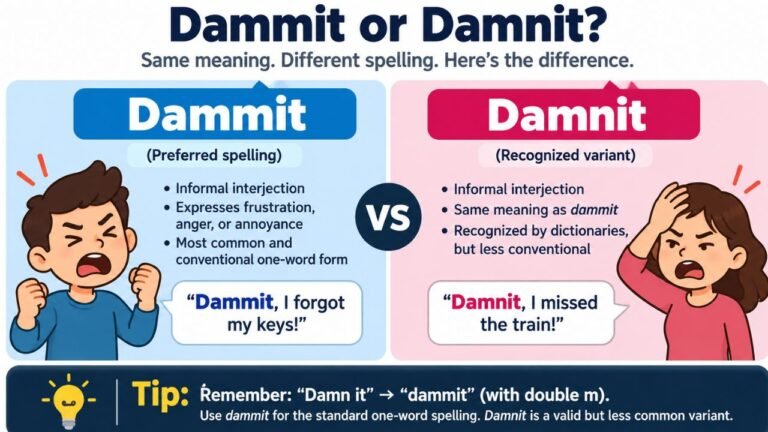
Both damnit and dammit are widely used in modern English. However, dammit is generally the more established spelling of the informal expression, while damnit is a common alternative spelling.
The original expression is “damn it,” consisting of two separate words. When people say it quickly, the sounds blend together, creating the familiar pronunciation represented by spellings such as dammit and damnit.
Here is a simple comparison:
| Feature | Damnit | Dammit |
|---|---|---|
| Meaning | Expresses frustration or anger | Expresses frustration or anger |
| Pronunciation | Usually pronounced the same | Usually pronounced the same |
| Usage | Informal writing and conversations | Informal writing and conversations |
| Spelling status | Common alternative spelling | More established informal spelling |
| Formal writing | Usually avoided | Usually avoided |
Neither spelling changes the basic meaning of the expression. The difference is primarily a matter of spelling convention and personal preference.
If you want to choose one spelling for general writing, dammit is a sensible choice because it is a well-established conventional form. Nevertheless, damnit remains recognizable and is frequently used by English speakers.
What Is the Difference Between Damnit and Dammit?
The most important difference between these two words is how they are spelled rather than what they mean.
The spelling dammit reflects a conventional informal rendering of the spoken expression “damn it.” The spelling damnit more visibly preserves the letter sequence associated with the original phrase, even though the pronunciation is usually the same.
Neither spelling communicates a different level of anger or a different emotional meaning. A person who writes damnit is not necessarily more frustrated than someone who writes dammit.
Consider these examples:
- “Dammit, I forgot to bring my notebook.”
- “Damnit, I forgot to bring my notebook.”
Both sentences express the same disappointment. A reader will generally understand either version without difficulty.
The choice may depend on the writer’s habits, the style of a particular publication, or the tone of a fictional character. Some people consistently use one spelling, while others switch between them.
For professional or published writing, consistency is more important than choosing between these two informal variants. If you select dammit, use that spelling throughout the document unless there is a specific reason to reproduce another person’s wording.
Understanding the Origin of the Expression
To understand why damnit and dammit exist, it helps to look at the phrase from which they developed.
The word “damn” has a long history in English. It has been used as a verb expressing condemnation and, over time, developed additional uses as an exclamation or intensifier. In everyday conversation, people often say “damn it” when something disappoints or annoys them.
When spoken quickly, the two words can sound like a single unit. Informal writing often represents spoken language in a simplified form, which helps explain the development of dammit and damnit.
These spellings are examples of how language changes through everyday use. People do not always write words exactly as they appear in formal dictionaries or grammar guides. They also develop spellings that reflect pronunciation, emotion, humor, and conversational style.
The same general process can be seen in contractions and informal expressions. Words may become shortened, combined, or spelled differently when used frequently in casual communication.
Although damnit and dammit are familiar to many English speakers, the original two-word expression, “damn it,” remains perfectly understandable and can be preferable when a writer wants to preserve standard word separation.
When Should You Use Dammit?
The spelling dammit is useful when you want to express frustration in an informal and natural way. It is common in dialogue, personal messages, fictional writing, and online conversations.
Here are several situations in which the expression might appear.
1. When Something Goes Wrong
People often use dammit when a plan fails or an unexpected problem occurs.
For example:
“Dammit, the computer froze before I could save the document.”
The expression communicates frustration without requiring a lengthy explanation. Readers can immediately understand that the speaker is disappointed by the situation.
2. When You Make a Mistake
Another common use involves reacting to a personal mistake.
For example:
“Dammit, I sent the message to the wrong person.”
In this situation, the word expresses regret and irritation. It may also communicate embarrassment, especially when the mistake has noticeable consequences.
3. When You Feel Impatient
The expression can also show impatience when something takes longer than expected.
For example:
“Dammit, why is this application taking so long to load?”
Here, the speaker is irritated by a delay. The word gives the sentence a stronger emotional tone than a neutral question would have.
4. In Fictional Dialogue
Writers frequently use informal expressions to make characters sound realistic. A character who is frustrated, frightened, or angry might say dammit to convey emotion quickly.
For example:
“Dammit, we have to leave before the storm gets worse,” Daniel said.
In this example, the expression helps communicate urgency and frustration. However, writers should avoid using profanity excessively because repeated use can reduce its impact.
When Should You Use Damnit?
The spelling damnit can be used in many of the same situations as dammit. It appears in casual writing, social media posts, text messages, and informal dialogue.
Some writers prefer damnit because they associate it more closely with the original phrase “damn it.” Others simply grew accustomed to the spelling through reading or personal communication.
For example:
- “Damnit, I left my wallet at home.”
- “Oh, damnit! I missed the last bus.”
- “Damnit, this is the third time I have made the same mistake.”
Each example communicates annoyance or disappointment.
There is no widely recognized difference in meaning between damnit and dammit. Choosing damnit does not make the expression more formal, more polite, or more grammatically correct in every situation.
If you already use damnit naturally, readers will generally understand what you mean. If you are following a publication’s style guide, however, use whichever spelling that guide specifies.
Is Damnit or Dammit Considered a Bad Word?
Both spellings are associated with the word “damn,” which is commonly considered mild profanity in English. Whether someone considers it offensive depends on cultural background, personal beliefs, age, and social circumstances.
In many casual settings, people use dammit or damnit without causing significant concern. Friends might use the expression while joking about a mistake or discussing a frustrating experience.
However, the same expression may be inappropriate in a formal meeting, a professional email, a school assignment, or a conversation with someone who dislikes profanity.
It is useful to consider three factors before using either spelling.
Your audience: Friends and close colleagues may be comfortable with casual language, while other people may prefer more restrained expressions.
Your environment: Informal chats, fictional dialogue, and personal social media posts generally allow more flexibility than official documents.
Your purpose: If you want to communicate professionally, expressing frustration without profanity often creates a better impression.
For example, instead of writing “Dammit, the report is late again,” you could write, “Unfortunately, the report has been delayed again.”
The second version communicates the problem without adding an emotional or potentially offensive element.
Damnit or Dammit in Text Messages and Social Media
Text messaging and social media have helped informal spellings become more visible. People frequently write the way they speak, particularly when reacting to something unexpected.
Both damnit and dammit may appear in comments, captions, direct messages, gaming chats, and online discussions.
For example, a person playing a difficult video game might write, “Dammit, I was so close to winning!”
Someone who forgets an important appointment might post, “Damnit, I completely forgot about my meeting.”
In these examples, the expression adds emotional emphasis and helps convey the writer’s immediate reaction.
Digital communication also allows people to adjust the tone of a message through punctuation, capitalization, and emojis. Writing “Dammit!” usually communicates a stronger reaction than writing “dammit…” or “dammit lol.”
However, capitalization and punctuation do not create a different dictionary meaning. They simply affect how readers interpret the emotion behind the words.
Remember that online communication is not always private. Comments and messages can be saved, shared, or viewed outside their original context. When communicating in a professional group or public forum, choose language that reflects the impression you want to make.
Examples of Damnit and Dammit in Everyday English
The following examples demonstrate how both spellings can fit naturally into different situations.
Examples Showing Frustration
- “Dammit, I forgot to charge my phone overnight.”
- “Damnit, the printer stopped working again.”
- “Oh, dammit! I spilled coffee on my shirt.”
- “Dammit, I thought the store was open until nine.”
Each sentence communicates annoyance about an unexpected problem.
Examples Showing Disappointment
- “Dammit, our team lost by one point.”
- “Damnit, I was hoping to finish the project today.”
- “Well, dammit, that was not the result I expected.”
In these examples, the expression reflects disappointment rather than intense anger.
Examples in Casual Conversations
- “Dammit, you were right about the weather.”
- “Oh, damnit, I left my headphones in the car.”
- “Damnit, now I have to start the whole thing again.”
These sentences sound conversational and are suitable for informal dialogue when mild profanity is acceptable.
Examples Without Profanity
Sometimes, a similar reaction can be expressed without using either spelling.
- “Oh no, I forgot my keys!”
- “That is frustrating. The computer crashed again.”
- “I cannot believe I missed the bus.”
- “Unfortunately, I made the same mistake twice.”
These alternatives are useful when writing for a broad audience or communicating in a professional environment.
Common Mistakes to Avoid
Although damnit and dammit are easy to understand, several common mistakes can make their use less effective.
Treating the Two Spellings as Different Words
The two spellings generally have the same meaning. It is incorrect to assume that damnit expresses disappointment while dammit expresses anger. Context and tone determine the emotion, not the spelling alone.
Assuming Both Are Appropriate Everywhere
Both forms are informal and mildly profane. They may fit naturally in casual dialogue but appear unprofessional in formal reports, business correspondence, or academic writing.
Using Inconsistent Spellings
Switching between damnit and dammit repeatedly within the same article can look careless. Although neither spelling changes the meaning, maintaining a consistent style improves readability.
Forgetting the Original Expression
The standard phrase “damn it” is also available. Writers do not have to combine the words into an informal spelling. In some sentences, keeping the two words separate may be the clearest choice.
Overusing the Expression
Repeated profanity can make writing sound repetitive or overly aggressive. Strong expressions tend to be more effective when used selectively.
For example, a character who says dammit once at a critical moment may seem more believable than a character who uses it in every sentence.
Which Version Should You Choose in Formal Writing?
For formal writing, the best choice is often to avoid both damnit and dammit altogether.
Formal writing generally emphasizes clarity, neutrality, and professionalism. Profanity can distract readers from the main point, particularly when discussing business matters, academic subjects, or public information.
Instead of writing:
“Dammit, we need to fix this problem immediately.”
You could write:
“We need to address this problem immediately.”
If you want to communicate frustration without sounding aggressive, you could write:
“This recurring problem is frustrating and requires immediate attention.”
These alternatives preserve the central message while making the tone more suitable for professional communication.
In creative writing, the situation is different. Characters do not always speak formally, and realistic dialogue may require expressions that people use in everyday life. In that context, either damnit or dammit can be appropriate, depending on the author’s preferred style.
The important point is to understand the audience and purpose before choosing your words.
Frequently Asked Questions About Damnit or Dammit
Is Dammit the Correct Spelling?
Dammit is a well-established informal spelling of “damn it” and is generally the more conventional choice between the two one-word forms. Damnit is also widely recognized as an alternative spelling.
Is Damnit Grammatically Correct?
Damnit is a recognizable informal spelling, although it is less conventional than dammit. In formal writing, “damn it” is often the safer choice when the expression is appropriate at all.
Do Damnit and Dammit Mean the Same Thing?
Yes. Both expressions generally communicate frustration, anger, irritation, or disappointment. The spelling does not create a meaningful difference in the emotion expressed.
Can I Use Dammit in a Text Message?
Yes. Dammit is commonly used in informal text messages and online conversations. However, consider the recipient and the tone of the conversation before using profanity.
Is Damnit More Offensive Than Dammit?
No. Neither spelling is inherently more offensive than the other. Both are associated with the same underlying expression, and their perceived offensiveness depends on context.
Should I Write Dammit or Damn It?
Both forms are understandable, but they serve slightly different writing preferences. Dammit is an established informal spelling, while “damn it” preserves the original two-word phrase. Choose the form that best fits your sentence and writing style.
Conclusion
The question of damnit or dammit comes down primarily to spelling preference rather than meaning. Both expressions are widely understood and commonly used to communicate frustration, irritation, disappointment, or anger.
However, dammit is generally the more established informal spelling, making it a practical choice for casual writing and dialogue. Damnit remains a familiar alternative, and readers will usually understand it without difficulty.
If you are writing a text message, a social media post, or a fictional conversation, either spelling can work when the tone permits informal language. For professional and academic writing, it is usually better to avoid profanity or use a more neutral alternative.
Ultimately, understanding the context is more important than debating the spelling. By choosing words that suit your audience and purpose, you can communicate your emotions clearly while keeping your writing natural, consistent, and effective.
Author

blowouttaper.co.uk@gmail.com
Related Posts

Reevaluation: Meaning, Importance, Benefits, and How to Reevaluate Decisions Effectively
- 0
- 2,568 words
Introduction to Reevaluation Reevaluation is an important process that involves examining something again to determine whether it is still accurate, effective, valuable,...
Read out all
City vs Town: Understanding the Key Differences Between a City and a Town
- 0
- 3,042 words
When people compare a city vs town, they often think about population size, buildings, transportation, and lifestyle. Although cities and towns are...
Read out all
Apposed: Meaning, Definition, Usage, and Examples in English
- 0
- 2,403 words
The English language contains many words that look unfamiliar but have clear and useful meanings once they are explained. One such word...
Read out all
What Is a Palindrome? Meaning, Examples, Types, and Fun Facts
- 0
- 2,218 words
Have you ever come across a word that looks exactly the same when you read it forward and backward? Words like “level,”...
Read out all
UploadBlog Post: A Complete Guide to Creating, Publishing, and Managing Quality Blog Content
- 0
- 2,854 words
Introduction to UploadBlog Post In the digital world, blogging has become an effective way to share knowledge, express ideas, build an online...
Read out all
fintechzoom.io: A Complete Guide to Financial News, Market Insights, and Digital Finance
- 0
- 2,322 words
Introduction to fintechzoom.io The financial world is changing rapidly as technology transforms the way people save, invest, trade, and manage their money....
Read out all