
×
Vacuum or Vaccum: Correct Spelling, Meaning & Usage Guide
In

If you’ve ever paused while writing and wondered whether it’s vaccum or vacuum, you’re not alone. This is one of the most common spelling confusions in English, and it trips up students, writers, and even professionals.

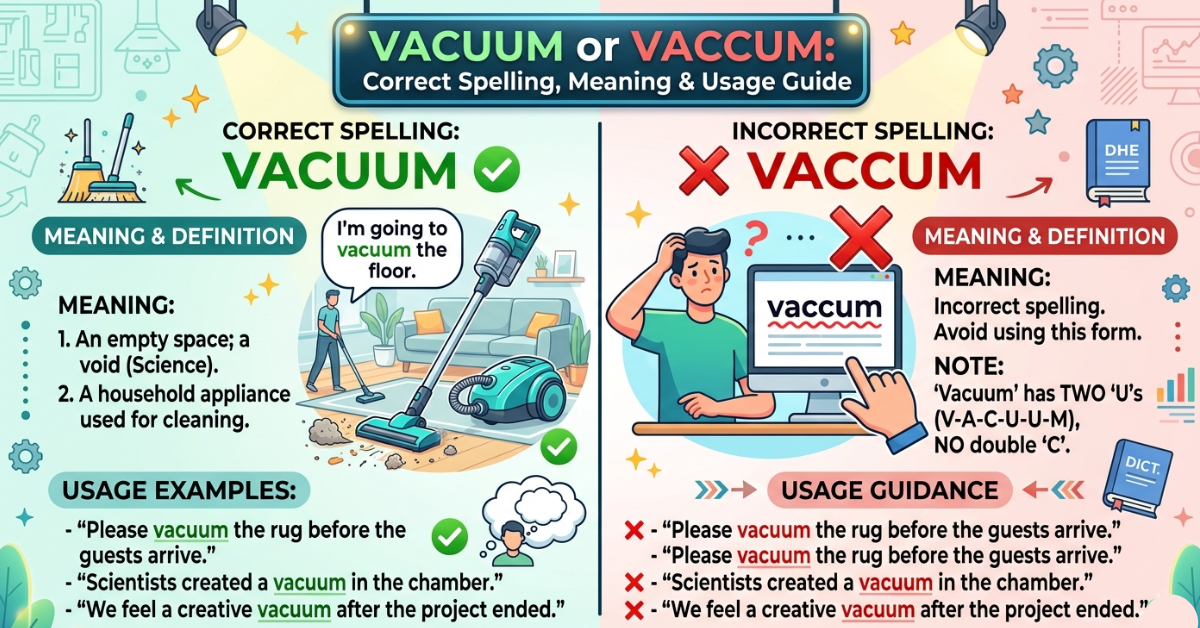
The correct spelling is vacuum, not “vaccum.” The word “vacuum or vaccum” often appears in searches because people are unsure about the double letters and pronunciation. In this article, we’ll break down the correct spelling, meaning, usage, and easy tricks to remember it.

By the end, you’ll never second-guess this word again.

Vacuum or Vaccum: Correct Spelling and Meaning

The correct spelling is vacuum, which comes from the Latin word “vacuus” meaning “empty.”

Why “vaccum” is incorrect

The misspelling “vaccum” happens mainly because:

  • People assume English doubles consonants randomly
  • The pronunciation makes the “u” sound subtle
  • Typing errors are common due to fast writing

However, in standard English, there is no word spelled “vaccum.”

Meaning of vacuum

The word vacuum can be used in different contexts:

  1. Science: A space with no matter (air or particles)
  2. Cleaning: A device that removes dirt using suction
  3. Metaphorical: A feeling of emptiness or lack

Examples:

  • Space is considered a near vacuum.
  • She used a vacuum to clean the carpet.
  • There was an emotional vacuum after the incident.

Why Vacuum Cleaners Are So Important

When people think of vacuum or vaccum, they usually mean the cleaning device. Vacuum cleaners have become essential in modern households.

Key benefits of vacuum cleaners:

  • Removes dust and allergens effectively
  • Saves time compared to manual cleaning
  • Reaches corners and tight spaces easily
  • Improves indoor air quality
  • Available in multiple types (robotic, upright, handheld)

Vacuum cleaners use suction power to lift dirt from surfaces, making cleaning faster and more efficient.

Common Spelling Mistakes with Vacuum

Even though the correct word is vacuum, many variations appear online due to confusion.

Frequent incorrect spellings:

  • vaccum
  • vacume
  • vacum

These mistakes usually come from phonetic spelling—writing the word as it sounds. Unfortunately, English spelling doesn’t always match pronunciation.

Easy way to remember the correct spelling

Try this trick:

“Vac + u + um = vacuum”

Think of it as having a double “u” in the middle, which represents the “double empty space” meaning of the word itself.

Vacuum in Different Contexts

The word vacuum is not limited to cleaning. It is widely used in science, language, and everyday expressions.

1. Scientific use

In physics, a vacuum refers to a space completely or partially empty of matter.

  • Outer space is the closest natural vacuum
  • Scientists create vacuum conditions in laboratories

2. Household use

In daily life, a vacuum usually means a vacuum cleaner.

  • Used for carpets, floors, and furniture
  • Helps maintain hygiene at home

3. Figurative use

The word is often used metaphorically.

  • “A leadership vacuum” means lack of leadership
  • “Emotional vacuum” refers to feelings of emptiness

Why People Search “Vacuum or Vaccum”

The confusion between vacuum or vaccum is extremely common in search engines. This happens because:

  • English spelling rules are inconsistent
  • Auto-correct sometimes accepts incorrect forms temporarily
  • Many people learn the word by hearing it, not reading it

Search data shows that spelling-related queries often increase when users are writing academic assignments, emails, or product reviews.

Quick Grammar Tip

If you ever feel unsure, remember this simple rule:

If it relates to suction, emptiness, or cleaning, it is always vacuum.

There is no correct usage of “vaccum” in any formal writing system.

FAQs

1. Is it vacuum or vaccum?

The correct spelling is vacuum. “Vaccum” is incorrect and should not be used in writing.

2. Why do people write vaccum instead of vacuum?

People often misspell it due to pronunciation confusion and typing errors. The double “u” is frequently forgotten.

3. What does vacuum mean in simple words?

A vacuum means an empty space or a device used for cleaning floors and surfaces by suction.

4. Is vaccum a real word?

No, vaccum is not a correct English word. The correct spelling is vacuum.

5. How can I remember the spelling of vacuum easily?

Remember it has two “u” letters in the middle: vac-u-um. Think of it as “double empty space.”

Conclusion

The confusion between vacuum or vaccum is common, but now you know the truth: only vacuum is correct. Whether you’re talking about science, cleaning devices, or metaphorical emptiness, the spelling remains the same.

Understanding this small detail improves your writing accuracy and makes your communication more professional. So next time you’re tempted to type “vaccum,” pause and remember—it’s always vacuum.

If you’re interested in improving your English spelling further, exploring similar confusing words can be a great next step.

Leave a Reply

Your email address will not be published. Required fields are marked *

Author

britsx85@gmail.com

Related Posts

Leak vs Leek: Meaning, Difference & Easy Guide
In

Leak vs Leek: Meaning, Difference & Easy Guide

Have you ever seen the words leak and leek and wondered why they look almost identical but mean completely different things? This...

Read out all
Knead vs Need: Meaning, Difference & Usage Guide
In

Knead vs Need: Meaning, Difference & Usage Guide

English can be tricky, especially when two words sound the same but mean completely different things. One such confusing pair is Knead...

Read out all
Jam vs Jamb: Meaning, Difference & Usage Explained
In

Jam vs Jamb: Meaning, Difference & Usage Explained

The confusion around jam vs jamb is more common than you might think, especially among English learners and even native speakers. At...

Read out all
Incite vs Insight: Meaning, Difference & Usage Explained
In

Incite vs Insight: Meaning, Difference & Usage Explained

Have you ever stumbled while writing and wondered whether to use incite vs insight? You’re not alone. These two words sound similar...

Read out all
Idle vs Idol: Meaning, Difference & Usage Guide
In

Idle vs Idol: Meaning, Difference & Usage Guide

The confusion between idle vs idol is more common than you might think, especially in spoken and written English where both words...

Read out all
Hanged vs Hung: Meaning, Grammar & Usage Explained
In

Hanged vs Hung: Meaning, Grammar & Usage Explained

The confusion between hanged vs hung often troubles English learners and even native speakers. Many people mix them up because both forms...

Read out all