
Address or Adress: Meaning, Spelling & Examples
- 0
- 610 words
If you’ve ever paused while typing and wondered whether it’s adress or address, you’re not alone. This is one of the most commonly misspelled words in English, and it confuses even confident writers. The correct spelling is address, but many people still search for “adress or address” to double-check.
Understanding the correct form is important because an address is used everywhere—from filling out forms to writing emails, sending parcels, or entering location details online. In this guide, we’ll break down the correct spelling, meaning, and provide clear adress or address example sentences so you never get confused again.
What is the Correct Spelling: Address or Adress?
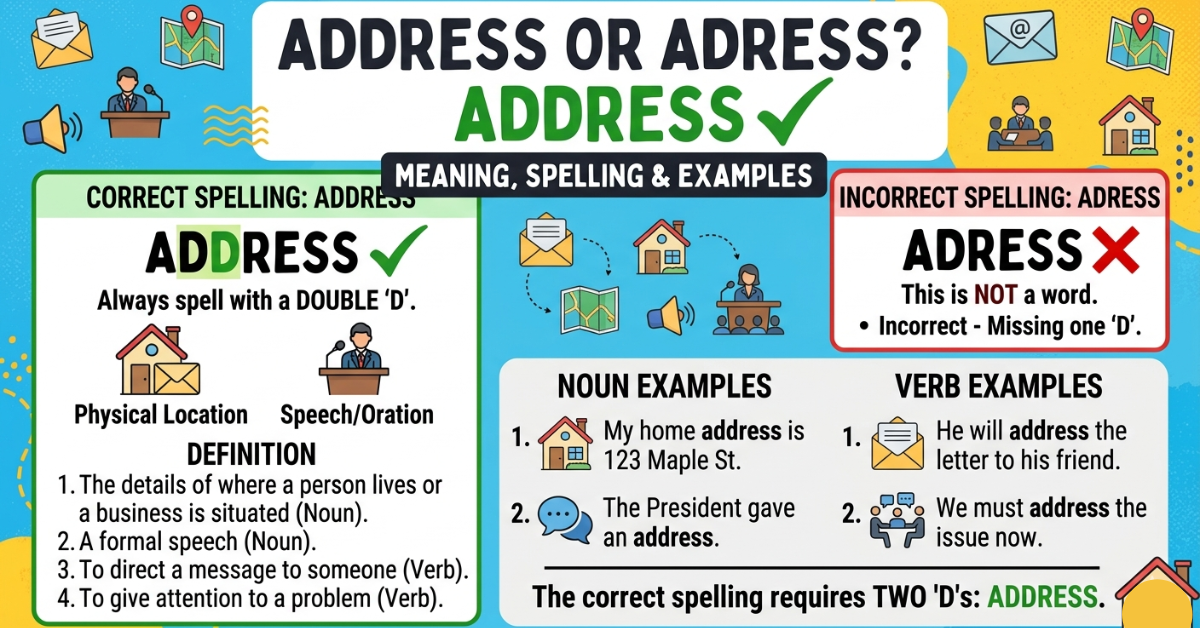
The correct spelling is address.
“Adress” is a common spelling mistake caused by how the word sounds when spoken. However, in standard English, it always includes a double “d”.
Why do people write “adress” instead of “address”?
There are a few reasons for this confusion:
- The pronunciation doesn’t clearly emphasize the double “d”
- Typing quickly leads to missing letters
- Influence from informal writing on social media
- Lack of practice with formal spelling rules
Even though “adress” appears often in searches, it is not grammatically correct.
Meaning of Address in Simple Terms
An address is the exact location where someone lives, works, or where something is sent.
It usually includes:
- House or building number
- Street name
- City or town
- Postal or ZIP code
- Country (for international use)
So when someone asks for your address, they are asking for your complete location details.
Adress or Address Example Sentences
Here are some simple examples to help you understand proper usage:
- Please write your address on the form clearly.
- She moved to a new address last month.
- I cannot deliver the parcel without your address.
- His email and home address were both updated.
Incorrect usage:
- (Incorrect) Please write your adress on the form.
- (Correct) Please write your address on the form.
These examples show how important correct spelling is in formal communication.
Common Mistakes People Make
Many learners confuse spelling when using the word in daily writing. Here are frequent errors:
- Writing “adress” instead of “address”
- Forgetting double consonants in English words
- Mixing up formal and informal spelling styles
- Not proofreading emails or forms
A simple trick is to remember: “a-dd-ress = double d, double check.”
Why Correct Spelling Matters
Using the correct spelling is not just about grammar—it affects clarity and professionalism.
Correct spelling helps in:
- Job applications
- Official documents
- Online registrations
- Email communication
- Delivery and shipping details
Even a small spelling mistake like “adress” can create confusion or delay important communication.
Quick Tips to Remember the Spelling
- Break it into parts: ad + dress
- Think of “address = a place you are dressed to go” (memory trick)
- Repeat writing it a few times daily
- Use spell-check tools when typing
FAQs
1. Is it adress or address?
The correct spelling is address. “Adress” is incorrect.
2. Why is “adress” wrong?
It is a common spelling mistake because the double “d” is often not emphasized in speech.
3. Can I use “adress” in informal writing?
No, even in informal writing, the correct form is still address.
4. What is an example of address usage?
Example: “Please send the letter to my new address.”
5. What is the easiest way to remember address spelling?
Remember it has two “d” letters: ad + dress.
Conclusion
Understanding the difference between adress or address helps improve your writing accuracy and communication skills. The correct form is always address, and using it properly ensures clarity in both formal and informal situations.
Next time you fill out a form or write an email, double-check the spelling—you’ll avoid common mistakes and present yourself more professionally.
Author
britsx85@gmail.com
Related Posts
Leak vs Leek: Meaning, Difference & Easy Guide
- 0
- 607 words
Have you ever seen the words leak and leek and wondered why they look almost identical but mean completely different things? This...
Read out all
Knead vs Need: Meaning, Difference & Usage Guide
- 0
- 731 words
English can be tricky, especially when two words sound the same but mean completely different things. One such confusing pair is Knead...
Read out all
Jam vs Jamb: Meaning, Difference & Usage Explained
- 0
- 653 words
The confusion around jam vs jamb is more common than you might think, especially among English learners and even native speakers. At...
Read out all
Incite vs Insight: Meaning, Difference & Usage Explained
- 0
- 744 words
Have you ever stumbled while writing and wondered whether to use incite vs insight? You’re not alone. These two words sound similar...
Read out all
Idle vs Idol: Meaning, Difference & Usage Guide
- 0
- 656 words
The confusion between idle vs idol is more common than you might think, especially in spoken and written English where both words...
Read out all
Hanged vs Hung: Meaning, Grammar & Usage Explained
- 0
- 731 words
The confusion between hanged vs hung often troubles English learners and even native speakers. Many people mix them up because both forms...
Read out all