
- 0
- 810 words
Why a Hot Water Pressure Washer Degreases What Pressure Cannot
Pressure washers are sold by pressure, and on most surfaces pressure is what matters. On grease it is not. Cold water at four thousand pounds per square inch will move loose dirt and leave an oily film behind, because the problem is chemical rather than mechanical. A 4000 PSI hot water pressure washer solves a different problem than a cold machine with the same figure on its label.
Why grease resists cold water
A hot water pressure washer exists because grease and oil are not water soluble. Cold water hits them, fails to mix and runs off, taking surface dirt with it and leaving the bonded layer underneath. Raising pressure makes the water arrive harder without making it any more capable of dissolving what it hits.
Heat changes the chemistry. Above roughly sixty degrees Celsius, animal and vegetable fats begin to saponify in the presence of alkaline detergent, which converts them into something water can carry away. Mineral oils do not saponify but their viscosity falls sharply with temperature, so they release from the surface instead of clinging to it.
Where the threshold actually sits
Most of the useful change happens between fifty and eighty degrees. Below that range the water is warm rather than effective; above it the gain tapers while the fuel consumption does not. This is why a hot machine run at moderate pressure often outperforms a cold machine at maximum pressure on the same slab. The work is being done by temperature, and the pressure is there to rinse away what the heat has released.
How a coil burner heats water in one pass
There is no tank of stored hot water in these machines. Cold water enters a coiled tube inside an insulated chamber, a diesel burner fires into that chamber, and the water leaves hot a few seconds later.
That means output temperature depends on flow. Slow the water down and it gets hotter; open a larger nozzle and the same burner delivers a lower temperature. Operators who understand this adjust the nozzle rather than chasing the burner when the heat seems inadequate.
Scale is what kills a coil
Hard water deposits lime inside the coil exactly where the heat is greatest. The deposit insulates the tube from the water, so the tube runs hotter while the water runs cooler, and eventually the metal fails.
Three habits extend coil life:
• Descale on a schedule in hard water areas
• Never fire the burner without water flowing
• Let the pump run cold before shutting down
The last one is a thirty second discipline that removes the heat soak after shutdown. Water standing in a hot coil is where the worst scale forms, and it forms on every stop rather than gradually over a season.
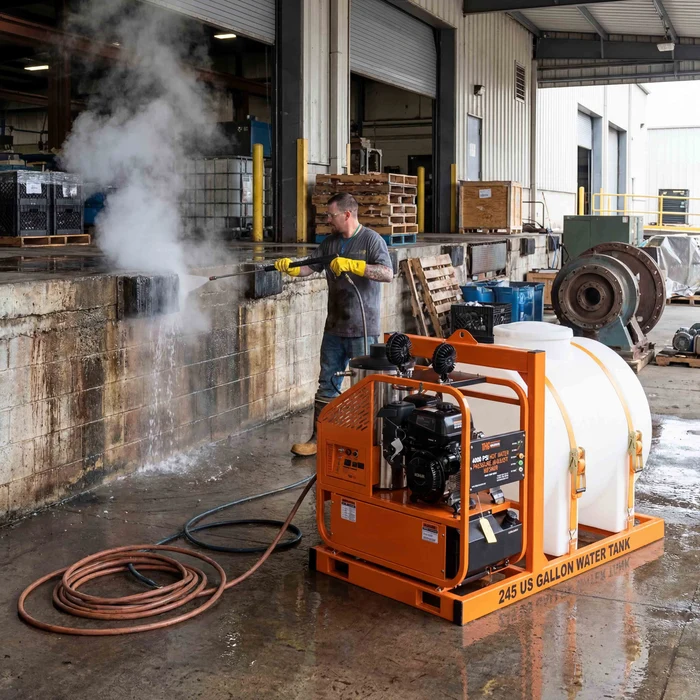
A 245 gallon tank cuts the machine free of a tap
A skid mounted hot water pressure washer with its own supply can work where there is no mains connection, which is most construction sites, farm yards and remote equipment. That is the practical reason for the tank rather than any performance benefit.
It also buffers supply. A pump starved of water cavitates and damages itself quickly, and drawing from a tank removes the risk of a garden tap that cannot keep up with a four gallon per minute machine.
Pressure washer psi and flow have to be read together
Pressure moves what is stuck. Flow carries it away. A machine with high pressure and low flow cuts a narrow line and leaves the surrounding area untouched, which feels powerful and cleans slowly. Four thousand pounds per square inch with a useful flow rate is a different tool from the same pressure at two gallons a minute, and on a large slab the flow figure decides the hours more than the pressure does.
Where a hot machine is not worth it
Vehicle washing, windows and most domestic surfaces do not need a hot water pressure washer and do not justify the burner, the fuel or the maintenance. A hot machine also strips wax and can damage some coatings.
The honest line is grease, food processing residue, agricultural waste and engine bays, which is the work a steam cleaner would otherwise be brought in for. If the soil is not oily, a cold machine of the same pressure does the same job with less to go wrong.
What the burner adds to the running cost
Pressure, flow and outlet temperature describe the machine. Tank capacity, burner fuel consumption, coil material and how the unit is descaled describe what it costs to run through a season. TMG Industrial builds this one on a skid with a 245 gallon tank and a 14 horsepower Kohler engine. Deciding whether the work is actually greasy, before paying for a burner and a coil, is the question that sizes this purchase correctly.
Author

primestarfirm@gmail.com
Related Posts

Building a More Flexible Material Handling Strategy With Reliable Equipment Access
- 0
- 2,306 words
Material handling plays an important role in warehouses, distribution centers, manufacturing facilities, construction operations, logistics environments, and many other workplaces where products...
Read out all
Best Wireless Earbuds Under 200 Dollars 2024: Top Picks, Features, and Buying Guide
- 0
- 2,906 words
Introduction Finding the best wireless earbuds under 200 dollars in 2024 can feel overwhelming because there are so many options available. Almost...
Read out all
Creating Reliable Indoor Comfort With Modern Temperature Control Systems
- 0
- 2,720 words
Maintaining a comfortable indoor environment throughout the year requires a dependable approach to temperature management, proper equipment selection, regular maintenance, and timely...
Read out all
How Much Does App Development Cost in 2026?
- 0
- 1,877 word
If you are planning to build a mobile application in 2026, one of the first questions you will probably ask is: How...
Read out all
Why Every Franchisor Needs a Franchise Lawyer Before Expanding
- 0
- 995 words
Growing a franchise system looks exciting from the outside—new locations, new franchisees, new revenue streams. But behind every successful franchise brand is...
Read out all
How to Build Reliable Web Automation With Playwright: Testing and Locator Best Practices
- 0
- 1,742 word
Every QA team knows the feeling. A test passes on your laptop, fails in CI, then passes again when you hit rerun....
Read out all