
×
Aura vs Ora: Key Differences, Meaning & Easy Guide
In

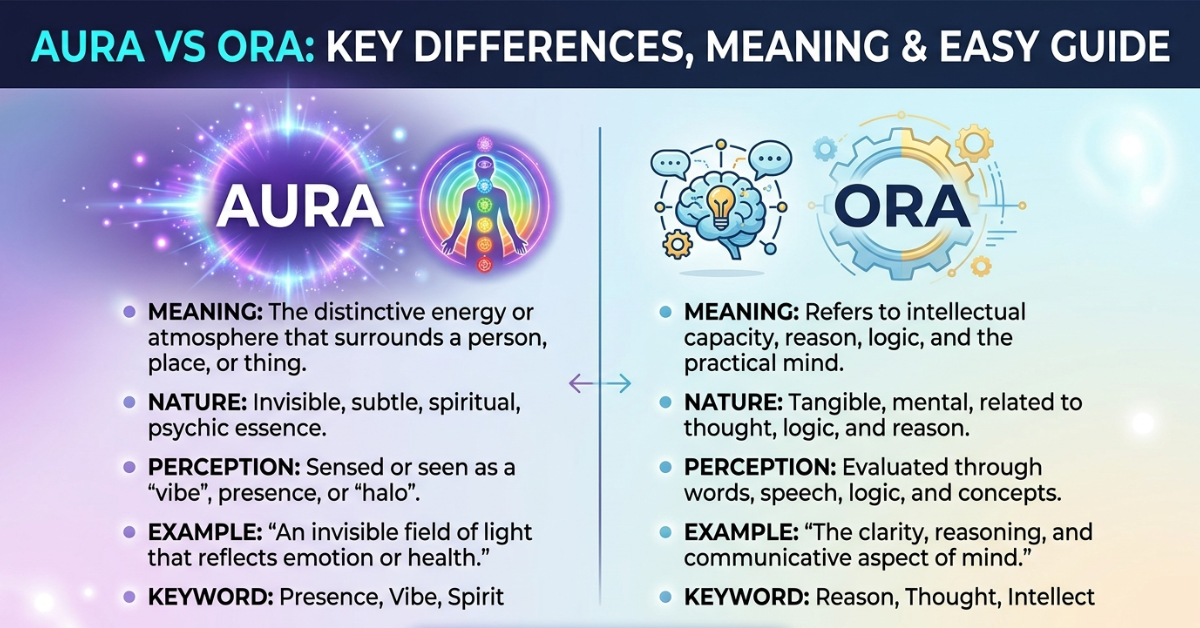
When people come across Aura vs Ora, it’s easy to get confused. These two words sound similar, but their meanings, usage, and contexts are completely different. Whether you’re writing, studying English, or just curious, understanding Aura vs Ora can help you avoid common mistakes and improve your vocabulary.

In this guide, we’ll break everything down in a simple, conversational way so you can clearly understand the difference without any confusion.

What Does “Aura” Mean?

The word aura refers to a feeling, energy, or atmosphere that surrounds a person, place, or thing. It is often used in emotional, spiritual, or descriptive contexts.

Common meanings of Aura:

  • A subtle energy around a person (spiritual belief)
  • A mood or atmosphere (literary use)
  • The impression someone gives off

Examples:

  • She has a calm and peaceful aura.
  • The room had a mysterious aura.
  • He carries an aura of confidence.

In simple words, aura is what you feel when you are around someone or something.

What Does “Ora” Mean?

Unlike aura, ora is not commonly used in modern English vocabulary. It is mainly a Latin word meaning “pray” or “speak,” and it is often seen in religious or historical contexts.

Where Ora is used:

  • Latin expressions
  • Religious texts
  • Rare literary usage

Examples:

  • “Ora pro nobis” means “Pray for us”
  • Used in historical or classical writings

So, while aura is widely used in everyday language, ora is mostly limited to formal or traditional contexts.

Aura vs Ora: Key Differences Explained

Understanding Aura vs Ora becomes much easier when we compare them side by side.

1. Meaning

  • Aura: Energy, vibe, or atmosphere
  • Ora: Latin word meaning prayer or speech

2. Usage

  • Aura: Common in modern English
  • Ora: Rare, mostly historical or religious

3. Context

  • Aura: Psychology, spirituality, descriptions
  • Ora: Latin phrases, ancient texts

4. Popularity

  • Aura: Widely used in daily language
  • Ora: Very uncommon today

Why People Confuse Aura vs Ora

There are a few simple reasons why Aura vs Ora gets mixed up:

  • They sound almost identical when spoken
  • Both are short words with similar spelling
  • People often see them in different contexts without explanation
  • Typing errors in writing or texting

But once you understand their meanings, the confusion disappears completely.

Easy Trick to Remember the Difference

Here’s a simple memory trick:

  • Aura = Atmosphere / Energy (think “A” for Atmosphere)
  • Ora = Old Latin / Prayer (think “O” for Old language)

This small trick makes it easy to avoid mixing them up.

Real-Life Usage of Aura

The word aura is used in many real-life situations:

  • Describing personality: She has a warm aura.
  • Talking about places: The beach has a relaxing aura.
  • Writing creatively: The story had a dark aura.

It’s flexible and widely used in both spoken and written English.

Real-Life Usage of Ora

Ora is much more limited but still meaningful in specific contexts:

  • Religious prayers: Ora pro nobis
  • Latin studies or historical documents
  • Academic references

You won’t usually hear it in everyday conversation.

Aura vs Ora in Modern Language

In modern communication, especially online and in social media, Aura vs Ora is mostly relevant because of spelling confusion. People often type quickly and mix the words unintentionally.

However:

  • Aura has become part of everyday vocabulary
  • Ora remains a specialized or classical term

So, if you’re writing casually, you’ll almost always use “aura.”

Common Mistakes to Avoid

Here are a few mistakes people make when using Aura vs Ora:

  • Using “ora” when they mean energy or vibe
  • Assuming both words are interchangeable
  • Mispronouncing aura as “ora” in speech
  • Confusing Latin phrases with modern English usage

Being aware of these helps you communicate more clearly.

FAQs about Aura vs Ora

1. What is the main difference between aura and ora?

Aura refers to energy or atmosphere, while ora is a Latin word meaning prayer or speech.

2. Is aura a scientific term?

Not exactly. It is mostly used in descriptive, emotional, or spiritual contexts rather than science.

3. Is ora used in modern English?

Very rarely. It mainly appears in Latin phrases or historical texts.

4. Can aura and ora be used interchangeably?

No, they have completely different meanings and cannot be swapped.

5. Why do aura and ora sound similar?

They share similar phonetics, but their origins and meanings are entirely different.

Conclusion

Understanding Aura vs Ora becomes simple once you break it down. Aura represents energy, feeling, or atmosphere, while ora is a classical Latin term linked to prayer and speech.

If you remember this basic difference, you’ll never confuse them again. Whether you’re improving your writing or just expanding vocabulary, knowing these distinctions adds clarity and confidence to your communication.

Keep exploring language differences like Aura vs Ora, and you’ll notice how small details can make a big impact on how you express yourself.

Leave a Reply

Your email address will not be published. Required fields are marked *

Author

britsx85@gmail.com

Related Posts

Arcade vs Arcane: Meaning, Differences & Uses Explained
In

Arcade vs Arcane: Meaning, Differences & Uses Explained

The confusion between Arcade vs Arcane is more common than you might think, especially because the words look and sound somewhat similar...

Read out all
Altar vs Alter: Meaning, Differences & Examples Explained
In

Altar vs Alter: Meaning, Differences & Examples Explained

The confusion between altar vs alter is more common than you might think. These two words sound exactly the same, but they...

Read out all
Aisle vs Isle: Meaning, Difference & Examples Explained
In

Aisle vs Isle: Meaning, Difference & Examples Explained

Ever found yourself stuck between two words Aisle vs Isle that look or sound similar but mean completely different things? That’s exactly...

Read out all
On the Other Hand Transition Words: Meaning & Usage Guide
In

On the Other Hand Transition Words: Meaning & Usage Guide

Writing becomes much clearer when ideas are connected smoothly, and that’s exactly where on the other hand transition words come in. These...

Read out all
Thank You As Always – Meaning, Usage & Examples
In

Thank You As Always – Meaning, Usage & Examples

In everyday communication, small phrases can carry a lot of meaning. One such expression is “thank you as always”, a polite and...

Read out all
Another Word for Asset to the Team: Best Alternatives
In

Another Word for Asset to the Team: Best Alternatives

In professional communication, finding the right words can make a big difference in how your message is received. One commonly used phrase...

Read out all