- 0
- 1,256 word
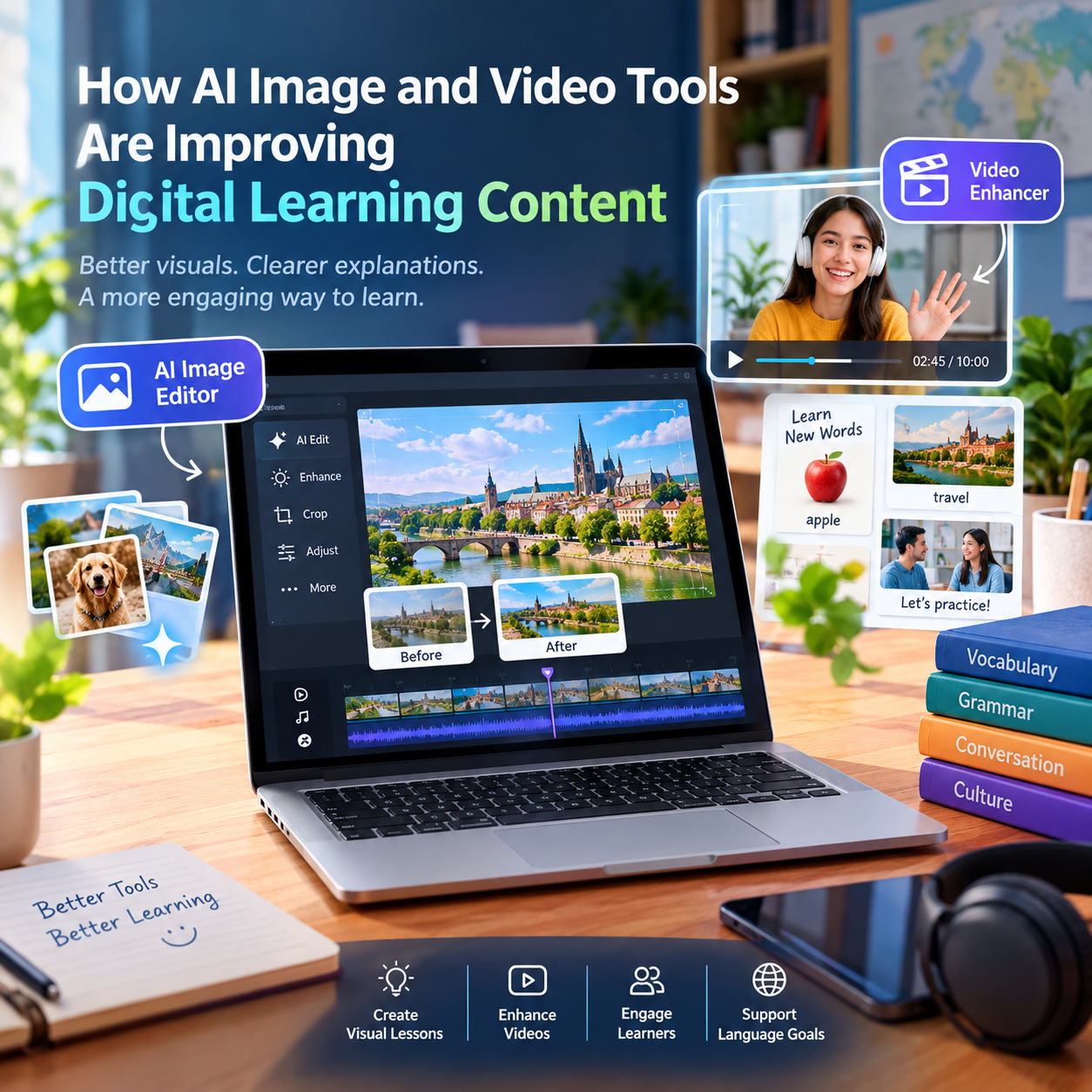
Digital learning has changed significantly over the last few years. Textbooks and written lessons are still important, but learners increasingly interact with educational content through images, videos, presentations, interactive exercises, and other visual formats.
For language learners in particular, visual and video content can make abstract ideas easier to understand. A picture can provide context for a new word, while a short video can demonstrate pronunciation, conversation, or how a phrase is used in a real situation.
Artificial intelligence is adding another layer to this process. Modern AI-powered editing tools can help educators, students, content creators, and website owners prepare visual materials without requiring advanced design or video-editing skills.
Why Visual Content Matters in Language Learning
Learning a language involves more than memorizing vocabulary. Students need to understand meaning, context, pronunciation, tone, sentence structure, and everyday communication.
Visual material can support several of these areas at the same time. For example, an image showing a particular situation can help learners understand vocabulary without relying entirely on a translation. Similarly, a short video can combine spoken language with facial expressions, movement, captions, and visual context.
Research into second-language learning videos has highlighted the importance of factors such as captions, language clarity, speech rate, and accessibility when designing digital learning materials.
This makes visual content especially useful for websites and educational platforms that want to serve learners with different levels of language ability.
The Growing Role of AI in Content Creation
Traditional image and video editing can require considerable time. A teacher preparing an online lesson might need to resize images, remove distracting elements, improve quality, prepare illustrations, edit video footage, and adjust the final files for different platforms.
AI-assisted editing can simplify parts of this workflow.
Instead of manually completing every adjustment, users can increasingly describe the type of change they want and allow AI-based systems to assist with the editing process. Recent research into instruction-based image editing shows how natural-language instructions are being used to make visual editing more accessible to people without deep technical expertise.
This does not mean that AI replaces human creativity. Rather, it can reduce repetitive work and give educators and creators more time to concentrate on the actual learning experience.
Using an AI Image Editor for Educational Visuals
Images can be particularly valuable when explaining vocabulary, objects, locations, activities, or cultural situations.
An AI image editor can be useful when an existing image needs basic improvements before being included in educational material.
For example, a content creator may have an image that needs to be cleaned up, adjusted, or prepared for a particular lesson format. Instead of rebuilding the visual from scratch, AI-assisted editing can help make the image more suitable for the intended purpose.
Language websites can use improved visuals in several ways:
- Vocabulary lessons can use clearer images to demonstrate objects and concepts.
- Grammar lessons can include visual examples of different situations.
- Cultural lessons can use carefully selected photographs and illustrations.
- Blog posts can use more engaging featured images.
- Online exercises can combine pictures with words to provide additional context.
The key is to make the image serve the lesson rather than using AI simply because it is available.
Making Learning Videos More Useful
Video provides something that static images cannot: movement and sound.
For language education, this can be especially valuable. Learners can hear pronunciation while seeing the speaker’s expressions or observing a particular situation. Videos can also demonstrate conversations, listening exercises, pronunciation techniques, and practical vocabulary.
However, video quality matters. Poorly recorded footage, unclear audio, distracting visuals, or low-quality frames can make an otherwise useful lesson harder to follow.
A video enhancer can assist creators who want to improve the visual quality of existing footage before publishing it as part of an online lesson or educational resource.
The objective should not simply be to make a video look impressive. Enhancement is most useful when it improves clarity and allows learners to concentrate on the information being presented.
Combining Images and Videos for Better Lessons
Images and videos do not have to be treated as separate types of content.
A language lesson could begin with an image introducing several new vocabulary words. The same lesson could then use a short video demonstrating those words in a conversation. Finally, students could complete a written exercise based on what they have seen and heard.
This creates multiple ways for learners to interact with the same concept.
For example, a lesson about ordering food could include:
- Images of common foods and drinks.
- Vocabulary labels beneath each image.
- A short conversation between a customer and a server.
- Captions for learners who need reading support.
- A listening exercise based on the conversation.
- A writing activity asking students to create their own dialogue.
This type of multimodal approach can make digital lessons more flexible for learners with different preferences and levels of proficiency.
AI Does Not Replace Human Review
Despite the convenience of AI tools, human review remains important.
AI-generated or AI-enhanced content can contain mistakes, unwanted changes, inaccurate representations, or misleading details. This is particularly important in educational content because students may treat published material as reliable.
Research examining AI-generated images in education has also identified concerns around representation and cultural bias, showing why visual content should be reviewed rather than accepted automatically.
The same principle applies to language-learning videos. Captions, translations, pronunciation, and visual examples should be checked before publication. Research on AI-supported multilingual video creation has found useful possibilities for captions, voiceovers, and differentiated learning materials, while also identifying limitations such as translation inaccuracies and uneven language support.
AI should therefore be viewed as an editing and production assistant, not the final authority.
Creating More Accessible Digital Content
Accessibility should also be considered when preparing online educational material.
Not every learner consumes information in exactly the same way. Some may benefit from captions, others from clear images, slower speech, transcripts, or a combination of formats.
For language-learning websites, this can be particularly important because learners may already be processing unfamiliar vocabulary and pronunciation.
Adding captions to videos, providing readable text alongside visual material, and avoiding unnecessarily complicated designs can make lessons easier to follow.
The goal is simple: use technology to remove unnecessary barriers rather than adding more complexity.
A Practical Workflow for Content Creators
Educators and website owners can keep their workflow relatively simple.
First, decide what the learner needs to understand. Next, determine whether an image, video, text explanation, or combination of formats will communicate the idea most effectively.
After creating or collecting the basic material, AI editing tools can be used to improve the visual presentation. Images can be adjusted for clarity and consistency, while videos can be reviewed and enhanced where necessary.
Finally, check everything manually. Confirm that the language is accurate, the visuals match the lesson, captions are correct, and the finished content is appropriate for the intended audience.
This approach keeps the educational objective at the center of the process.
The Future of AI-Assisted Learning Content
AI is making visual content production more accessible, but the most useful applications are likely to be those that solve genuine communication problems.
For language-learning platforms, that could mean clearer vocabulary illustrations, better educational videos, more accessible lessons, and content that can be adapted for learners at different levels.
The technology will continue to evolve, but the basic principle remains unchanged: good educational content should make information easier to understand.
AI image and video tools can support that goal by helping creators spend less time on repetitive production tasks and more time thinking about what learners actually need.
Author

hyderghumro3@gmail.com
Related Posts

FindTechGroup.com Review: What the Platform’s Core Philosophy Reveals About Its Long-Term Credibility
- 0
- 1,258 word
A platform’s stated philosophy only carries weight when its operational decisions reflect the same priorities. The gap between what a platform says...
Read out all
Data Science Course in Hyderabad: Why Boston Institute of Analytics Is India’s #1 Ranked Institute for Placement Support
- 0
- 3,103 words
Hyderabad has now become one of the most prominent places for hiring data scientists with a number of vacancies in the field...
Read out all
iBoomto AI Table Extractor: A Smarter Way to Handle PDF Data
- 0
- 1,116 word
PDFs are very good at keeping documents neat and consistent, but the problem of extracting information from them is quite different. I...
Read out all
Tozymagazine.com USA: A Complete Guide to This Growing Digital Magazine
- 0
- 1,242 word
The digital publishing world continues to evolve, and new online magazines are gaining attention from readers across the United States. One name...
Read out all
Top 10 SEO Companies in Lahore, Pakistan
- 0
- 1,441 word
Introduction Lahore has long been one of Pakistan’s biggest hubs for IT and digital business, and that growth has fueled a competitive...
Read out all
Material Handling Equipment Solutions: Types, Applications, Selection Tips, Safety, and Maintenance
- 0
- 2,612 words
Material movement is an essential part of many business operations, including warehousing, construction, manufacturing, distribution, logistics, and industrial work. Companies need reliable...
Read out all