
- 0
- 1,558 word
Hosting a winter holiday dinner comes with plenty of pressure, and nothing causes more kitchen anxiety than the Thanksgiving or Christmas turkey. Pull the bird out of the oven too early, and you risk serving undercooked poultry. Leave it in too long, and that expensive centerpiece turns into dry, chalky meat that no amount of gravy can save.
To cook a golden, juicy turkey, you should know exactly where to put a thermometer in a turkey and monitoring the internal temperature accurately from start to finish. Whether you are roasting a classic bird in the oven, smoking one outside in the crisp winter air, or frying it in the backyard, proper probe placement is very important. Here is everything you need to know about checking turkey temperatures like a seasoned pitmaster.
Why Is Important to Insert Probes in the Right Place
Most turkey recipes give you an estimated cooking time based on weight, usually around 13 to 15 minutes per pound at 325°F. While these charts are helpful for planning when to put the bird in the oven, they are only rough guesses. Oven temperatures fluctuate, cold winter air enters the kitchen every time the door opens, and every bird has a slightly different shape and fat distribution.
A turkey also cooks unevenly because it contains two very different types of meat:
- White meat (the breast): Lean, delicate, and prone to drying out quickly once it passes 165°F.
- Dark meat (the thighs and legs): Rich in fat and connective tissue, tasting much better and more tender when cooked to 175°F or even 180°F.
If you stick your food thermometer into the wrong spot, you will get a false reading that ruins this delicate balance. Placing the probes in the right locations ensures your white meat stays succulent while your dark meat becomes fall-off-the-bone tender.
Where to Insert a Meat Thermometer into Turkey
To get a true reading of your turkey’s doneness, you need to check two specific areas. Never rely on just one spot, especially on a large bird weighing over 14 pounds.
The Thickest Part of the Breast
The breast is the largest muscle on the turkey and the easiest place to accidentally overcook.
- How to insert: Slide the probe horizontally from the side or angled slightly downward from the top into the deepest, thickest section of the breast meat.
- What to avoid: Stop before hitting the breastbone (keel bone) in the center or the rib cage underneath.
- Target temperature: at least 165°F.
The Innermost Part of the Thigh
The thigh takes the longest to cook because it is tucked close to the body cavity, shielding it from direct oven heat.
- How to insert: Push the probe straight into the thickest part of the thigh muscle, aiming toward the body but staying clear of the joint.
- What to avoid: Do not touch the thigh bone (femur) or the hip socket. Metal touching bone conducts heat faster than meat, giving you an artificially high reading.
- Target temperature: 175°F for rich, tender dark meat (165°F is the bare USDA safety minimum, though dark meat is still slightly chewy at that temp).
4 Common Mistakes to Avoid When Using a Turkey Thermometer
Even with a great recipe, small habits with your thermometer can throw off your numbers. Keep these quick rules in mind on cooking day:
Hitting bone or cartilage:
Bones heat up much faster than muscle tissue. If your temperature suddenly spikes by 15 degrees in two seconds, pull the probe back slightly because you are touching bone.
Measuring pockets of fat or skin:
Fat renders into hot liquid during roasting. Make sure the sensor tip sits squarely in the center of dense muscle, not just beneath the skin.
Trusting the plastic pop-up timer:
Those disposable white or red buttons built into store-bought turkeys are notorious for popping at 180°F or higher. By the time they pop, your turkey breast is already severely overcooked.
Opening the oven door too often:
Every time you open the oven to jab the bird with a manual thermometer, the internal oven temperature drops by 25°F to 50°F. This stretches out your cooking time and dries out the skin.
Why Using a Wireless Meat Thermometer to Measure Turkey Temperature
During the winter holidays, your kitchen is already packed with side dishes, timers going off, and family members walking around. Constantly opening the oven door or bundling up to walk outside to the smoker in freezing weather just to check the turkey is exhausting.
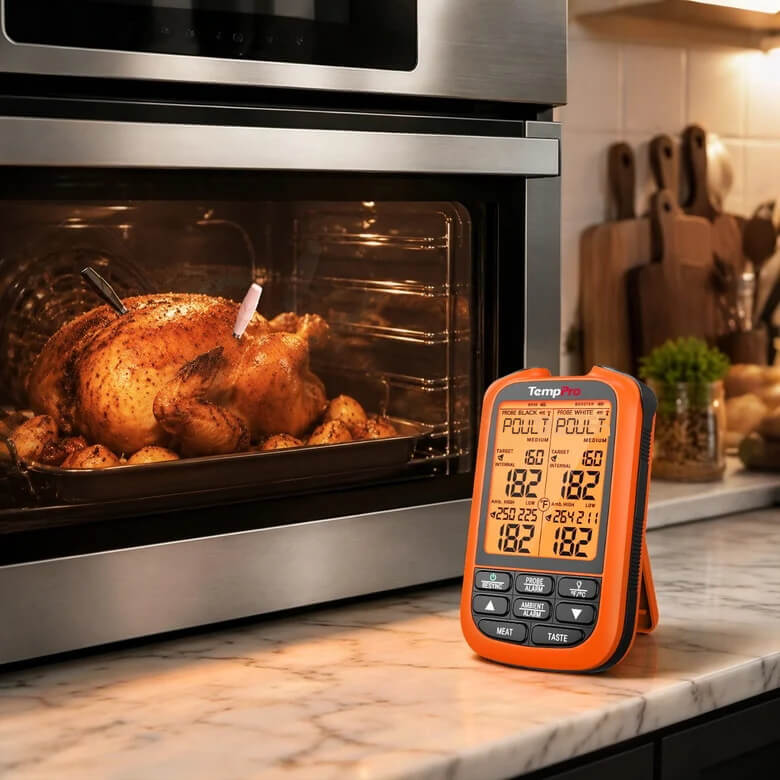
Using a smart wireless meat thermometer like the TempPro TempSpike XR TP862B Wireless Meat Thermometer solves this exact headache. Instead of guessing or letting heat escape from your oven or grill, you insert the probes before cooking begins and track the internal temperature from anywhere in your house.
Key Features of the TempPro TempSpike XR TP862B
- 100% Wire-Free Probes: Comes with two completely wire-free probes, allowing you to monitor both the turkey breast and the thigh simultaneously without tangled cords getting caught in the oven door.
- Dual-Sensor Technology: Each probe tracks both the internal meat temperature (up to 212°F) and the ambient oven or smoker temperature (up to 572°F) at the same time, alerting you if your oven runs too hot or your smoker fire dips in the winter cold.
- Extended 1000-Foot Wireless Range: Powered by advanced RF technology between the booster and display, you can relax in the living room watching football or prep appetizers in another room while keeping an eye on your cook.
- No App or Wi-Fi Required: The dedicated receiver displays real-time temperature readings without smartphone pairing, internet access, or complicated setup.
- IPX8 Waterproof: Holiday cleanup is already a chore. Once dinner is over, you can wash the stainless-steel probes under the running water.
- Long Battery Life: Enjoy 30+ hours of probe battery life and 15+ days of receiver battery life on a full charge, making it suitable for extended roasting and smoking sessions.
Step-by-Step: How to Cook Your Turkey Using Dual Wireless Probes
If you want stress-free results this season, follow this simple workflow:
Prep and Season: Pat your thawed turkey dry with paper towels, season generously inside and out, and place it breast-side up on a roasting rack.
Insert Probe 1 (Breast): Slide the first wireless probe horizontally into the thickest part of the turkey breast until it reaches the safety notch engraved on the metal shaft. Always insert up to the notch to protect the internal electronics from high oven heat.
Insert Probe 2 (Thigh): Push the second probe deep into the inner thigh muscle, stopping short of the leg bone.
Set Your Target Alerts: On your receiver, set the breast alarm for 165°F (accounting for carryover heat) and the thigh alarm for 175°F.
Roast Hands-Free: Place the turkey in your preheated 325°F oven or smoker. Keep the oven door closed and monitor the live temperature curves from your countertop.
Rest Before Carving: When your alert chimes, transfer the turkey to a cutting board and tent it loosely with foil for 20 to 30 minutes. During this rest, the breast temperature will naturally climb the final 5 degrees to reach the USDA-safe 165°F mark, and the juices will redistribute throughout the meat.
FAQs about Turkey Thermometer Probes Placement
Should I leave a meat thermometer in the turkey while it cooks?
Yes, if you are using an oven-safe leave-in probe or a wireless thermometer like the TempPro TempSpike XR TP862B. Leaving the probes in throughout the cook gives you continuous temperature tracking without letting heat escape from the oven. Never leave a standard plastic-handled instant-read thermometer inside a hot oven, as the housing will melt.
What temperature should a turkey be pulled from the oven?
Pull your turkey out of the oven when the thickest part of the breast hits 165°F and the thigh reaches 175°F. As the turkey rests on the counter under loose foil for 20 to 30 minutes, carryover cooking will raise the breast temperature to the safe 165°F standard without drying out the meat.
How do I know if my thermometer probe is touching the turkey bone?
If the probe slides in easily and suddenly hits a hard stop, pull it back about half an inch. You can also tell by watching the display: if the temperature jumps rapidly by 10 to 20 degrees as you push deeper, the tip is resting against hot bone rather than muscle tissue.
Where do I check the temperature of a stuffed turkey?
If you cook stuffing inside the turkey cavity, you must check the center of the stuffing itself in addition to the breast and thigh. Insert a clean probe directly into the middle of the stuffing and verify that it reaches 165°F before serving to eliminate any risk of foodborne bacteria.
Final Thoughts
Cooking a whole turkey is not a difficult task. Once you know the right spots to check and give the bird enough time to rest, juicy slices and tender dark meat become easy to repeat every winter. Pairing smart probe placement with a reliable tool like the TempPro TempSpike XR TP862B Wireless Meat Thermometer lets you stay present with your guests instead of hovering over a hot oven.
Wishing you a warm, flavorful holiday meal and a calm kitchen this season. If you are planning the rest of the menu next, check out our guides on roasting prime rib, checking pork chops, and keeping your kitchen comfortable when winter air turns dry.
Author

khizarnisar367@gmail.com
Related Posts

Martian Mallow: The Fascinating Story Behind the Vintage Lip Smacker and Its 1990s Nostalgia
- 0
- 2,440 words
Introduction Some products become memorable because of their quality, while others earn a special place in people’s memories through their unusual names,...
Read out all
Amcoder: A Complete Guide to the Software Engineering Practice Platform
- 0
- 2,354 words
Introduction Technology continues to transform the way people learn, work, and communicate. Programming has become one of the most valuable skills in...
Read out all
Learning a New Language Through Movies and Web Series
- 0
- 1,765 word
Learning a language from a textbook and hearing it spoken in everyday conversation can feel like two entirely different experiences. Textbooks introduce...
Read out all
Finding Courage, Hope, and Strength in Uncertain Times
- 0
- 927 words
Life is full of unexpected moments. Some days bring happiness and new opportunities, while others challenge our patience and confidence. There are...
Read out all
Breakfast Burrito Near Me: How to Find the Perfect Breakfast Burrito for a Delicious Start to Your Day
- 0
- 2,178 words
Finding a delicious breakfast is one of the best ways to start the day. Whether you are heading to work, meeting friends,...
Read out all
Nearest Coffee Shop: How to Find the Perfect Place for Coffee, Comfort, and Convenience
- 0
- 2,315 words
Finding the nearest coffee shop can make an ordinary day feel a little more enjoyable. Whether you need a quick cup of...
Read out all