
- 0
- 1,128 word
Have you ever read a sentence and wondered whether the correct word was vicious or viscous? You’re not alone. These two words look remarkably similar and even sound somewhat alike, making them one of the most commonly confused word pairs in English.
Understanding vicious vs viscous is easier than it seems. Although they differ by only one letter, their meanings are completely unrelated. One describes cruelty or aggression, while the other refers to the thickness of a liquid. In this guide, you’ll learn their definitions, pronunciation, examples, memory tricks, common mistakes, and practical tips so you can confidently use the right word every time.
Why Do People Confuse Vicious and Viscous?
The confusion comes from several factors:
- Their spellings are nearly identical.
- They share the same first four letters.
- Their pronunciation is somewhat similar.
- Both appear in formal writing and academic texts.
Despite these similarities, they belong to completely different contexts.
| Word | Meaning | Common Context |
| Vicious | Cruel, violent, harmful, or extremely aggressive | Animals, people, attacks, criticism, behavior |
| Viscous | Thick, sticky, and resistant to flowing | Oil, syrup, honey, lava, paint |
Remember this simple rule:
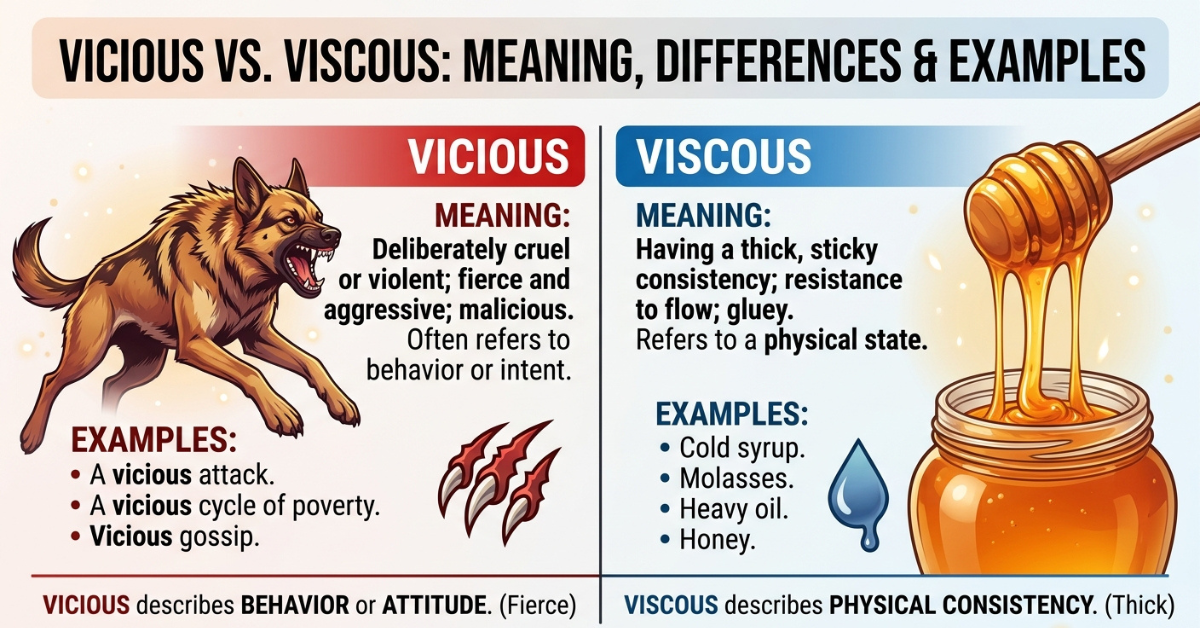
Vicious describes behavior. Viscous describes liquids.
What Does Vicious Mean?
Vicious is an adjective used to describe something that is deliberately cruel, violent, dangerous, or intensely harmful.
It often refers to:
- Aggressive people
- Dangerous animals
- Harsh criticism
- Destructive behavior
- Severe attacks
- Harmful cycles
Examples of Vicious
- The dog became vicious after being threatened.
- The journalist faced a vicious online attack.
- A vicious storm destroyed several homes.
- The boxer delivered a vicious punch.
- She escaped a vicious cycle of poverty.
In each example, the word conveys intensity, violence, or harm.
Common Synonyms of Vicious
Some similar words include:
- Brutal
- Cruel
- Savage
- Ruthless
- Ferocious
- Malicious
- Hostile
- Violent
- Merciless
Each carries the idea of aggression or harmful intent.
What Does Viscous Mean?
Viscous is an adjective used to describe liquids that are thick, sticky, and slow to flow.
Scientists often use this word when discussing a liquid’s viscosity, which measures its resistance to movement.
Common examples include:
- Honey
- Syrup
- Motor oil
- Molasses
- Paint
- Glue
- Lava
Examples of Viscous
- Honey is more viscous than water.
- The engine requires a highly viscous lubricant.
- The paint became too viscous after sitting overnight.
- Molten lava can be extremely viscous.
- The mixture turned thick and viscous.
Notice that every example involves a substance—not a person’s behavior.
Vicious vs Viscous: Side-by-Side Comparison
| Feature | Vicious | Viscous |
| Part of Speech | Adjective | Adjective |
| Meaning | Cruel, violent, harmful | Thick and slow-flowing |
| Used For | People, animals, actions | Liquids and fluids |
| Associated With | Aggression | Thickness |
| Opposite | Gentle, kind | Thin, watery |
Pronunciation Difference
Although similar, their pronunciation is different.
Vicious
Pronounced:
VISH-us
The ending sounds like:
“shus”
Viscous
Pronounced:
VIS-kus
The middle “k” sound clearly separates it.
Listening carefully makes distinguishing them much easier.
Memory Tricks to Remember the Difference
Simple memory devices can prevent confusion.
Trick 1: Vicious = Violence
Both begin with “Vi.”
Think:
Vicious → Violence
If someone or something is cruel or dangerous, use vicious.
Trick 2: Viscous = Sticky Substance
Think of:
Viscous → Sticky Syrup
Anything thick or gooey is viscous.
Trick 3: Science vs Behavior
Ask yourself:
“Am I talking about behavior or a liquid?”
- Behavior → Vicious
- Liquid → Viscous
Real-Life Examples
Here are situations where each word naturally fits.
Example 1
Incorrect: The honey was vicious.
Correct: The honey was viscous.
Example 2
Incorrect: The tiger was viscous.
Correct: The tiger was vicious.
Example 3
Incorrect: The syrup attacked viciously.
This sentence makes no sense.
Correct:
The syrup is highly viscous.
Example 4
Incorrect: The criminal had viscous intentions.
Correct:
The criminal had vicious intentions.
Common Mistakes People Make
Many English learners accidentally swap these words.
Mistake 1
Using viscous to describe a person.
Incorrect:
He is a viscous criminal.
Correct:
He is a vicious criminal.
Mistake 2
Using vicious to describe a liquid.
Incorrect:
This oil is vicious.
Correct:
This oil is viscous.
Mistake 3
Confusing spelling because of pronunciation.
Reading regularly helps reinforce the correct usage.
Understanding Viscosity
The word viscous comes from the scientific concept of viscosity.
Viscosity measures how easily a liquid flows.
Examples:
| Liquid | Viscosity |
| Water | Low |
| Milk | Low |
| Cooking Oil | Medium |
| Honey | High |
| Molasses | Very High |
Higher viscosity means slower flow.
Where You’ll Commonly See Each Word
Vicious
You’ll often encounter this word in:
- News articles
- Crime reports
- Politics
- Sports
- Literature
- History
- Psychology
Examples:
- vicious attack
- vicious rumor
- vicious argument
- vicious cycle
Viscous
You’ll commonly see this word in:
- Chemistry
- Engineering
- Medicine
- Physics
- Cooking
- Automotive maintenance
- Manufacturing
Examples:
- viscous liquid
- viscous solution
- viscous oil
- viscous fluid
Quick Test
Choose the correct word.
1.
The snake made a ______ attack.
Vicious
2.
Molasses is extremely ______.
Viscous
3.
The politician received ______ criticism.
Vicious
4.
The lubricant became more ______ in cold weather.
Viscous
If you answered all four correctly, you’ve mastered the difference.
Practical Tips to Never Mix Them Up
- Connect vicious with violence and aggression.
- Associate viscous with viscosity and thick liquids.
- Check whether you’re describing a person or a substance.
- Read the sentence aloud to see which meaning fits naturally.
- Practice writing your own example sentences.
These habits make correct usage automatic over time.
Key Takeaways
- Vicious means cruel, violent, aggressive, or harmful.
- Viscous means thick, sticky, and slow-flowing.
- Vicious describes people, behavior, attacks, and actions.
- Viscous describes liquids and fluids.
- The easiest memory trick is: Vicious = Violence; Viscous = Viscosity.
Frequently Asked Questions
Is it vicious or viscous syrup?
The correct word is viscous because syrup is a thick liquid. Vicious describes harmful behavior, not substances.
Can a person be viscous?
No. A person cannot accurately be described as viscous unless you’re speaking metaphorically in a humorous or creative context. Normally, a cruel person is vicious.
What is the easiest way to remember vicious vs viscous?
Think of vicious = violence and viscous = viscosity. One refers to aggressive behavior, while the other refers to thick liquids.
Is honey viscous or vicious?
Honey is viscous because it flows slowly due to its thickness.
What does a vicious cycle mean?
A vicious cycle is a chain of negative events where one problem causes another, making the original problem even worse. It’s commonly used in economics, psychology, and everyday conversations.
Is motor oil viscous?
Yes. Motor oil is a viscous liquid, and its viscosity is carefully designed to protect engine components under different temperatures.
Conclusion
Although vicious and viscous differ by just one letter, their meanings couldn’t be more different. Vicious refers to cruelty, violence, and harmful behavior, while viscous describes liquids that are thick and slow to flow. Understanding the distinction will improve your writing, speaking, and overall confidence in English.
The next time you encounter these similar-looking words, remember the simple rule: behavior is vicious, liquids are viscous. With a little practice and the memory tricks shared in this guide, you’ll never mix them up again.
Author

linguaezone.com@gmail.com
Related Posts
Kill Two Birds With One Stone Alternative: 50 Better Options
- 0
- 1,569 word
Have you ever paused before saying “kill two birds with one stone” because it sounded too violent or simply didn’t fit the...
Read out all
Happy Sabbath Meaning: A Complete Guide to Its Significance
- 0
- 1,632 word
Have you ever received the message “Happy Sabbath” and wondered what it truly means? Is it simply another way of saying “have...
Read out all
I’m So Proud of You in Other Words: 120+ Heartfelt Alternatives
- 0
- 1,562 word
Have you ever wanted to tell someone you’re proud of them but felt like saying “I’m so proud of you” sounded repetitive?...
Read out all
How Do You Spell Happy Anniversary? Correct Spelling Guide
- 0
- 1,221 word
Have you ever paused before writing an anniversary card and wondered, “How do you spell happy anniversary?” You’re not alone. Whether you’re...
Read out all
Waiting for Your Response Email: Best Examples & Tips
- 0
- 1,483 word
Have you ever sent an important email and found yourself wondering whether you should follow up or simply wait? Whether you’re communicating...
Read out all
Great Asset to the Team: Meaning, Examples & Tips
- 0
- 1,494 word
Have you ever wanted to compliment a coworker but struggled to find words that sound professional and sincere? One of the most...
Read out all