
- 0
- 1,413 word
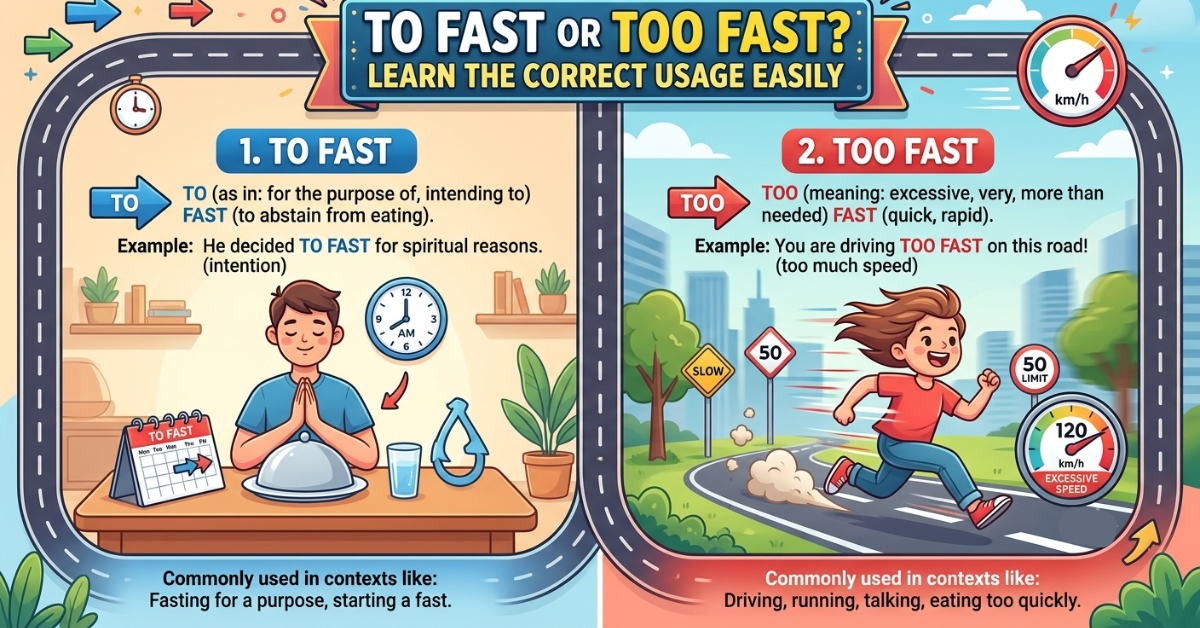
Have you ever paused while typing and wondered, “Is it to fast or too fast?” You’re not alone. It’s one of the most common English grammar mistakes because the words to and too sound exactly the same but have very different meanings.
If you’ve searched for to fast or too fast, is it to fast or too fast, way to fast or too fast, or growing up to fast or too fast, you’re looking for the same answer: which version is grammatically correct?
The short answer is simple: “Too fast” is correct whenever you mean excessively fast or faster than desired. In this guide, you’ll learn the difference between to and too, understand why people confuse them, explore dozens of examples, discover common mistakes, and pick up easy memory tricks that will help you avoid this error forever.
The Short Answer: Is It To Fast or Too Fast?
The correct phrase is:
Too fast
The phrase “to fast” is usually incorrect when talking about speed.
Compare the two:
- Incorrect: The car was to fast.
- Correct: The car was too fast.
Here, too means more than necessary, excessively, or beyond what is acceptable.
Understanding the Difference Between “To” and “Too”
Although they sound identical, these words perform completely different jobs in English.
What Does “To” Mean?
To is a preposition or part of an infinitive verb.
Examples:
- I want to learn.
- We walked to school.
- She went to the store.
- They decided to leave early.
Notice that to doesn’t describe an amount or degree.
What Does “Too” Mean?
Too usually means:
- Excessively
- More than desired
- Also
Examples:
- The music is too loud.
- It’s too cold outside.
- He drives too fast.
- I want pizza too.
When discussing speed that’s excessive, too is always the correct choice.
Why People Confuse To and Too
There are several reasons this mistake happens so often.
They Sound Exactly the Same
English contains many homophones—words that sound identical but have different spellings and meanings.
Since to and too are pronounced the same, people often choose the wrong spelling when writing.
Autocorrect Doesn’t Always Help
Many spelling checkers accept both words because each is a real English word. The software often can’t determine whether you meant to or too without understanding the entire sentence.
Fast Typing Leads to Mistakes
When writing emails, social media posts, or text messages quickly, it’s easy to type to instead of too without noticing.
Is It To Fast or Too Fast?
If you’re asking:
Is it to fast or too fast?
The answer is:
Too fast
Examples:
- You’re driving too fast.
- She speaks too fast.
- Time goes too fast.
- The movie ended too fast.
- The internet is surprisingly too fast for my old laptop.
Whenever you mean excessively fast, choose too.
Way To Fast or Too Fast: Which Is Correct?
Another common search is:
Way to fast or too fast
The correct phrase is:
Way too fast
Examples:
- That motorcycle was way too fast.
- You’re talking way too fast.
- The game became way too fast for beginners.
Why?
The word way acts as an intensifier.
Structure:
Way + too + adjective
Examples:
- Way too expensive
- Way too difficult
- Way too loud
- Way too crowded
- Way too fast
Incorrect:
- Way to fast
Correct:
- Way too fast
Growing Up To Fast or Too Fast?
Many people wonder about this emotional expression.
The correct phrase is:
Growing up too fast
Examples:
- Kids are growing up too fast.
- My daughter is growing up too fast.
- Time feels like it’s moving too fast.
Here, too means more quickly than expected or desired.
When Can “To Fast” Actually Be Correct?
Interestingly, to fast is not always wrong.
It becomes correct when fast is being used as a verb, meaning to avoid eating for religious, medical, or personal reasons.
Examples:
- She plans to fast tomorrow.
- Many people choose to fast during certain holidays.
- Doctors sometimes recommend patients to fast before surgery.
Notice that here, fast is an action—not a description of speed.
Examples of “Too Fast” in Everyday English
Here are common situations where too fast is correct.
Driving
- You’re driving too fast.
- Slow down—it’s too fast for these roads.
Sports
- The ball was moving too fast to catch.
- The race started too fast.
Technology
- The animation moves too fast.
- The slideshow changes too fast.
Learning
- The teacher explains concepts too fast.
- The lesson moves too fast for beginners.
Conversation
- She talks too fast.
- Please don’t speak too fast.
Common Sentences People Write Incorrectly
Here are mistakes you’ll often see online.
| Incorrect | Correct |
| You’re going to fast. | You’re going too fast. |
| He talks to fast. | He talks too fast. |
| The movie ended to fast. | The movie ended too fast. |
| Kids grow up to fast. | Kids grow up too fast. |
| That’s way to fast. | That’s way too fast. |
An Easy Trick to Remember
A simple memory trick can prevent this mistake forever.
Think of it this way:
Too has an extra “O.”
That extra letter reminds you there’s extra speed, extra amount, or more than enough.
Examples:
- Too hot
- Too cold
- Too expensive
- Too heavy
- Too fast
Extra “O” = Extra amount.
Similar Grammar Mistakes
If you’ve confused to and too, you may also encounter these common mistakes:
- Their vs There vs They’re
- Your vs You’re
- Then vs Than
- Affect vs Effect
- Its vs It’s
- Lose vs Loose
- Accept vs Except
- Compliment vs Complement
These errors usually happen because the words sound similar but have different meanings.
Why This Mistake Matters
Using the correct word improves:
- Professional writing
- Academic assignments
- Emails
- Social media posts
- Job applications
- Business communication
Small grammar improvements help your writing appear more polished and credible.
Practical Tips to Avoid the Mistake
Here are some quick habits that work.
Ask Yourself a Question
Can you replace the word with excessively?
If yes, use too.
Example:
The car is too fast.
The car is excessively fast.
It still makes sense.
Look for an Adjective
If fast describes something, it’s usually preceded by too when you mean “excessively.”
Examples:
- Too slow
- Too loud
- Too bright
- Too small
- Too fast
Read the Sentence Aloud
After writing, pause and ask:
“Am I talking about direction, an infinitive, or excess?”
If it’s excess, use too.
Key Takeaways
- Too fast is correct when something is excessively fast.
- To fast is only correct when fast is used as a verb, meaning not to eat.
- The correct phrase is way too fast, never way to fast.
- The correct expression is growing up too fast.
- Remember that too has an extra “O,” which represents “extra.”
Frequently Asked Questions
Is it to fast or too fast?
The correct phrase is too fast when describing excessive speed. Use to fast only when referring to the action of fasting.
Why is “too fast” correct?
Because too means “more than necessary” or “excessively.” When something moves faster than desired, too fast is the correct expression.
Is “way to fast or too fast” correct?
The correct phrase is way too fast. The word way intensifies too, making the sentence grammatically correct.
Is it growing up to fast or too fast?
The correct expression is growing up too fast because too means more quickly than expected or desired.
Can “to fast” ever be correct?
Yes. It’s correct when fast is a verb that means to abstain from food. For example, “Doctors asked him to fast before the procedure.”
How can I remember the difference?
Remember that too has an extra “O.” Think of it as standing for extra, making it the right choice whenever something is excessive.
Conclusion
Understanding the difference between to and too is one of the easiest ways to improve your English writing. Whenever you’re describing something that happens more quickly than it should, the correct phrase is too fast. Whether you’re asking is it to fast or too fast, wondering about way to fast or too fast, or writing growing up too fast, the same rule applies: too expresses excess.
The only time to fast is correct is when fast functions as a verb meaning to avoid food for a period of time. Keeping this simple distinction in mind will help you write with greater confidence and accuracy. Continue practicing these small grammar rules, and you’ll notice a big improvement in the clarity and professionalism of your writing.
Author

linguaezone.com@gmail.com
Related Posts
Kill Two Birds With One Stone Alternative: 50 Better Options
- 0
- 1,569 word
Have you ever paused before saying “kill two birds with one stone” because it sounded too violent or simply didn’t fit the...
Read out all
Happy Sabbath Meaning: A Complete Guide to Its Significance
- 0
- 1,632 word
Have you ever received the message “Happy Sabbath” and wondered what it truly means? Is it simply another way of saying “have...
Read out all
I’m So Proud of You in Other Words: 120+ Heartfelt Alternatives
- 0
- 1,562 word
Have you ever wanted to tell someone you’re proud of them but felt like saying “I’m so proud of you” sounded repetitive?...
Read out all
How Do You Spell Happy Anniversary? Correct Spelling Guide
- 0
- 1,221 word
Have you ever paused before writing an anniversary card and wondered, “How do you spell happy anniversary?” You’re not alone. Whether you’re...
Read out all
Waiting for Your Response Email: Best Examples & Tips
- 0
- 1,483 word
Have you ever sent an important email and found yourself wondering whether you should follow up or simply wait? Whether you’re communicating...
Read out all
Great Asset to the Team: Meaning, Examples & Tips
- 0
- 1,494 word
Have you ever wanted to compliment a coworker but struggled to find words that sound professional and sincere? One of the most...
Read out all