
- 0
- 1,086 word
Have you ever heard someone ask, “thumb in or thumb out?” and wondered what on earth they meant? In the simplest sense, the phrase points to thumb position: whether the thumb is tucked closer to the palm or held outside the fingers. In most practical situations, the thumb in or thumb out meaning becomes clear only when you look at the context — especially in sports, hand posture, and safety-related movement.
This guide breaks down what the phrase means, where it is used, why thumb position matters, and how to tell whether thumb in or thumb out is the better choice in real life.
What Does Thumb In or Thumb Out Mean?
At its core, the phrase is about the position of the thumb on a hand. The thumb is the short, opposable digit beside the fingers, and because it moves differently from the other fingers, small changes in thumb placement can change comfort, grip, and control.
Thumb In
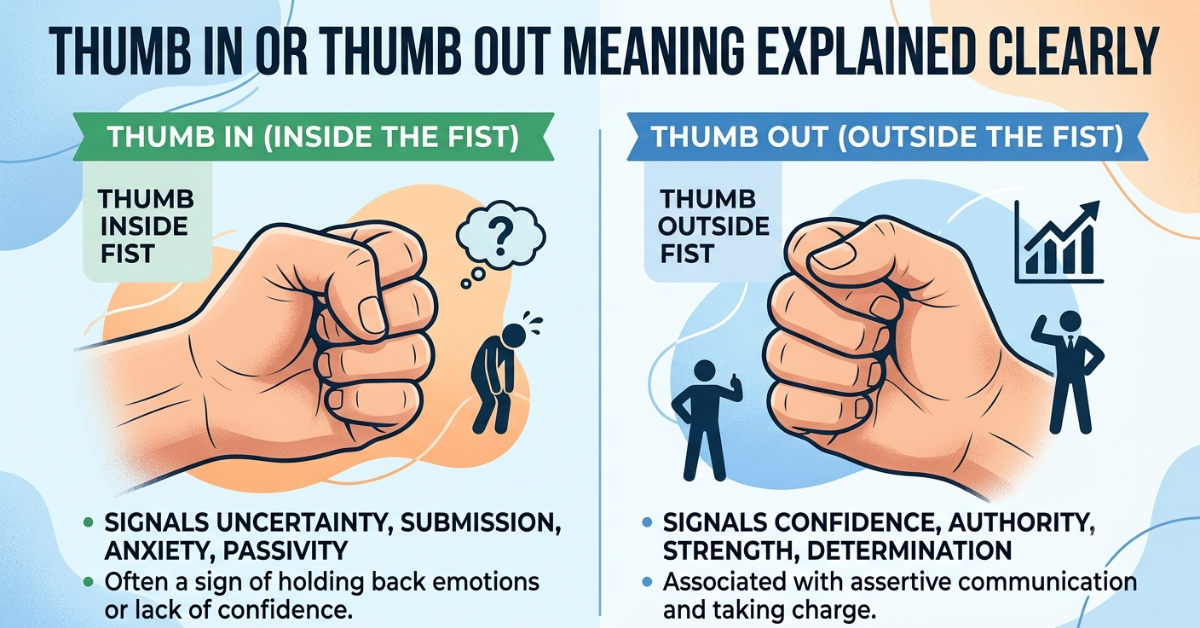
“Thumb in” usually means the thumb is tucked inward, closer to the palm or hidden within a closed hand. In everyday use, people may describe this as a compact or contained hand position. In a fist, however, tucking the thumb too far inside is often not recommended in striking sports because it can put the thumb at risk.
Thumb Out
“Thumb out” means the thumb is kept outside the fingers or extended away from the palm. In many settings, this is the more visible, more natural, and safer position — especially when making a fist for punching or maintaining a functional grip. Pediatric hand-splint guidance also describes the thumb being “out of the palm” as the open-hand opposite of a fisted position.
Where the Phrase Is Used
The phrase is not just about grammar or dictionary meaning. It shows up in real physical situations where thumb placement matters, especially in sports, movement training, and hand positioning.
1) Boxing and Striking
This is one of the clearest places where thumb position matters. Boxing guidance commonly says the thumb should wrap over the first two fingers when you make a fist, rather than being tucked inside the hand. That advice is meant to reduce the chance of injuring the thumb when impact lands. Research on boxing glove design has also examined how glove structure affects thumb joint angles during fist formation.
2) Grip and Hand Safety
In many gripping actions, a thumb-out or thumb-supported position improves control. Because the thumb is opposable, it helps humans grasp and manipulate objects efficiently. That is why even small changes in thumb placement can affect the stability of a grip or the comfort of repeated movement.
3) Open-Hand vs Closed-Fist Position
In rehabilitation and hand-positioning contexts, the thumb is sometimes described as either resting out of the palm or folded inward with a fisted hand. This is useful language when comparing a relaxed open hand with a clenched hand, since the thumb changes the overall shape of the hand.
Thumb In vs Thumb Out: Which Is Correct?
The honest answer is: it depends on the situation. If you are talking about a fist for striking, most reliable guidance favors keeping the thumb outside and wrapped safely over the fingers rather than tucked inside. If you are describing a relaxed hand or a motion that needs compactness, thumb in may simply mean the thumb is folded inward.
So the thumb in or thumb out meaning is not one fixed rule. It changes with the task:
- In boxing or striking, thumb out is generally the safer form.
- In hand splinting or open-hand posture, thumb out of the palm is the relaxed, open position.
- In casual conversation, the phrase usually just refers to the visible direction of the thumb.
Common Mistakes People Make
One common mistake is assuming the phrase always means the same thing everywhere. It does not. Thumb position in a fist, thumb position in a sports drill, and thumb position in a relaxed pose are all different conversations.
Another mistake is treating thumb placement as a tiny detail that does not matter. In reality, studies and coaching guidance show that thumb position can affect comfort, control, and injury risk, especially in punching and glove use.
Practical Tips for Using the Phrase Correctly
Use these simple rules:
- If the context is boxing or punching, thumb out is usually the right idea. Keep the thumb wrapped safely on the outside of the fist.
- If the context is posture or hand movement, describe the thumb as tucked in or extended out. That makes the meaning clearer.
- If you are writing for a general audience, explain the gesture in plain language. That avoids confusion because the phrase is context-based rather than a fixed idiom.
Key Takeaways
- The phrase refers to thumb position, not a special grammar rule.
- In striking sports, thumb outside the fist is generally safer than thumb inside.
- In therapy and hand-position descriptions, thumb out of the palm often means an open hand.
- The exact thumb in or thumb out meaning depends on context, not just the words themselves.
FAQs
What does thumb in or thumb out mean in simple terms?
It means whether the thumb is tucked inward toward the palm or held outside the fingers. The exact meaning depends on whether you are talking about a fist, a grip, or a relaxed hand.
Is thumb out safer than thumb in for punching?
Yes, in most boxing and striking guidance, the thumb is kept outside and wrapped safely over the fingers instead of being tucked inside. That position helps reduce thumb injuries.
Can thumb in or thumb out affect grip strength?
Yes. Because the thumb is opposable and central to gripping, its position can affect control, comfort, and hand function.
Why do coaches care about thumb position?
Coaches care because thumb placement can affect safety and technique, especially in boxing and other striking sports. A small thumb-position mistake can lead to injury or a weaker fist.
Is thumb out the same as an open hand?
Not exactly, but it is often part of an open-hand posture. In hand-splint and therapy contexts, “thumb out of the palm” is used to describe the open position opposite a fisted hand.
Conclusion
The phrase may sound simple, but the thumb in or thumb out meaning changes with context. In sports, it can affect technique and safety. In everyday movement, it helps describe how the hand is held. Once you understand the difference, the phrase becomes much easier to interpret and use clearly. Keep the context in mind, and the meaning will stay straightforward.
Author

linguaezone.com@gmail.com
Related Posts

Kill Two Birds With One Stone Alternative: 50 Better Options
- 0
- 1,569 word
Have you ever paused before saying “kill two birds with one stone” because it sounded too violent or simply didn’t fit the...
Read out all
Happy Sabbath Meaning: A Complete Guide to Its Significance
- 0
- 1,632 word
Have you ever received the message “Happy Sabbath” and wondered what it truly means? Is it simply another way of saying “have...
Read out all
I’m So Proud of You in Other Words: 120+ Heartfelt Alternatives
- 0
- 1,562 word
Have you ever wanted to tell someone you’re proud of them but felt like saying “I’m so proud of you” sounded repetitive?...
Read out all
How Do You Spell Happy Anniversary? Correct Spelling Guide
- 0
- 1,221 word
Have you ever paused before writing an anniversary card and wondered, “How do you spell happy anniversary?” You’re not alone. Whether you’re...
Read out all
Waiting for Your Response Email: Best Examples & Tips
- 0
- 1,483 word
Have you ever sent an important email and found yourself wondering whether you should follow up or simply wait? Whether you’re communicating...
Read out all
Great Asset to the Team: Meaning, Examples & Tips
- 0
- 1,494 word
Have you ever wanted to compliment a coworker but struggled to find words that sound professional and sincere? One of the most...
Read out all