
- 0
- 2,202 words
Have you ever typed “stear a car” and paused for a second, wondering if it looks right? You’re not alone. English is full of words that sound similar but don’t follow the spelling patterns we expect, and steer or stear is one of those small but surprisingly common confusions.
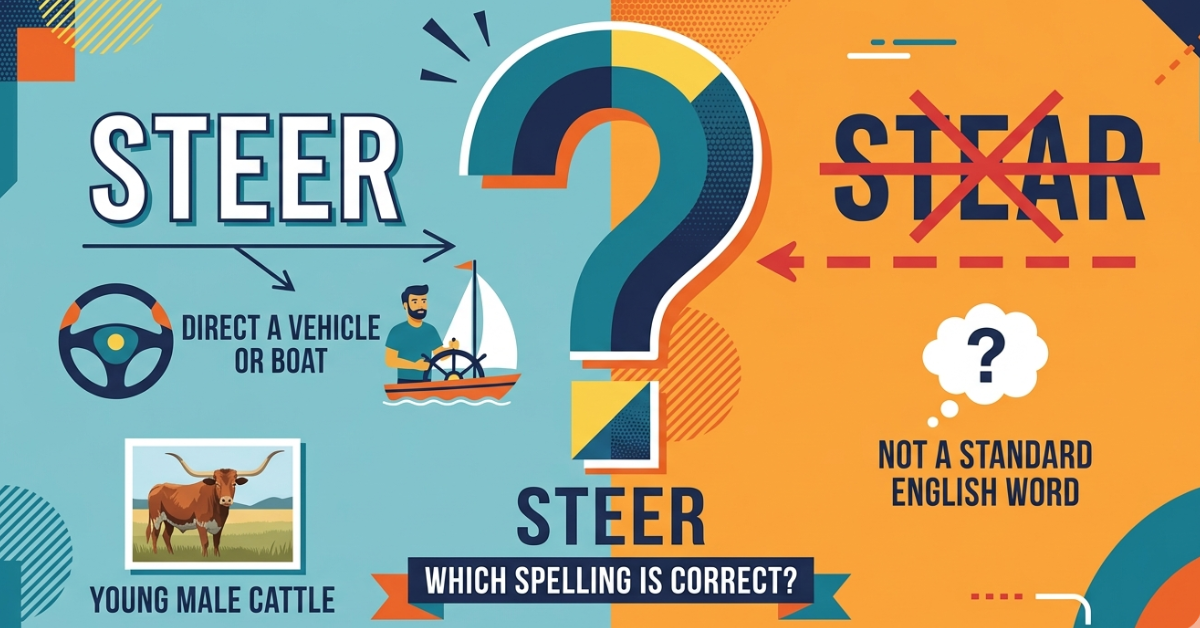
The short answer is this: the correct word is steer when you’re talking about controlling the direction of a car, bike, boat, or any other vehicle. “Stear” is not the correct spelling in standard English for driving or guiding a vehicle. So if you’re writing about driving, the right phrase is “steer a car,” not “stear a car.”
In this guide, you’ll learn the difference between steer or stear, what steer actually means, why people often misspell it, how to use steer a car correctly in sentences, and how to remember the right spelling without second-guessing yourself.
Steer or Stear: Which One Is Correct?
If your question is whether it should be steer or stear a car, the answer is clear:
- Correct: steer a car
- Incorrect: stear a car
The verb steer means to control the direction of a vehicle. It can also mean to guide, direct, or influence the movement of something or someone. Major dictionaries define steer as controlling the direction of a vehicle such as a car, boat, or bicycle.
Correct examples
- She learned how to steer a car at the age of 18.
- It’s hard to steer on icy roads.
- He grabbed the wheel and tried to steer away from the pothole.
- New drivers often focus so much on the pedals that they forget how to steer smoothly.
Incorrect examples
- She learned how to stear a car.
- He couldn’t stear around the corner.
So if your goal is to write naturally and correctly in English, always use “steer” for driving-related contexts.
What Does “Steer” Mean?
The word steer is a verb with a practical everyday meaning: to control where a vehicle, vessel, or moving object goes.
In driving and transport, “steer” means:
- to turn and control a car with the steering wheel
- to guide a bike, motorcycle, or scooter
- to control the direction of a boat or ship
- to direct movement safely through a path, road, or route
For example:
- “She carefully steered the car through the narrow street.”
- “He steered the boat away from the rocks.”
- “This vehicle is easy to steer.”
Dictionaries also show that steer can be used more broadly in a figurative sense, such as steering a conversation, steering a business, or steering someone toward a decision.
Why Do People Confuse “Steer” and “Stear”?
The confusion usually happens for one simple reason: English spelling doesn’t always match the way words sound.
When spoken, steer sounds like “steer” /stɪr/, and some people assume the vowel pattern should be ea, as in:
- hear
- fear
- clear
- near
Because of that, “stear” can look plausible at first glance. But English spelling is full of exceptions, and steer is one of them.
Why the mistake happens
People often write stear because:
- They are spelling by sound.
- They’ve seen many ea words with a similar vowel sound.
- They are typing quickly and don’t notice the mistake.
- English is not their first language.
- Autocorrect doesn’t always catch every nonstandard variation in context.
This is especially common in phrases like:
- steer or stear a car
- how to steer a car
- how do you steer
- is it steer or stear
Is “Stear” Ever a Real Word?
This is where things get slightly interesting.
In everyday English, “stear” is not the correct word for controlling a car or vehicle. That’s the key point. However, the letter sequence stear can appear in specialized scientific or chemical terms, such as words related to stearic acid or compounds like stearin. In other words, stear may appear as a word element or root in chemistry-related vocabulary, but not as the standard verb for driving.
So if your question is:
“Can I write ‘stear a car’?”
No. That is incorrect.
“Does the form ‘stear’ exist anywhere?”
Only in limited technical or word-root contexts—not as the normal verb meaning “control a vehicle.”
That distinction matters because searchers often assume that if a spelling exists somewhere, it must be acceptable in all contexts. It isn’t.
Steer a Car: What the Phrase Actually Means
When someone says “steer a car,” they mean to control the car’s direction using the steering wheel.
That includes actions like:
- keeping the car straight on the road
- turning left or right
- moving around obstacles
- staying in the correct lane
- guiding the car safely through traffic, curves, or parking spaces
Examples of “steer a car” in context
- It takes practice to steer a car smoothly in reverse.
- She learned to steer a car confidently after a few weeks of driving lessons.
- On wet roads, drivers should steer gently instead of making sudden turns.
- He was so nervous that he gripped the wheel too tightly while trying to steer the car.
This is why the phrase “steer or stear a car” matters so much for learners and writers. It’s a very common expression in driving, education, and everyday conversation.
How to Use “Steer” Correctly in a Sentence
If you want to sound natural and grammatically correct, here are the most common ways to use steer.
As a verb for driving or control
- I can steer the car, but I still struggle with parking.
- She steered around the fallen branch.
- He steered through heavy traffic without panicking.
As a verb for guidance or direction
- The teacher steered the discussion back to the main topic.
- Her mentor steered her toward a design career.
- The company is trying to steer its brand in a new direction.
In passive or descriptive use
- This SUV is easy to steer.
- The boat was difficult to steer in rough water.
- The vehicle steers well at low speeds.
Common Phrases With “Steer”
Once you know that steer is the correct spelling, it helps to see how often it appears in everyday English.
Driving-related phrases
- steer a car
- steer the wheel
- steer into a turn
- steer around an obstacle
- steer through traffic
- easy to steer
- hard to steer
Figurative phrases
- steer a conversation
- steer someone in the right direction
- steer a company through change
- steer clear of something
The last one—steer clear of—is especially common and means to avoid something.
Example:
- “You should steer clear of texting while driving.”
Steer vs Other Driving Words: What’s the Difference?
People often use several driving words together, but they don’t mean exactly the same thing.
1. Steer
To control the direction of the car.
Example:
- She steered left to avoid the cyclist.
2. Drive
To operate a vehicle in general.
Example:
- He drove to work this morning.
You can drive a car without specifically mentioning the directional control, but when you talk about the act of turning or guiding it, steer is the better word.
3. Turn
To change direction.
Example:
- Turn right at the traffic signal.
Turning is an action; steering is the control that makes that action happen.
4. Navigate
To plan or direct a route through roads, traffic, or obstacles.
Example:
- She navigated the city center during rush hour.
In many cases, navigate is broader than steer.
Steer vs Steering: Are They the Same?
They’re related, but not identical.
- Steer = the verb
- Steering = the action, system, or noun form related to directing a vehicle
Examples
- I learned how to steer the car.
- The car’s steering feels very light.
- Good steering control is important on slippery roads.
- He made a mistake while steering into the parking space.
This is another reason why people searching steer or stear a car get confused—because steering is such a common driving word, and they’re trying to backtrack to the base verb.
How to Remember the Correct Spelling of “Steer”
If you often forget whether it’s steer or stear, use one of these memory tricks.
Memory Trick #1: Think of “steering wheel”
You already know the word steering.
If a car has a steering wheel, the verb must be steer, not stear.
Memory Trick #2: Link it with “peer,” “cheer,” and “deer”
These words all use -eer:
- deer
- cheer
- peer
- steer
If you remember that pattern, the spelling becomes much easier.
Memory Trick #3: Say the full phrase
Repeat this sentence:
“I steer a car with a steering wheel.”
Seeing steer and steering together reinforces the correct form naturally.
Examples of Correct Usage in Real-Life Contexts
Here are some natural examples across different situations.
Driving lessons
- My instructor taught me how to steer a car gently while changing lanes.
- Beginners often overcorrect when they first learn to steer.
Road safety
- On rainy roads, steer slowly and avoid sudden movements.
- If the car skids, don’t panic—try to steer smoothly in the right direction.
Parking
- It’s easier to steer into a parking bay if you line up properly first.
- She turned the wheel too late and couldn’t steer neatly into the spot.
Figurative everyday English
- The manager tried to steer the meeting away from office drama.
- Her older sister steered her toward architecture school.
Grammar Note: Verb Forms of “Steer”
If you’re writing formally or learning English grammar, it helps to know the main forms of the verb.
| Base Form | Past Simple | Past Participle | Present Participle |
| steer | steered | steered | steering |
Examples
- I steer carefully at night.
- She steered around the dog.
- He has steered through worse traffic than this.
- They are steering toward the exit.
The form “steared” is not correct. The past tense is steered.
Mistakes to Avoid When Writing “Steer”
If you want your English to look polished, avoid these common mistakes:
1. Writing “stear” instead of “steer”
- Incorrect: I don’t know how to stear a car.
- Correct: I don’t know how to steer a car.
2. Mixing up “drive” and “steer”
- Drive = operate the vehicle
- Steer = control direction
3. Using the wrong past tense
- Incorrect: She steared into the driveway.
- Correct: She steered into the driveway.
4. Forgetting figurative uses
Steer doesn’t only apply to vehicles. It can also mean guide, direct, or influence.
Why This Small Spelling Difference Matters
At first glance, steer or stear may look like a tiny spelling issue. But if you’re writing a school assignment, blog post, driving lesson note, caption, exam answer, or professional email, the wrong spelling can make your writing look careless—even if your meaning is obvious.
Using the correct word matters because it helps with:
- clarity
- credibility
- grammar accuracy
- search visibility in online writing
- confidence in spoken and written English
It also matters for learners who are building vocabulary around transport, driving, and road safety.
Quick Answer Box: Steer or Stear a Car?
If you only need the short version, here it is:
- Correct phrase: steer a car
- Wrong spelling: stear a car
- Meaning of steer: to control the direction of a vehicle
- Past tense: steered
- Related noun: steering
Key Takeaways
Before you go, here’s the entire topic simplified:
- Steer is the correct spelling when talking about controlling a vehicle.
- Stear is not the correct standard English word in the phrase “stear a car.”
- The correct phrase is “steer a car.”
- Steer can also mean guide, direct, or influence in non-driving contexts.
- The verb forms are steer, steered, steering.
- A good memory trick is to connect steer with steering wheel.
FAQ: Steer or Stear
1. Is it steer or stear a car?
It is steer a car, not stear a car. Steer is the correct verb used for controlling the direction of a vehicle.
2. What does steer mean in driving?
In driving, steer means to control the direction of the car using the steering wheel. It includes turning, staying in lane, and guiding the vehicle safely.
3. Is “stear” a real English word?
Not in the sense of driving a vehicle. In standard everyday English, “stear a car” is incorrect. The form stear may appear in technical word roots, but not as the normal verb for controlling a car.
4. How do you use steer in a sentence?
You can say, “She carefully steered the car through traffic.” You can also use it figuratively, as in “He steered the conversation back to the main point.”
5. What is the past tense of steer?
The past tense of steer is steered. For example: “He steered around the pothole.”
6. What is the difference between drive and steer?
Drive means to operate a vehicle overall, while steer specifically means controlling its direction. You drive a car, but you steer it left, right, or around obstacles.
Conclusion
If you’ve been wondering whether it’s steer or stear, the rule is simple: use “steer” whenever you’re talking about controlling a car, bike, boat, or any other vehicle. The phrase “steer a car” is correct; “stear a car” is not.
It may seem like a small spelling detail, but getting it right makes your writing cleaner, clearer, and more professional. And once you connect steer with steering wheel, it becomes much easier to remember. If you’re working on English writing, driving vocabulary, or grammar accuracy, this is one of those tiny fixes that instantly improves your language.
Author

linguaezone.com@gmail.com
Related Posts

Kill Two Birds With One Stone Alternative: 50 Better Options
- 0
- 1,569 word
Have you ever paused before saying “kill two birds with one stone” because it sounded too violent or simply didn’t fit the...
Read out all
Happy Sabbath Meaning: A Complete Guide to Its Significance
- 0
- 1,632 word
Have you ever received the message “Happy Sabbath” and wondered what it truly means? Is it simply another way of saying “have...
Read out all
I’m So Proud of You in Other Words: 120+ Heartfelt Alternatives
- 0
- 1,562 word
Have you ever wanted to tell someone you’re proud of them but felt like saying “I’m so proud of you” sounded repetitive?...
Read out all
How Do You Spell Happy Anniversary? Correct Spelling Guide
- 0
- 1,221 word
Have you ever paused before writing an anniversary card and wondered, “How do you spell happy anniversary?” You’re not alone. Whether you’re...
Read out all
Waiting for Your Response Email: Best Examples & Tips
- 0
- 1,483 word
Have you ever sent an important email and found yourself wondering whether you should follow up or simply wait? Whether you’re communicating...
Read out all
Great Asset to the Team: Meaning, Examples & Tips
- 0
- 1,494 word
Have you ever wanted to compliment a coworker but struggled to find words that sound professional and sincere? One of the most...
Read out all