
×
Shoe-in vs Shoo-in: Meaning, Usage & Difference
In

The confusion around Shoe-in vs Shoo-in is more common than you might think. Many English learners and even native speakers mix up these two spellings when talking about someone who is almost guaranteed to win or be selected.

In reality, only one of them is considered correct in modern usage. The other is a misspelling that became popular over time due to how the word sounds when spoken. Let’s break it down in a simple, clear, and practical way so you never get confused again.

What Does “Shoe-in vs Shoo-in” Actually Mean?

The phrase Shoe-in vs Shoo-in refers to a situation where someone is almost certain to succeed, win, or be chosen for something.

For example:

  • A student who is clearly the best candidate for class president
  • A sports team expected to win easily
  • A job applicant who stands out far above others

In all these cases, the person or team is considered a “sure winner.”

But here’s where it gets interesting: the correct expression is actually “shoo-in.”

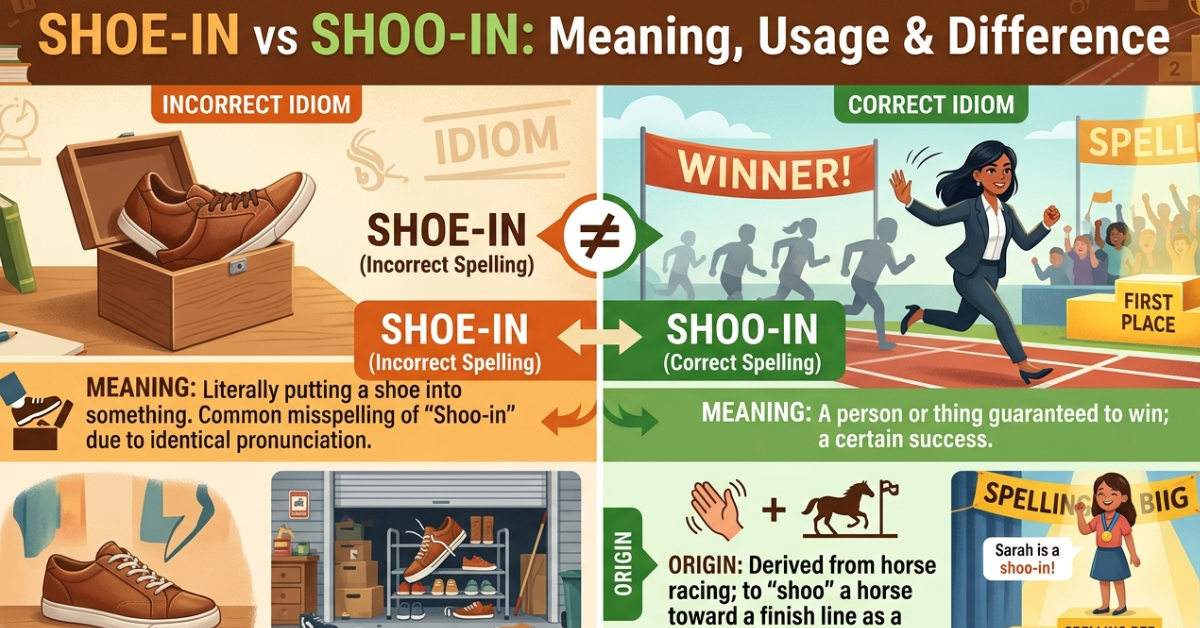
Correct Spelling: Shoo-in (Not Shoe-in)

The correct term is shoo-in, not shoe-in.

Why “Shoo-in” is Correct

The word comes from horse racing slang in the early 20th century. A “shoo-in” referred to a race that was so fixed or certain that the winner only had to be “shooed” (gently guided) across the finish line.

So the idea is:

  • The winner is so certain that they just need a little “shoo” to finish first.

Over time, people misheard it and started spelling it as “shoe-in,” probably because “shoe” is a more familiar word than “shoo.”

Shoe-in vs Shoo-in: Common Mistake Explained

The confusion in Shoe-in vs Shoo-in happens mainly because of pronunciation.

When spoken quickly, “shoo-in” sounds like “shoe-in,” leading many people to assume the spelling includes the word “shoe.”

However:

  •  Shoe-in = incorrect (common misspelling)
  •  Shoo-in = correct (standard English usage)

Even though “shoe-in” is widely used informally, it is still considered non-standard in formal writing.

How to Use Shoo-in in Sentences

To fully understand Shoe-in vs Shoo-in, it helps to see how the correct word is used in real sentences.

Examples:

  • She is a shoo-in for the scholarship because of her excellent grades.
  • The experienced candidate is a shoo-in for the manager position.
  • That team is a shoo-in for the championship this season.

In each case, the meaning is the same: a very high chance of winning or being chosen.

Why People Still Use “Shoe-in”

Even though Shoe-in vs Shoo-in has a correct answer, the incorrect version still appears everywhere. Here’s why:

1. Sound Confusion

The pronunciation naturally sounds like “shoe,” so people assume that spelling is correct.

2. Informal Usage

In casual writing, people often ignore spelling accuracy and stick to what looks familiar.

3. Internet Influence

Social media and blogs sometimes repeat the incorrect form, making it seem acceptable.

Despite this, educated writing still prefers “shoo-in.”

Quick Comparison Table

Feature Shoo-in Shoe-in
Correct spelling Yes No
Formal usage Acceptable Incorrect
Origin Horse racing slang Misinterpretation
Meaning Certain winner Same meaning but wrong form

This makes it clear that in the debate of Shoe-in vs Shoo-in, only one version is grammatically correct.

Memory Trick to Remember the Correct Form

Here’s an easy way to remember it:

  • Think of “shoo” as pushing something forward
  • A winner is so obvious that you just “shoo” them into victory
  • So, it’s shoo-in, not shoe-in

Simple association like this can help you avoid the mistake forever.

Shoe-in vs Shoo-in in Modern English Usage

Today, shoo-in is widely accepted in dictionaries and formal English usage. However, you will still see “shoe-in” in:

  • Casual online posts
  • Social media comments
  • Informal conversations

But in academic writing, exams, and professional communication, the correct form is always preferred.

Understanding Shoe-in vs Shoo-in helps you write more confidently and avoid common grammar errors.

FAQs About Shoe-in vs Shoo-in

1. What is the correct spelling: shoe-in or shoo-in?

The correct spelling is shoo-in. “Shoe-in” is a common mistake.

2. What does shoo-in mean?

It means someone who is almost certain to win or be selected for something.

3. Why do people say shoe-in instead of shoo-in?

Because both words sound similar when spoken, leading to confusion in spelling.

4. Is shoe-in acceptable in formal writing?

No, “shoe-in” is considered incorrect in formal English writing.

5. Can shoo-in be used in professional English?

Yes, “shoo-in” is widely accepted and used in both casual and professional contexts.

Conclusion: Shoe-in vs Shoo-in Made Simple

To wrap it up, the debate around Shoe-in vs Shoo-in is really about one common mistake and one correct term. The proper expression is “shoo-in,” which refers to a person or thing that is almost guaranteed to succeed.

While “shoe-in” is widely used informally, it is technically incorrect and should be avoided in formal writing.

If you remember the simple idea of “shooing” someone into a certain win, you’ll never confuse it again. Keep practicing correct usage, and your English will sound more polished and professional over time.

Leave a Reply

Your email address will not be published. Required fields are marked *

Author

britsx85@gmail.com

Related Posts

Leak vs Leek: Meaning, Difference & Easy Guide
In

Leak vs Leek: Meaning, Difference & Easy Guide

Have you ever seen the words leak and leek and wondered why they look almost identical but mean completely different things? This...

Read out all
Knead vs Need: Meaning, Difference & Usage Guide
In

Knead vs Need: Meaning, Difference & Usage Guide

English can be tricky, especially when two words sound the same but mean completely different things. One such confusing pair is Knead...

Read out all
Jam vs Jamb: Meaning, Difference & Usage Explained
In

Jam vs Jamb: Meaning, Difference & Usage Explained

The confusion around jam vs jamb is more common than you might think, especially among English learners and even native speakers. At...

Read out all
Incite vs Insight: Meaning, Difference & Usage Explained
In

Incite vs Insight: Meaning, Difference & Usage Explained

Have you ever stumbled while writing and wondered whether to use incite vs insight? You’re not alone. These two words sound similar...

Read out all
Idle vs Idol: Meaning, Difference & Usage Guide
In

Idle vs Idol: Meaning, Difference & Usage Guide

The confusion between idle vs idol is more common than you might think, especially in spoken and written English where both words...

Read out all
Hanged vs Hung: Meaning, Grammar & Usage Explained
In

Hanged vs Hung: Meaning, Grammar & Usage Explained

The confusion between hanged vs hung often troubles English learners and even native speakers. Many people mix them up because both forms...

Read out all