
- 0
- 1,761 word
Have you ever paused while typing an email, assignment, or social media caption and wondered: is it recieve or receive? You’re definitely not alone. It’s one of those English spelling traps that catches even careful writers because the letters i and e seem to switch places when you least expect it.
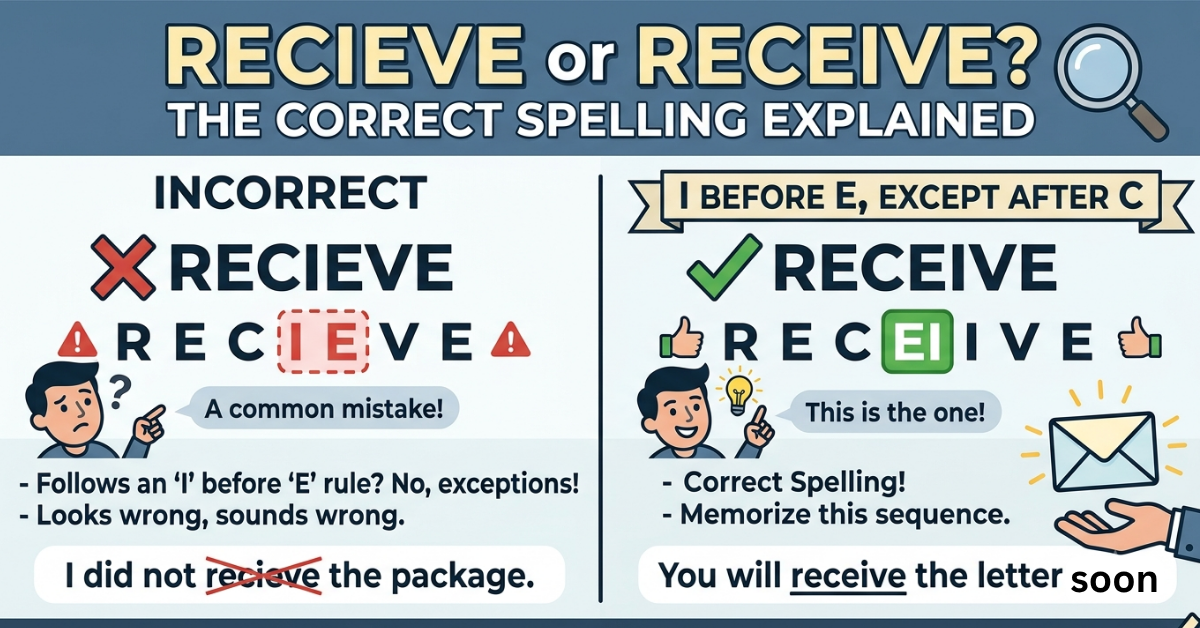
If you’ve searched for recieve or receive, the short answer is simple: receive is the correct spelling, and recieve is incorrect. But there’s more to it than that. In this guide, you’ll learn why receive is spelled the way it is, why so many people write recieve by mistake, how to remember the correct version, and how to use the word confidently in real sentences.
Recieve or Receive: Which Spelling Is Correct?
The correct spelling is receive.
- Correct: receive
- Incorrect: recieve
So if you’re choosing between recieve or receive, always go with receive.
What does “receive” mean?
The word receive means to get, accept, take in, or be given something.
For example:
- I received your message this morning.
- She was happy to receive the package.
- Students receive feedback after the test.
- The hospital received new medical equipment.
In every case, the correct spelling is receive.
Why Do People Confuse “Recieve” and “Receive”?
The confusion usually comes from one of the most repeated spelling rules in English:
“I before E, except after C.”
Since receive comes after the letter c, the correct order becomes e-i, not i-e.
That means:
- r-e-c-e-i-v-e = receive (Correct)
- r-e-c-i-e-v-e = recieve (Incorrect)
Why the mistake happens so often
There are a few reasons this typo is extremely common:
1. The sound doesn’t clearly reveal the spelling
When you say receive, the vowel sound doesn’t make it obvious whether the word should contain ie or ei.
2. Many English words use “ie”
Words like believe, friend, piece, and field make people naturally lean toward ie spellings.
3. Typing quickly leads to letter reversal
Because recieve looks close enough at a glance, it’s an easy typo to miss when writing fast.
4. English spelling isn’t always intuitive
Even fluent English speakers second-guess words like receive, weird, their, seize, and ceiling.
The Correct Rule Behind “Receive”
The word receive follows the classic spelling pattern:
“I before E, except after C”
Here’s how that applies:
- believe → i before e
- piece → i before e
- receive → exception after c, so e before i
- ceiling → also e before i after c
So in the recieve or receive debate, the spelling rule strongly supports receive.
Important note: the rule is helpful, not perfect
English has many exceptions, including:
- weird
- seize
- their
- foreign
- height
So while “I before E, except after C” helps with receive, it won’t solve every spelling word in English. Still, for this specific case, it works perfectly.
How to Remember the Correct Spelling of Receive
If you often mix up recieve or receive, these memory tricks can help.
1. Use the “after C” reminder
Break the word like this:
re + ceive
Notice the c comes right before ei. That matches the rule:
- after c → use ei
2. Think: “C gets E before I”
A simple mental shortcut:
If there’s a C, E comes before I in receive.
3. Practice with related words
Learn the full word family so the spelling becomes automatic:
- receive
- receives
- received
- receiving
- receiver
Once you get used to the base spelling receive, the other forms become easier too.
4. Save a personal example sentence
Make one sentence you’ll remember, such as:
- I receive emails every morning.
Seeing the correct form in a familiar sentence can make it stick faster than memorizing a rule alone.
Receive Meaning and Usage in Everyday English
The word receive is used in both casual and formal English. It can appear in emails, academic writing, business communication, customer service, education, and everyday conversation.
Common meanings of “receive”
1. To get something
- I received your parcel.
- We received the invitation yesterday.
2. To accept something given or sent
- She received the award on stage.
- He received an apology from the company.
3. To experience or be subjected to something
- The proposal received strong criticism.
- The film received positive reviews.
4. To admit or welcome someone
- The school received new students this semester.
- Guests were warmly received at the event.
Examples of “Receive” in Sentences
Seeing the word in context makes it much easier to remember.
Everyday examples
- Did you receive my text?
- I didn’t receive the OTP code.
- She was excited to receive a birthday gift.
- We received your application successfully.
Workplace examples
- Please confirm once you receive the invoice.
- Our team received approval from management.
- Customers will receive a confirmation email after payment.
Academic examples
- Students receive grades at the end of the term.
- She received a scholarship for outstanding performance.
- You will receive feedback on your assignment next week.
Technology and digital communication examples
- I didn’t receive the verification link.
- The server received the request but failed to respond properly.
- Users receive notifications when someone replies.
Common Word Forms of Receive
To use the word correctly, it helps to know its different forms.
| Word Form | Correct Spelling | Example |
| Base verb | receive | I will receive the package tomorrow. |
| Third-person singular | receives | She receives a monthly report. |
| Past tense | received | We received your order. |
| Present participle | receiving | He is receiving treatment. |
| Noun/person form | receiver | The receiver signed for the parcel. |
Notice that all of these forms keep the same spelling pattern from receive.
Recieve vs Receive: A Quick Comparison
If you want the difference at a glance, here’s the simplest comparison.
| Word | Correct? | Meaning / Status |
| receive | Yes | Correct English spelling meaning “to get” or “to accept” |
| recieve | No | Misspelling of receive |
So if you’re writing an email, essay, blog post, message, or caption, receive is always the right choice.
Why Correct Spelling Matters More Than You Think
At first glance, recieve may seem like a tiny mistake. But spelling still shapes how your writing is perceived.
1. It affects credibility
In professional writing, a misspelled word can make the text look rushed or unpolished. If you write recieve in a job email, assignment, or business message, it may leave the wrong impression.
2. It matters for academic work
Teachers, professors, and examiners often notice recurring spelling mistakes. Even if the meaning is clear, repeated errors can weaken the overall quality of your writing.
3. It impacts digital communication
From online forms to client emails, correct spelling improves clarity and professionalism. In some contexts, even searchability and text matching can be affected by spelling errors.
4. It strengthens confidence
When you know exactly whether it’s recieve or receive, you stop hesitating every time you type the word. That alone can make your writing smoother and faster.
Other Commonly Confused Words Like Receive
If receive gives you trouble, you’re not the only one. English has plenty of look-alike spelling traps.
Similar confusing words
- believe vs beleive
- piece vs peice
- friend vs freind
- ceiling vs cieiling
- weird vs wierd
- their vs thier
These mistakes often happen for the same reason: English spelling patterns don’t always match pronunciation in a predictable way.
Practical Tips to Stop Misspelling “Receive”
If you want to stop second-guessing recieve or receive, use these simple strategies.
1. Add it to your personal “tricky words” list
Keep a short note in your phone or notebook with words you commonly misspell, including receive.
2. Proofread slowly for common errors
When editing, scan specifically for words you know you get wrong. It’s easier than trying to catch every possible typo at once.
3. Use the word in repetition
Write it a few times in meaningful sentences:
- I will receive the parcel tomorrow.
- Did you receive my email?
- She received the award proudly.
This helps train visual memory.
4. Learn word families together
Instead of memorizing only receive, learn:
- receive
- received
- receiving
- receiver
That makes the pattern feel familiar no matter how the word appears.
5. Don’t rely only on autocorrect
Autocorrect helps, but it’s not a replacement for knowing the correct spelling. Building the habit yourself is more reliable—especially in exams or handwritten work.
Mini Grammar Note: Is “Receive” a Verb?
Yes, receive is primarily a verb.
It describes an action: getting, accepting, or taking in something.
Examples:
- I receive emails every day.
- They received a warm welcome.
- We are receiving updates from the team.
Related nouns can include:
- reception
- receiver
- receipt (not the same meaning, but related in origin)
Key Takeaways
If you only remember a few things from this guide, make them these:
- Receive is the correct spelling.
- Recieve is always a misspelling.
- The word follows the rule “I before E, except after C.”
- Receive means to get, accept, or be given something.
- Learning the word family—receive, received, receiving, receiver—makes it easier to remember.
- Correct spelling matters in emails, assignments, professional writing, and everyday communication.
Frequently Asked Questions
Is it recieve or receive?
The correct spelling is receive. The version recieve is incorrect and considered a common spelling mistake.
Why is receive spelled with “ei” and not “ie”?
Because it follows the rule “I before E, except after C.” In receive, the letters come after c, so the correct order is ei.
Is “recieve” ever correct in English?
No. Recieve is not a correct spelling in standard English. If you mean “to get” or “to accept,” the correct word is receive.
How do I remember the spelling of receive?
A simple trick is: after C, use EI. Since receive has a c before the vowel pair, the correct spelling is receive.
What is the meaning of receive?
Receive means to get, accept, obtain, or be given something. For example, you can receive a message, a gift, an award, or feedback.
How do you use receive in a sentence?
Here’s a simple example: I didn’t receive your email yesterday. Other forms include received, receiving, and receives.
Conclusion
If you’ve ever been stuck on recieve or receive, the answer is clear: receive is the only correct spelling. The confusion is understandable—English spelling has a way of making simple words feel oddly complicated—but this is one of those cases where a small rule can save you every time: after C, use EI.
Once you connect receive with its meaning, examples, and word family, it becomes much easier to remember. The next time you type an email, write an assignment, or post online, you won’t have to pause and guess. And if you want to sharpen your writing even more, keep learning these commonly confused words one by one—they add up to clearer, more confident English.
Author

linguaezone.com@gmail.com
Related Posts

Kill Two Birds With One Stone Alternative: 50 Better Options
- 0
- 1,569 word
Have you ever paused before saying “kill two birds with one stone” because it sounded too violent or simply didn’t fit the...
Read out all
Happy Sabbath Meaning: A Complete Guide to Its Significance
- 0
- 1,632 word
Have you ever received the message “Happy Sabbath” and wondered what it truly means? Is it simply another way of saying “have...
Read out all
I’m So Proud of You in Other Words: 120+ Heartfelt Alternatives
- 0
- 1,562 word
Have you ever wanted to tell someone you’re proud of them but felt like saying “I’m so proud of you” sounded repetitive?...
Read out all
How Do You Spell Happy Anniversary? Correct Spelling Guide
- 0
- 1,221 word
Have you ever paused before writing an anniversary card and wondered, “How do you spell happy anniversary?” You’re not alone. Whether you’re...
Read out all
Waiting for Your Response Email: Best Examples & Tips
- 0
- 1,483 word
Have you ever sent an important email and found yourself wondering whether you should follow up or simply wait? Whether you’re communicating...
Read out all
Great Asset to the Team: Meaning, Examples & Tips
- 0
- 1,494 word
Have you ever wanted to compliment a coworker but struggled to find words that sound professional and sincere? One of the most...
Read out all