×
Other Ways to Say Welcome Back (Best Phrases Guide)
In

Have you ever found yourself saying “welcome back” on autopilot, even when you want to sound more warm, creative, or professional? Whether it’s a colleague returning after vacation, a friend coming back online, or someone rejoining a group, the right words can make your message feel more genuine.

That’s where other ways to say welcome back become useful. Instead of repeating the same phrase, you can choose from a wide range of natural expressions that better fit the tone and situation. In this guide, you’ll learn meaningful alternatives for formal, casual, emotional, and professional contexts—plus how to use them correctly in real conversations.

Why You Should Use Different Ways to Say Welcome Back

Using varied expressions isn’t just about sounding fancy—it actually improves communication.

Here’s why people search for other ways to say welcome back:

  • To sound more personal and less repetitive
  • To match tone (formal vs casual)
  • To improve workplace communication
  • To make messages feel more thoughtful
  • To adapt to cultural or emotional context

In short, the right phrase can change how your message is received.

Casual Other Ways to Say Welcome Back

When talking to friends, family, or close colleagues, you want to sound warm and relaxed.

Friendly Everyday Alternatives

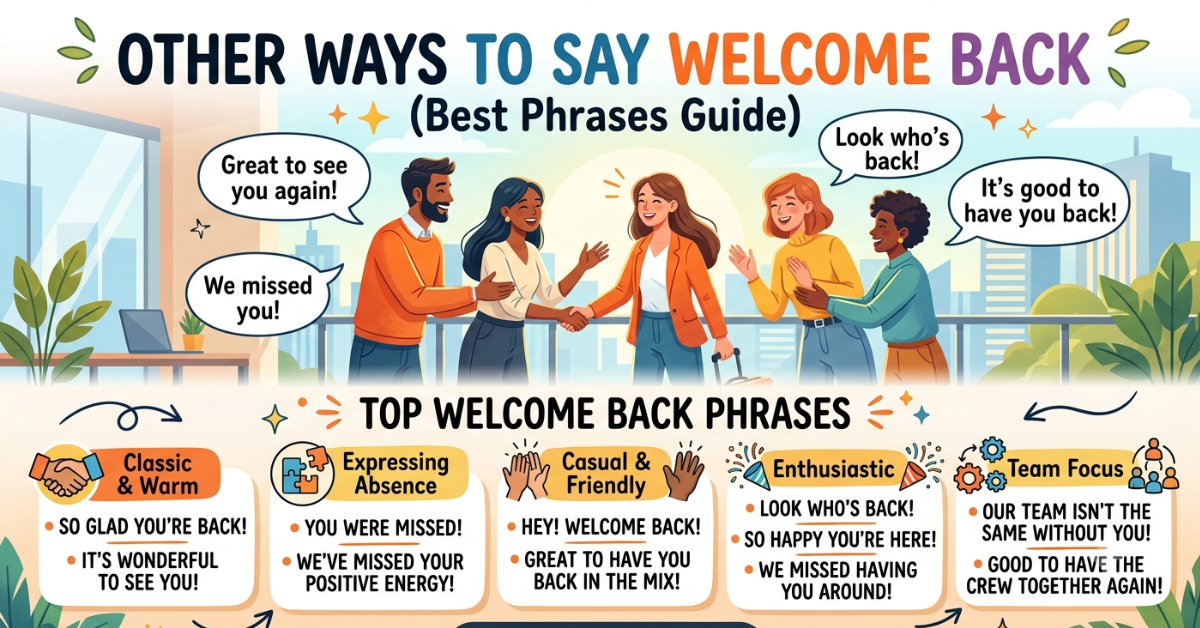
  • Good to have you back
  • Hey, you’re back!
  • Nice to see you again
  • Long time no see!
  • Look who’s back!
  • Glad you’re back
  • Welcome home (for close relationships)
  • Missed you around here

Example Usage

  • “Hey, you’re back! How was your trip?”
  • “Good to have you back, things weren’t the same without you.”

These casual phrases are some of the most common other ways to say welcome back in everyday speech.

Professional and Workplace Alternatives

In office or formal settings, your tone should stay respectful and polished.

Professional Phrases

  • Welcome back to the team
  • We’re glad to have you back
  • It’s great to see you again
  • Welcome back, hope you had a refreshing break
  • Happy to have you back on board
  • Your presence was missed
  • Welcome back, let’s catch up on updates
  • Great to have you rejoin us

Example Usage

  • “Welcome back to the team, we’re excited to continue the project together.”
  • “Hope you had a restful break—great to have you back on board.”

These are ideal other ways to say welcome back in emails, meetings, and corporate communication.

Warm and Emotional Alternatives

Sometimes, someone’s return carries emotional weight—after illness, travel, or long absence.

Heartfelt Expressions

  • We missed you so much
  • It feels complete again with you here
  • So happy you’re back
  • The place wasn’t the same without you
  • It’s really good to have you here again
  • You were truly missed
  • Everything feels better now that you’re back

Example Usage

  • “We missed you so much, it’s great to have you back.”
  • “It feels complete again with you here.”

These emotional other ways to say welcome back help strengthen relationships and show sincerity.

Creative and Fun Ways to Say Welcome Back

If you want something playful or modern, try these:

  • Guess who’s back!
  • The legend returns
  • Back in action
  • Look who decided to show up again
  • And they’re back!
  • Reunited at last
  • Back like you never left

These phrases are popular in informal chats, social media captions, and friendly banter.

Email-Friendly Alternatives for “Welcome Back”

If you’re writing emails, tone matters even more. Here are polished options:

  • I hope you had a great time away
  • Welcome back, I look forward to working with you again
  • I trust your break was refreshing
  • It’s a pleasure to have you back
  • Looking forward to catching up
  • Welcome back—here are the latest updates

These variations of other ways to say welcome back help maintain professionalism while still sounding warm.

How to Choose the Right Phrase

Not every phrase works everywhere. Here’s a quick guide:

  • Friends & family: Casual or funny phrases
  • Workplace: Professional, respectful tone
  • Emotional situations: Warm, supportive language
  • Social media: Creative and playful expressions

Think about:

  • Your relationship with the person
  • The reason for their absence
  • The emotional tone you want to set

Key Takeaways

  • “Welcome back” has many natural alternatives depending on context
  • Tone matters more than complexity
  • Professional settings require polished phrases
  • Casual situations allow humor and creativity
  • Emotional contexts need warmth and sincerity

Practical Tips for Using These Phrases

  • Don’t overthink it—keep it natural
  • Match the energy of the conversation
  • Avoid overly formal language in casual chats
  • Use personalization (name, context) for stronger impact
  • Rotate phrases to avoid repetition

FAQs: Other Ways to Say Welcome Back

1. What are some simple other ways to say welcome back?

Some simple alternatives include “good to have you back,” “nice to see you again,” and “glad you’re back.” These are easy to use in daily conversation.

2. What is a professional way to say welcome back?

Professional options include “welcome back to the team,” “happy to have you back on board,” and “we’re glad to have you back.”

3. Can I use funny phrases instead of welcome back?

Yes, but only in casual settings. Phrases like “look who’s back!” or “the legend returns” work well with friends or social media.

4. What is a warm alternative to welcome back?

Warm alternatives include “we missed you so much,” “it feels complete again with you here,” and “so happy you’re back.”

5. Are there email-friendly alternatives to welcome back?

Yes, phrases like “I trust your break was refreshing” or “welcome back, looking forward to working with you again” are ideal for emails.

Conclusion

Finding other ways to say welcome back helps you communicate more naturally, warmly, and effectively. Whether you’re speaking to colleagues, friends, or family, choosing the right phrase can make your message feel more thoughtful and engaging.

Instead of relying on the same expression every time, experiment with tone, context, and emotion. The more you adapt your language, the more genuine your communication becomes.

If you want to improve your everyday expressions further, start by mixing a few of these alternatives into your conversations—you’ll notice the difference immediately.

Leave a Reply

Your email address will not be published. Required fields are marked *

Author

britsx85@gmail.com

Related Posts

To Fast or Too Fast? Learn the Correct Usage Easily
In

To Fast or Too Fast? Learn the Correct Usage Easily

Have you ever paused while typing and wondered, “Is it to fast or too fast?” You’re not alone. It’s one of the...

Read out all
Inter vs Intra: Meaning, Differences & Easy Examples
In

Inter vs Intra: Meaning, Differences & Easy Examples

Have you ever wondered why words like international, interstate, intramural, and intracellular all sound similar but mean completely different things? The secret...

Read out all
Learn the difference between vicious vs viscous with simple definitions, examples, pronunciation, and easy memory tricks to use each word correctly.
In

Vicious vs Viscous: What’s the Difference?

Have you ever read a sentence and wondered whether the correct word was vicious or viscous? You’re not alone. These two words...

Read out all
What Is FAFO? Meaning, Slang, Parenting, and Texting
In

What Is FAFO? Meaning, Slang, Parenting, and Texting

Ever seen FAFO in a comment, text, or parenting discussion and wondered what it means? The short answer is that what is...

Read out all
Layed vs Laid: Which Spelling Is Correct?
In

Layed vs Laid: Which Spelling Is Correct?

Have you ever paused while writing and wondered whether it should be layed or laid? You are not alone. This is one...

Read out all
Afterward or Afterwards: Which One Should You Use?
In

Afterward or Afterwards: Which One Should You Use?

Have you ever paused while writing because you couldn’t decide whether to use afterward or afterwards? You’re not alone. Many English learners...

Read out all