Muscle vs Mussel: Key Differences Explained Simply
- 0
- 688 words
If you’ve ever seen the words muscle vs mussel, you’re not alone in wondering why they sound identical but mean completely different things. One refers to the powerful tissue in your body that helps you move, while the other is a type of edible shellfish found in oceans and rivers.
In this guide, we’ll break down muscle vs mussel in the simplest way possible so you never mix them up again. Whether you’re learning English, studying biology, or just curious, this article has you covered.
What is a Muscle? (Body Strength Explained)
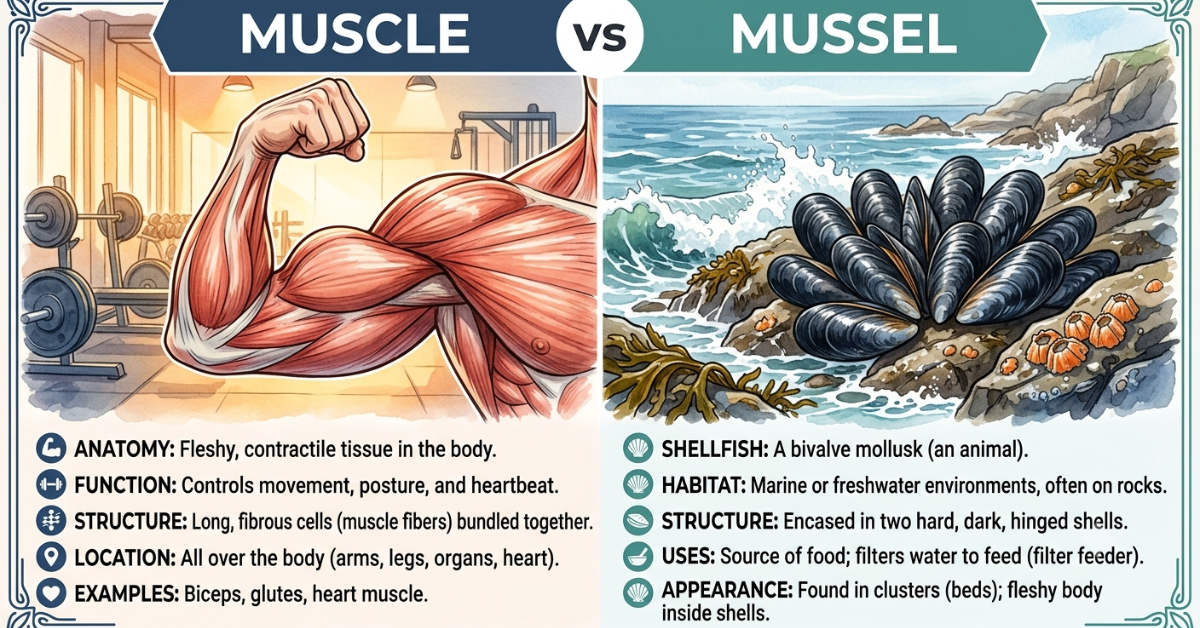
A muscle is a soft tissue in the human (and animal) body that helps with movement, posture, and strength. Every time you walk, smile, or lift something, your muscles are working behind the scenes.
Types of Muscles in the Human Body
There are three main types:
- Skeletal muscles – attached to bones and help you move
- Smooth muscles – found in organs like the stomach
- Cardiac muscle – makes up the heart
Why Muscles Are Important
Muscles are essential for:
- Movement and mobility
- Breathing
- Blood circulation
- Maintaining posture
Without muscles, the human body simply cannot function.
What is a Mussel? (Seafood Explained)
A mussel is a small marine or freshwater shellfish with a hard outer shell. It belongs to the family of bivalve mollusks and is commonly eaten in many parts of the world.
Where Mussels Are Found
Mussels typically live:
- Along ocean shores
- In rivers and lakes
- Attached to rocks or underwater surfaces
Why People Eat Mussels
Mussels are popular in cuisine because they are:
- Rich in protein
- Low in fat
- Packed with nutrients like iron and zinc
They are often cooked in soups, pasta, or steamed dishes.
Muscle vs Mussel: The Key Differences
Now let’s clearly break down muscle vs mussel so you can remember it easily.
| Feature | Muscle | Mussel |
| Meaning | Body tissue | Sea shellfish |
| Category | Biology (human anatomy) | Marine life (animal) |
| Function | Movement & strength | Filter feeding organism |
| Location | Inside the body | Oceans, rivers, lakes |
| Usage | Health, fitness, anatomy | Food, seafood cuisine |
Even though muscle vs mussel sounds identical, their meanings are completely unrelated.
Easy Trick to Remember Muscle vs Mussel
Here’s a simple memory hack:
- Muscle = Movement (both start with “M” and relate to motion)
- Mussel = Meal (you eat mussels as seafood)
This trick makes it almost impossible to confuse again.
Common Mistakes People Make
Many people confuse the two words because of pronunciation. Here are common errors:
- Writing “I ate grilled muscles” instead of mussels
- Thinking mussels are related to gym workouts
- Mishearing conversations due to similar sounds
Understanding helps avoid these simple but funny mistakes.
Why the Confusion Happens
The English language has many homophones—words that sound the same but have different meanings. It is a perfect example.
Other reasons include:
- Similar pronunciation
- Spelling differences that are easy to miss
- Lack of context in spoken conversation
Fun Fact About Muscle vs Mussel
Did you know?
- A single mussel can filter up to 20 liters of water per day
- Human muscles make up nearly 40% of body weight
Both are powerful in their own way—just in completely different worlds!
FAQs About Muscle vs Mussel
1. What is the main difference between muscle vs mussel?
Muscles are body tissues used for movement, while mussels are edible shellfish found in water.
2. Are muscle and mussel pronounced the same?
Yes, they are homophones and sound almost identical in English.
3. Is a mussel related to body muscles?
No, mussels are animals, not body tissues. They are completely unrelated to muscles.
4. Why do people confuse muscle vs mussel?
Because they sound the same but have different spellings and meanings.
5. Can mussels be eaten raw?
Some cuisines do eat them raw, but they are usually cooked to ensure safety.
Conclusion
Understanding muscle vs mussel is a simple but useful way to improve both your vocabulary and general knowledge. While muscles help your body move and stay strong, mussels are nutritious seafood enjoyed around the world.
Next time you see or hear muscle vs mussel, you’ll instantly know the difference without hesitation. Keep learning, keep exploring, and build your language confidence one word at a time.
Author
britsx85@gmail.com
Related Posts
Peace vs Piece: Meaning, Difference & Easy Tips to Remember
- 0
- 698 words
English can be tricky, especially when two words sound exactly the same but mean totally different things. One of the most confusing...
Read out all
Patience vs Patients: Meaning & Differences Explained
- 0
- 639 words
The confusion between patience vs patients is more common than you might think, especially for English learners and even native speakers. These...
Read out all
Pail vs Pale: Meaning, Differences & Easy Guide
- 0
- 785 words
The confusion between pail vs pale is more common than you might think. These two words look almost identical, sound similar in...
Read out all
Overdo vs Overdue: Meaning, Difference & Examples
- 0
- 603 words
Confused between overdo vs overdue? You’re not alone—these two words look similar, but they have completely different meanings and uses. Many English...
Read out all
Oar vs Ore: Meaning, Differences & Easy Guide Explained
- 0
- 661 words
The confusion between oar vs ore is more common than you might think. Even native English speakers sometimes mix them up because...
Read out all
Naval vs Navel: Meaning, Difference & Easy Guide
- 0
- 859 words
English words can sometimes be confusing, especially when they look almost identical but carry completely different meanings. One such commonly mixed-up pair...
Read out all