
- 0
- 1,218 word
Have you ever heard someone say it meant a lot to me and felt like the words carried more emotion than they seemed to at first glance? That phrase is short, simple, and deeply personal. People use it when something touched them in a meaningful way, whether it was a kind gesture, a thoughtful message, support during a hard time, or even a small act that left a big impression.
In this article, we will break down the meaning of it meant a lot to me, how to use it naturally in conversation, when it sounds best, and what you can say instead if you want to express the same feeling in a different way. We will also look at examples, common mistakes, and frequently asked questions so the phrase becomes easy to understand and use confidently.
What Does “It Meant a Lot to Me” Mean?
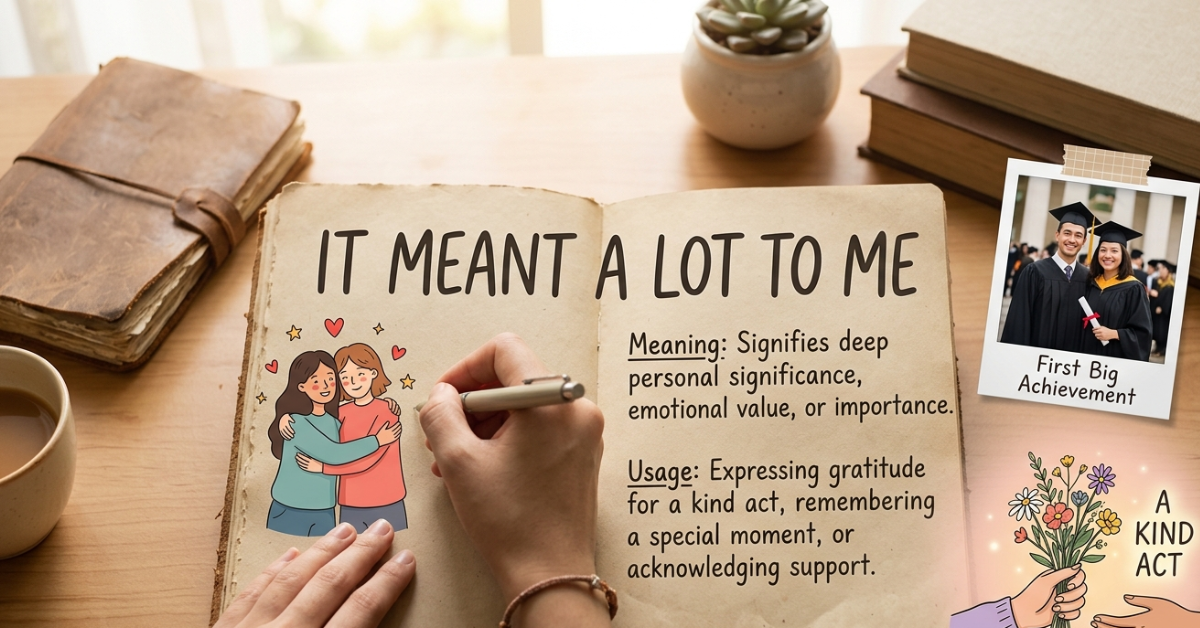
The phrase means that something had strong emotional value or importance in your life. It is often used to show gratitude, appreciation, or emotional impact.
It can refer to:
- a kind word
- a gift or gesture
- support from someone
- a special memory
- recognition or encouragement
- an event that felt personal and meaningful
In simple words, when someone says that, they are saying that the moment, action, or words were not ordinary. They mattered.
Why This Phrase Feels So Personal
One reason this expression sounds powerful is that it is honest without being dramatic. It does not over-explain feelings, but it still gives the other person a clear sense that their action was appreciated.
That is why people often use it after:
- receiving help during a difficult time
- getting a heartfelt compliment
- being remembered on a special day
- hearing encouragement when they needed it most
- experiencing a thoughtful surprise
The phrase works because it sounds sincere. It is warm, respectful, and emotionally clear.
How to Use “It Meant a Lot to Me” in a Sentence
You can use this phrase in everyday conversation, text messages, thank-you notes, or formal messages.
Examples
- Your support during that time meant a lot to me.
- The message you sent meant a lot to me.
- Hearing that from you meant a lot to me.
- Your kindness meant a lot to me.
- That moment meant a lot to me and I will always remember it.
Notice how the phrase usually fits naturally after a noun or idea that had emotional value.
When to Say It
This phrase is especially useful when you want to sound genuine and appreciative. It is common in both casual and emotional situations.
Use it when:
- Someone supports you emotionally
- A friend or family member does something thoughtful
- You want to thank someone sincerely
- A memory or moment felt meaningful
- You want to show that you noticed their effort
A simple phrase can often express more feeling than a long explanation.
Different Ways to Say the Same Thing
If you do not want to repeat the exact phrase every time, there are many natural alternatives.
Similar expressions include:
- I really appreciate it.
- That was very meaningful to me.
- I’m truly grateful.
- It really touched me.
- That will stay with me.
- I won’t forget it.
- It was very special to me.
- I deeply appreciate that.
These alternatives are useful when you want your writing or speech to feel varied but still emotional.
What Makes This Phrase So Effective?
The strength comes from its balance. It is not too formal, but it is not too casual either. It feels human.
Here is why people respond well to it:
- it sounds honest
- it shows gratitude
- it creates emotional connection
- it is easy to understand
- it works in many situations
Sometimes the simplest words are the most powerful ones.
Common Mistakes to Avoid
Although the phrase is easy to use, a few small mistakes can make it sound unnatural.
1. Using it too often in the same message
Repeating the phrase several times can weaken its effect. Use it once clearly, then follow with a more specific detail.
2. Making it too vague
Instead of saying only, “It meant a lot to me,” explain what exactly touched you.
For example:
- Your encouragement during my exam stress meant a lot to me.
3. Using it in the wrong tense
The correct form is meant, not mean or means when speaking about the past.
Correct:
- It meant a lot to me.
Incorrect:
- It mean a lot to me.
Best Situations for This Phrase
This phrase works beautifully in both spoken and written English. Here are some of the most common situations where it fits well.
- thank-you messages
- birthday replies
- farewell messages
- appreciation notes
- emotional texts
- social media captions
- heartfelt conversations
It is especially useful when you want to sound warm, thankful, and personal without sounding too formal.
Example Messages Using “It Meant a Lot to Me”
Here are some natural examples you can use or adapt.
For a friend
Your support during that difficult week meant a lot to me. I honestly don’t know what I would have done without you.
For family
Thank you for always believing in me. It meant a lot to me more than I can say.
For a teacher or mentor
Your advice and encouragement meant a lot to me, and I will always value it.
For a kind gesture
That small act of kindness meant a lot to me. You probably do not realize how much it helped.
These examples show that the phrase works best when paired with a little detail.
How It Feels in Real Life
People do not usually say it just to be polite. They say it when something genuinely affected them. That emotional weight is what gives the phrase its power.
It can express:
- gratitude
- comfort
- respect
- emotional closeness
- appreciation for effort
That is why it often creates a stronger connection than a simple “thanks.”
Conclusion
It’s a simple phrase, but it carries real emotional depth. It is one of those expressions that sounds natural, sincere, and meaningful in almost any situation. Whether you are thanking a friend, appreciating a loved one, or responding to a kind gesture, this phrase helps you say something heartfelt without sounding forced.
The best way to use is to keep it honest and specific. Add a little context, speak from the heart, and the message will feel even more powerful. From thank-you notes to emotional conversations, this phrase remains one of the easiest and most genuine ways to show appreciation.
FAQs
What does “it meant a lot to me” mean?
It means something was emotionally important, meaningful, or deeply appreciated.
Is “it meant a lot to me” formal or informal?
It can be used in both. It is simple enough for casual conversation and sincere enough for thoughtful writing.
Can I say “it meant alot to me”?
No, the correct spelling is a lot, written as two words.
What can I say instead of “it meant a lot to me”?
You can say “I really appreciate it,” “that was very meaningful to me,” or “I’m truly grateful.”
Is this phrase okay for texts and social media?
Yes, it works very well in messages, captions, comments, and thank-you notes.
How do I make it sound more natural?
Add a specific detail. For example: “Your support during that time meant a lot to me.”
Author

linguaezone.com@gmail.com
Related Posts
Kill Two Birds With One Stone Alternative: 50 Better Options
- 0
- 1,569 word
Have you ever paused before saying “kill two birds with one stone” because it sounded too violent or simply didn’t fit the...
Read out all
Happy Sabbath Meaning: A Complete Guide to Its Significance
- 0
- 1,632 word
Have you ever received the message “Happy Sabbath” and wondered what it truly means? Is it simply another way of saying “have...
Read out all
I’m So Proud of You in Other Words: 120+ Heartfelt Alternatives
- 0
- 1,562 word
Have you ever wanted to tell someone you’re proud of them but felt like saying “I’m so proud of you” sounded repetitive?...
Read out all
How Do You Spell Happy Anniversary? Correct Spelling Guide
- 0
- 1,221 word
Have you ever paused before writing an anniversary card and wondered, “How do you spell happy anniversary?” You’re not alone. Whether you’re...
Read out all
Waiting for Your Response Email: Best Examples & Tips
- 0
- 1,483 word
Have you ever sent an important email and found yourself wondering whether you should follow up or simply wait? Whether you’re communicating...
Read out all
Great Asset to the Team: Meaning, Examples & Tips
- 0
- 1,494 word
Have you ever wanted to compliment a coworker but struggled to find words that sound professional and sincere? One of the most...
Read out all