
- 0
- 1,174 word
Have you ever paused while writing because you weren’t sure whether to type hopeing or hoping? You’re not alone. It’s one of those spelling questions that catches even confident English writers off guard.
The good news is that the answer is simple once you understand the rule. In this guide, you’ll learn why hoping is the correct spelling, why hopeing is incorrect, the grammar rule behind it, common mistakes to avoid, and practical examples that will help you remember it every time.
The Short Answer: Hopeing or Hoping?
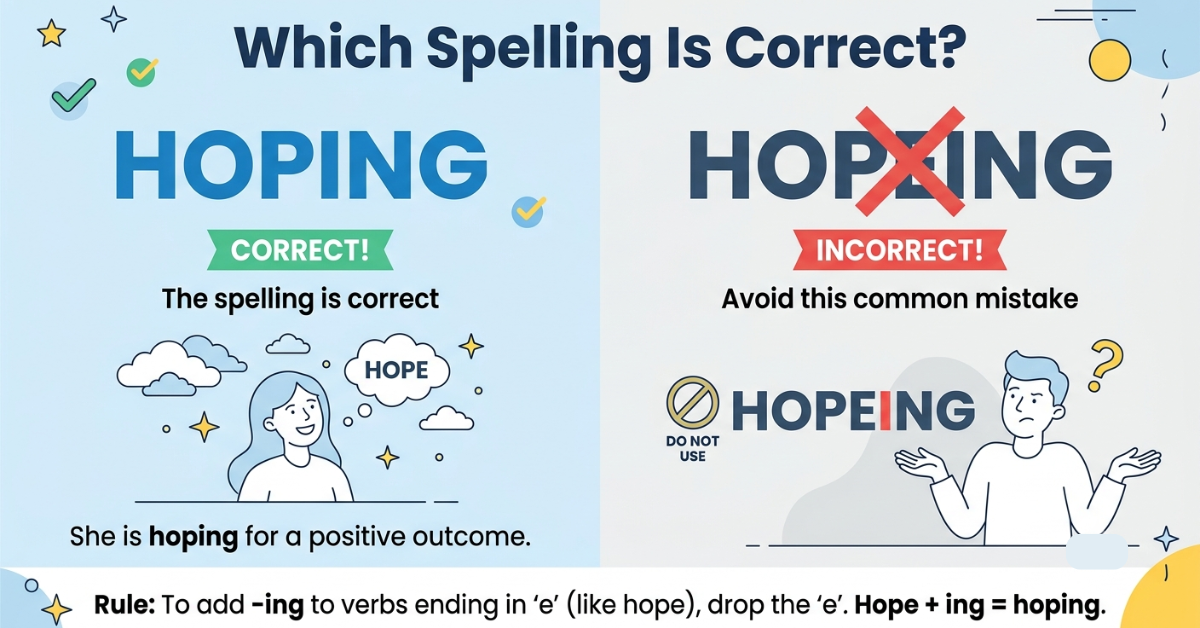
The correct spelling is hoping.
Hopeing – Incorrect
Hoping – Correct
The word hoping is the present participle (or -ing form) of the verb hope.
Examples:
- I am hoping to hear from you soon.
- She is hoping for good news.
- We’re hoping the weather stays nice this weekend.
The spelling hopeing is not considered correct in standard English.
Why Is “Hoping” Correct?
The answer comes from a common English spelling rule.
When a verb ends with a silent e, you usually drop the final e before adding -ing.
Rule
Verb + ing
If the verb ends in silent e:
Remove the e → Add -ing
Hope → Hoping
Not:
Hope → Hopeing
More Examples of the Same Rule
Here are other verbs that follow the exact same pattern.
| Base Verb | Correct -ing Form | Incorrect Form |
| hope | hoping | hopeing |
| make | making | makeing |
| write | writing | writeing |
| come | coming | comeing |
| smile | smiling | smileing |
| move | moving | moveing |
| dance | dancing | danceing |
Once you recognize this rule, you’ll avoid many common spelling mistakes.
What Does “Hoping” Mean?
Hoping means:
- wishing something good happens
- expecting something positive
- wanting a desired outcome
It expresses optimism, desire, or expectation.
Examples
- I’m hoping everything goes well.
- They’re hoping to buy a new home.
- We’re hoping for better results next year.
- She kept hoping for a second chance.
Why Do People Write “Hopeing”?
The mistake happens because people simply add -ing without remembering the silent e rule.
Since many words are formed by attaching -ing, it’s natural to think:
Hope + ing = Hopeing
However, English spelling removes the silent e first.
That’s why:
- hope → hoping (Correct)
- hopeing (Incorrect)
The Grammar Rule Explained
Drop the Silent E Before Adding -Ing
Most English verbs ending with a silent e lose that letter before adding -ing.
Examples include:
- love → loving
- save → saving
- believe → believing
- arrive → arriving
- live → living
- smile → smiling
The same pattern applies to hope.
Exceptions to the Rule
English has exceptions, but hope isn’t one of them.
Some verbs keep the e before -ing to preserve pronunciation.
Examples include:
- dye → dyeing
- singe → singeing
These exceptions prevent confusion with other words.
For hope, there is no exception.
Examples of Hoping in Everyday Sentences
Here are examples from daily conversations.
Personal
- I’m hoping to visit my grandparents next month.
- She’s hoping everything works out.
School
- The students are hoping to pass their exams.
- We’re hoping the project receives a good grade.
Workplace
- The company is hoping to expand internationally.
- Our team is hoping for positive client feedback.
Travel
- We’re hoping the flight isn’t delayed.
- They’re hoping to see the northern lights.
Common Mistakes to Avoid
Many learners confuse similar spellings.
Incorrect
- I am hopeing you can help.
- She is hopeing for rain.
- We are hopeing everything goes well.
Correct
- I am hoping you can help.
- She is hoping for rain.
- We are hoping everything goes well.
A quick proofread can catch this error before sending an email, assignment, or social media post.
Easy Trick to Remember
A simple memory tip is:
Silent E disappears before -ing.
Think of it this way:
- Hope drops the e
- Then welcomes -ing
So you always get:
hoping
Never:
hopeing
Similar Words That Follow the Same Pattern
Learning similar words makes the rule easier to remember.
- Create → Creating
- Inspire → Inspiring
- Appreciate → Appreciating
- Improve → Improving
- Celebrate → Celebrating
- Share → Sharing
- Compare → Comparing
Notice that each word removes the silent e before adding -ing.
Hopeing or Hoping in Emails and Professional Writing
Correct spelling matters in professional communication.
Instead of writing:
I am hopeing to hear from you.
Write:
I am hoping to hear from you.
Correct spelling makes your writing appear polished, credible, and professional.
British vs American English
Unlike words such as colour/color or organise/organize, there is no difference between British and American English here.
Both varieties use:
hoping
Neither accepts:
hopeing
Is “Hopeing” Ever Correct?
No.
Modern dictionaries, grammar guides, educational institutions, and professional style manuals recognize only hoping.
The spelling hopeing is simply a common typo or spelling mistake.
Practical Tips to Avoid This Mistake
If you often confuse hopeing or hoping, try these habits:
- Remember the “drop the silent e” rule.
- Read your writing aloud before sending it.
- Enable spell check while writing.
- Practice spelling commonly used verbs.
- Review emails and assignments for simple spelling errors.
- Learn similar verb patterns to reinforce the rule.
These small habits improve both spelling accuracy and writing confidence.
Quick Comparison: Hopeing or Hoping
| Feature | Hoping | Hopeing |
| Correct spelling | Yes | No |
| Accepted in English | Yes | No |
| Used in dictionaries | Yes | No |
| Professional writing | Recommended | Avoid |
| Grammar rule | Drop silent “e” | Breaks spelling rule |
Key Takeaways
- Hoping is the correct spelling.
- Hopeing is incorrect.
- Drop the silent e before adding -ing.
- The same rule applies to many English verbs.
- Both British and American English use hoping.
- Remembering one simple grammar rule helps eliminate this mistake permanently.
Frequently Asked Questions
Is it hopeing or hoping?
The correct spelling is hoping. English spelling rules require dropping the silent e before adding -ing, making hopeing incorrect.
Why is hopeing wrong?
Hopeing breaks the standard spelling rule for verbs ending in a silent e. The correct form removes the e, resulting in hoping.
Is hoping grammatically correct?
Yes. Hoping is the present participle and gerund form of the verb hope, making it grammatically correct in sentences like, “I am hoping for good news.”
Do British and American English spell it differently?
No. Both British and American English use hoping. There is no regional variation for this word.
How can I remember the correct spelling?
Remember this simple rule: Drop the silent e before adding -ing. Once you learn this pattern, words like making, coming, writing, and hoping become much easier to spell correctly.
What other words follow the same rule?
Many verbs follow this pattern, including:
- make → making
- write → writing
- smile → smiling
- dance → dancing
- arrive → arriving
- move → moving
Conclusion
If you’ve ever wondered whether to write hopeing or hoping, the answer is straightforward: hoping is always the correct spelling. The reason lies in a simple English grammar rule—verbs ending in a silent e usually drop that e before adding -ing.
By understanding this rule and practicing it with similar words, you’ll avoid one of the most common spelling mistakes in English. The next time you write an email, assignment, or message, you’ll know exactly which spelling to use. Keep applying these grammar tips, and your writing will become clearer, more accurate, and more professional over time.
Author

linguaezone.com@gmail.com
Related Posts

Kill Two Birds With One Stone Alternative: 50 Better Options
- 0
- 1,569 word
Have you ever paused before saying “kill two birds with one stone” because it sounded too violent or simply didn’t fit the...
Read out all
Happy Sabbath Meaning: A Complete Guide to Its Significance
- 0
- 1,632 word
Have you ever received the message “Happy Sabbath” and wondered what it truly means? Is it simply another way of saying “have...
Read out all
I’m So Proud of You in Other Words: 120+ Heartfelt Alternatives
- 0
- 1,562 word
Have you ever wanted to tell someone you’re proud of them but felt like saying “I’m so proud of you” sounded repetitive?...
Read out all
How Do You Spell Happy Anniversary? Correct Spelling Guide
- 0
- 1,221 word
Have you ever paused before writing an anniversary card and wondered, “How do you spell happy anniversary?” You’re not alone. Whether you’re...
Read out all
Waiting for Your Response Email: Best Examples & Tips
- 0
- 1,483 word
Have you ever sent an important email and found yourself wondering whether you should follow up or simply wait? Whether you’re communicating...
Read out all
Great Asset to the Team: Meaning, Examples & Tips
- 0
- 1,494 word
Have you ever wanted to compliment a coworker but struggled to find words that sound professional and sincere? One of the most...
Read out all