
Filed vs Filled: Meaning, Differences & Correct Usage
- 0
- 1,307 word
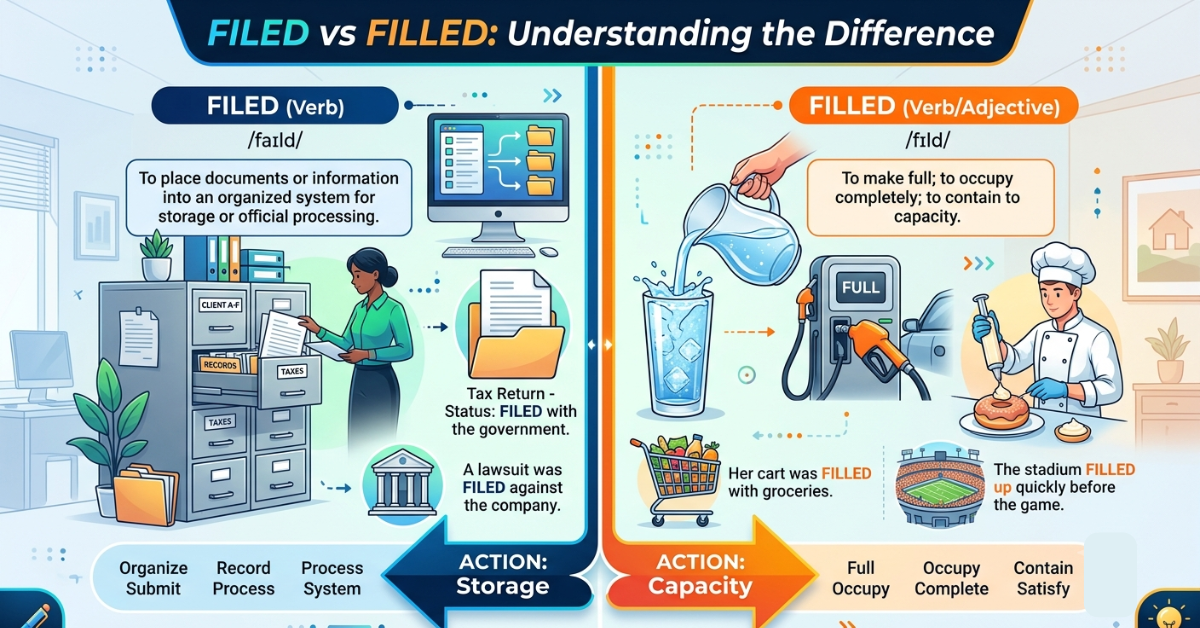
Have you ever written “I filled my taxes” or “The glass was filed with water” and wondered if it sounded right? You’re not alone. These two words look similar, but they have completely different meanings, making them one of the most common English writing mistakes.
Understanding filed vs filled is essential for writing emails, academic papers, business documents, and everyday conversations accurately. In this guide, you’ll learn the difference between these commonly confused words, when to use each one, practical examples, memory tricks, and common mistakes to avoid.
What Does “Filed” Mean?
The word filed is the past tense of file.
It generally means to submit, organize, store, or officially record something. Depending on the context, it may also refer to smoothing an object using a metal file.
Common meanings of filed
- Submitted an official document
- Organized documents into a system
- Recorded information
- Presented a legal claim
- Smoothed an object’s surface
Examples
- She filed her tax return before the deadline.
- The lawyer filed the lawsuit yesterday.
- He filed the documents alphabetically.
- The employee filed the report with Human Resources.
- The carpenter filed the rough edges of the metal.
In nearly every professional or legal setting, filed relates to documentation or official submission.
What Does “Filled” Mean?
The word filled is the past tense of fill.
It means to make something full, occupy space, satisfy a requirement, or complete something.
Common meanings of filled
- Put something into a container
- Occupied available space
- Completed a form or application
- Satisfied a need or desire
- Stuffed with ingredients
Examples
- She filled the bottle with water.
- The stadium quickly filled with fans.
- Please fill the application form carefully.
- He filled the basket with fresh fruit.
- The bakery sells cream-filled pastries.
Unlike “filed,” filled usually describes adding something until it becomes complete or full.
Filed vs Filled: The Main Difference
Although the words differ by only one letter, their meanings are entirely different.
| Filed | Filled |
| Means submitted or organized | Means made full or completed |
| Related to documents and records | Related to containers, spaces, forms, or needs |
| Common in legal and office settings | Common in everyday conversation |
| Action: submit or organize | Action: add until full |
Quick comparison
Filed
- Filed taxes
- Filed a complaint
- Filed paperwork
- Filed legal documents
- Filed records
Filled
- Filled a glass
- Filled a room
- Filled a form
- Filled a prescription
- Filled with excitement
When Should You Use “Filed”?
Use filed whenever you’re talking about officially submitting, recording, or organizing documents.
Common situations
Legal documents
- Filed a lawsuit
- Filed court papers
- Filed evidence
Government paperwork
- Filed taxes
- Filed immigration documents
- Filed permits
Office work
- Filed invoices
- Filed employee records
- Filed reports
Organization
- Filed papers alphabetically
- Filed receipts
When Should You Use “Filled”?
Use filled when something becomes full or complete.
Everyday situations
- Filled a cup
- Filled the tank
- Filled the basket
Forms and applications
Although people often confuse these words, you fill out a form before you file it.
Example:
- She filled out the application.
- Then she filed it with the university.
This simple sequence helps remember the difference.
Filed vs Filled in Common English Expressions
Understanding common phrases makes choosing the correct word much easier.
Filed
- Filed a complaint
- Filed taxes
- Filed paperwork
- Filed bankruptcy
- Filed a motion
- Filed records
Filled
- Filled with joy
- Filled with water
- Filled a vacancy
- Filled an order
- Filled a prescription
- Filled the room with laughter
Side-by-Side Examples
Here are examples showing both words used correctly.
Example 1
Incorrect: She filled her taxes yesterday.
Correct: She filed her taxes yesterday.
Example 2
Incorrect: The bottle was filed with juice.
Correct: The bottle was filled with juice.
Example 3
Incorrect: He filed the swimming pool.
Correct: He filled the swimming pool.
Example 4
Incorrect: They filled a lawsuit against the company.
Correct: They filed a lawsuit against the company.
Example 5
Incorrect: The office filled all the documents.
Correct: The office filed all the documents.
Why People Confuse Filed and Filled
Several factors make these words easy to mix up.
Similar spelling
Only one extra letter separates them.
Similar pronunciation
In fast speech, both words can sound alike.
Both are action verbs
Because both describe actions, writers sometimes choose the wrong one without noticing.
Autocorrect mistakes
Typing quickly often causes spelling suggestions that change one into the other.
Memory Trick to Remember the Difference
A simple trick can help forever.
Think of the letter A in “filed”
Filed = Archive
If something goes into an archive or official record, use filed.
Think of the letter I in “filled”
Filled = Inside
If something goes inside until it’s full, use filled.
Another easy reminder:
You fill a form. You file the completed form.
Filed vs Filled in Professional Writing
Using the correct word is especially important in business communication.
Correct
- The accountant filed the annual tax return.
- Please fill the attendance sheet.
- The HR department filed employee records.
- The technician filled the fuel tank.
Incorrect
- The accountant filled the tax return.
- Please file your water bottle.
Professional writing becomes more credible when these words are used accurately.
Filed vs Filled in Legal and Business Contexts
Many official documents involve both actions.
For example:
- Fill out an application.
- Review it carefully.
- File it with the appropriate office.
This sequence appears in:
- Job applications
- Court documents
- Tax returns
- Government forms
- Insurance claims
- University admissions
Understanding the order prevents common writing mistakes.
Common Mistakes to Avoid
Avoid these frequent errors.
Mistake 1
Using filled instead of filed for taxes.
Incorrect:
I filled my taxes.
Correct:
I filed my taxes.
Mistake 2
Using filed for containers.
Incorrect:
She filed the cup with coffee.
Correct:
She filled the cup with coffee.
Mistake 3
Confusing forms with submissions.
Correct sequence:
- Fill out the form.
- File the completed form.
Practical Tips for Remembering the Difference
- Associate filed with paperwork.
- Associate filled with making something full.
- Read the sentence aloud.
- Ask yourself: Am I submitting something or making it full?
- Practice using both words in everyday writing.
Filed vs Filled at a Glance
| Question | Correct Word |
| Submitted taxes? | Filed |
| Made a glass full? | Filled |
| Sent legal papers? | Filed |
| Completed a form? | Filled |
| Organized records? | Filed |
| Filled a bottle? | Filled |
Key Takeaways
- Filed means submitted, recorded, or organized.
- Filled means made full or completed.
- You fill out forms before you file them.
- Taxes, lawsuits, and reports are usually filed.
- Bottles, rooms, and containers are filled.
- Remember: Archive = Filed, Inside = Filled.
Frequently Asked Questions
Is it filed taxes or filled taxes?
The correct phrase is filed taxes. Taxes are officially submitted to a tax authority, so “filed” is the appropriate word.
Do you fill or file a form?
You usually fill out a form first. Once completed, you may file it with an organization or government office.
What is the difference between filed and filled?
The difference in filed vs filled is simple: filed refers to submitting or organizing documents, while filled means making something full or completing it.
Why do people confuse filed and filled?
They have similar spelling and pronunciation, but their meanings are completely different. Careful reading helps avoid this mistake.
Is “filled a complaint” correct?
No. The correct expression is filed a complaint because complaints are officially submitted to an authority.
Can both words appear in the same sentence?
Yes.
Example:
She filled out the application and filed it online before the deadline.
Conclusion
Knowing the difference between filed vs filled can instantly improve your writing and help you avoid common grammar mistakes. While filed refers to submitting, organizing, or officially recording documents, filled means making something full or completing a task.
The easiest way to remember is this: You fill something with content, but you file something for record. Whether you’re writing emails, completing legal documents, or preparing professional reports, using the correct word makes your communication clearer and more accurate. Keep these examples in mind, practice regularly, and you’ll never confuse these two words again.
Author
khatrialiraza31@gmail.com
Related Posts
Kill Two Birds With One Stone Alternative: 50 Better Options
- 0
- 1,569 word
Have you ever paused before saying “kill two birds with one stone” because it sounded too violent or simply didn’t fit the...
Read out all

Happy Sabbath Meaning: A Complete Guide to Its Significance
- 0
- 1,632 word
Have you ever received the message “Happy Sabbath” and wondered what it truly means? Is it simply another way of saying “have...
Read out all

I’m So Proud of You in Other Words: 120+ Heartfelt Alternatives
- 0
- 1,562 word
Have you ever wanted to tell someone you’re proud of them but felt like saying “I’m so proud of you” sounded repetitive?...
Read out all

How Do You Spell Happy Anniversary? Correct Spelling Guide
- 0
- 1,221 word
Have you ever paused before writing an anniversary card and wondered, “How do you spell happy anniversary?” You’re not alone. Whether you’re...
Read out all

Waiting for Your Response Email: Best Examples & Tips
- 0
- 1,483 word
Have you ever sent an important email and found yourself wondering whether you should follow up or simply wait? Whether you’re communicating...
Read out all

Great Asset to the Team: Meaning, Examples & Tips
- 0
- 1,494 word
Have you ever wanted to compliment a coworker but struggled to find words that sound professional and sincere? One of the most...
Read out all