×
Beginning or Begining: Correct Spelling Guide
In

If you’ve ever typed begining or beginning and paused, wondering which one is correct, you’re not alone. This is one of the most common spelling mistakes in English, especially for learners and even native speakers.

In this guide, we’ll clearly explain why beginning is the correct form, why the other version appears so often, and how you can remember it easily. We’ll also look at usage examples, grammar rules from English Grammar, and practical tips to avoid confusion in writing.

What Is the Correct Spelling: Beginning or Begining?

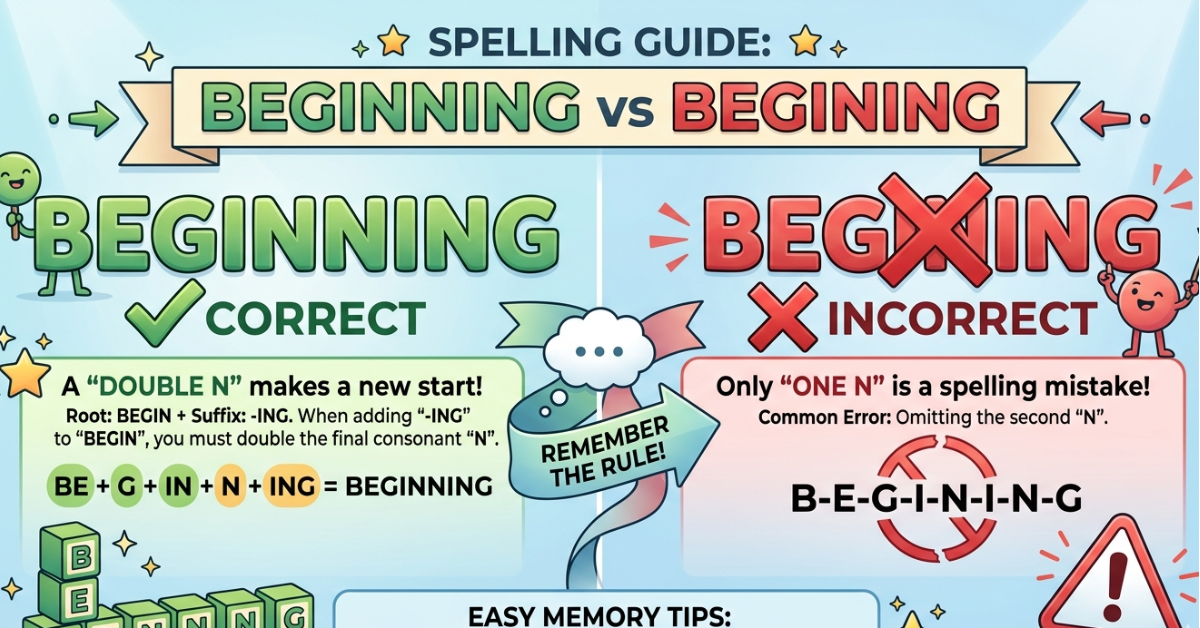
Let’s clear this up right away—the correct spelling is “beginning.”

The incorrect version, begining, is missing a key letter. English often doubles consonants in certain verb forms, and this is one of those cases.

So remember:

  •  begining (incorrect)
  •  beginning (correct)

The word beginning comes from the verb begin, and when forming its continuous or noun form, the consonant “n” is doubled.

Why Do People Write “Begining” by Mistake?

The confusion between begining or beginning happens for a few simple reasons:

1. Pronunciation confusion

We don’t always pronounce the double “n” clearly, so people assume one is enough.

2. English spelling rules are tricky

Unlike phonetic languages, English doesn’t always match spelling with sound.

3. Fast typing habits

On mobile devices or during quick writing, one letter is often dropped accidentally.

Meaning of “Beginning” in English Grammar

In English Grammar, the word beginning has two main uses:

1. As a noun

It refers to the start of something.

Examples:

  • The beginning of the story was exciting.
  • She was there from the beginning.

2. As a verb form (continuous tense)

It shows an action that is starting.

Examples:

  • The movie is beginning now.
  • It’s beginning to rain.

Easy Rules to Remember “Beginning”

If you struggle with begining or beginning, here are simple memory tricks:

 Double the “n”

When you add suffixes like -ing, the final consonant often doubles:

  • begin → beginning

 Think of “start + start again”

The repetition of sound reminds you of the double letter.

 Break it down

Be + gin + ning → helps you visually remember the structure.

Common Examples of “Beginning” in Sentences

Here are practical uses to strengthen your understanding:

  • The beginning of a new chapter feels exciting.
  • At the beginning of the year, I set new goals.
  • She is beginning to understand the concept.
  • Every great story has a strong beginning.

Notice how natural the correct form looks compared to begining.

Common Spelling Mistakes Related to “Beginning”

People who confuse begining or beginning often also struggle with:

  • planning vs planing
  • running vs runing
  • stopping vs stoping

These follow a similar rule: doubling the final consonant before adding -ing.

Quick Tips to Avoid the Mistake

Here are some simple ways to always get it right:

  1. Proofread your writing slowly
  2. Use spell-check tools
  3. Practice writing common -ing verbs
  4. Read more English content regularly
  5. Remember: “begin = beginning” (double n rule)

FAQs About Beginning or Begining

1. Which is correct, begining or beginning?

The correct spelling is beginning.

2. Why is “beginning” spelled with double n?

Because English grammar rules require doubling the final consonant before adding “-ing.”

3. Is “begining” ever used in English?

No, begining is always incorrect in standard English.

4. What does “beginning” mean?

It means the start or early stage of something.

5. How can I remember the correct spelling?

Think: begin → beginning (double n, double check).

Conclusion

Understanding the difference between begining or beginning is simple once you know the rule: the correct spelling always includes a double “n.” This small detail makes a big difference in writing clarity and professionalism.

With a little practice and awareness of English spelling patterns, you can avoid this common mistake easily. Keep practicing, stay consistent, and your writing will become more accurate and confident over time.

Leave a Reply

Your email address will not be published. Required fields are marked *

Author

britsx85@gmail.com

Related Posts

Leak vs Leek: Meaning, Difference & Easy Guide
In

Leak vs Leek: Meaning, Difference & Easy Guide

Have you ever seen the words leak and leek and wondered why they look almost identical but mean completely different things? This...

Read out all
Knead vs Need: Meaning, Difference & Usage Guide
In

Knead vs Need: Meaning, Difference & Usage Guide

English can be tricky, especially when two words sound the same but mean completely different things. One such confusing pair is Knead...

Read out all
Jam vs Jamb: Meaning, Difference & Usage Explained
In

Jam vs Jamb: Meaning, Difference & Usage Explained

The confusion around jam vs jamb is more common than you might think, especially among English learners and even native speakers. At...

Read out all
Incite vs Insight: Meaning, Difference & Usage Explained
In

Incite vs Insight: Meaning, Difference & Usage Explained

Have you ever stumbled while writing and wondered whether to use incite vs insight? You’re not alone. These two words sound similar...

Read out all
Idle vs Idol: Meaning, Difference & Usage Guide
In

Idle vs Idol: Meaning, Difference & Usage Guide

The confusion between idle vs idol is more common than you might think, especially in spoken and written English where both words...

Read out all
Hanged vs Hung: Meaning, Grammar & Usage Explained
In

Hanged vs Hung: Meaning, Grammar & Usage Explained

The confusion between hanged vs hung often troubles English learners and even native speakers. Many people mix them up because both forms...

Read out all