
- 0
- 1,163 word
Have you ever paused while writing because you couldn’t decide whether to use afterward or afterwards? You’re not alone. Many English learners and native speakers alike wonder, is it afterward or afterwards, and whether one is more correct than the other.
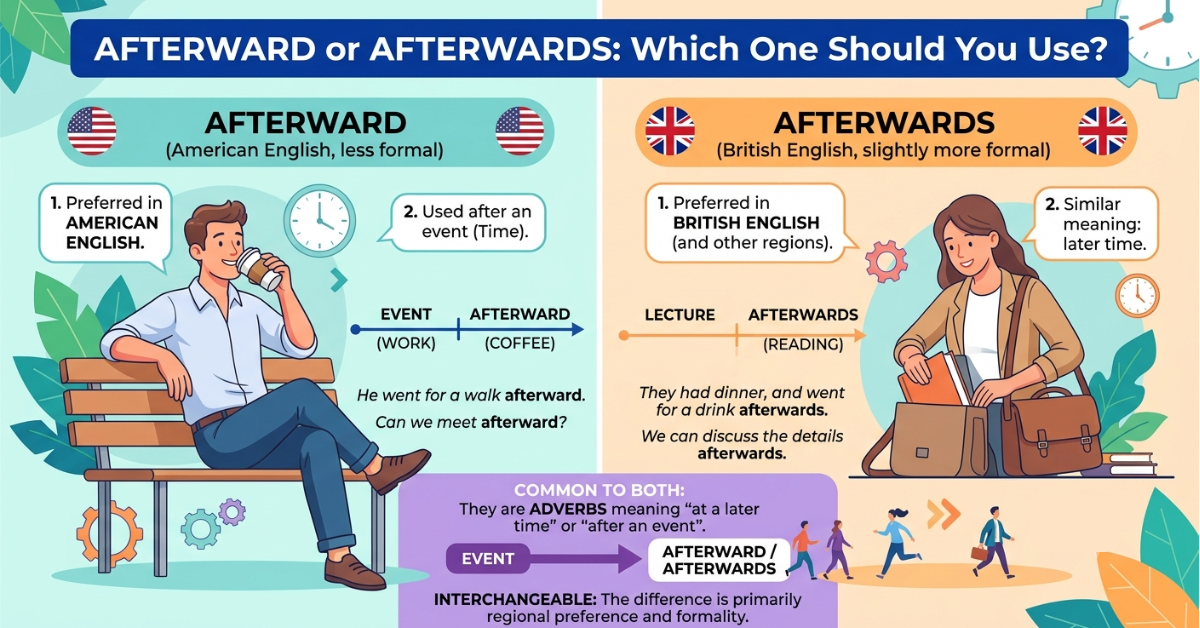
The good news is that both words are correct. The difference is not in meaning but primarily in regional usage and writing style. In this guide, you’ll learn the afterward or afterwards meaning, discover when to use each version, explore grammar rules, compare examples, and avoid common mistakes.
What Does Afterward or Afterwards Mean?
The afterward or afterwards meaning is exactly the same.
Both words are adverbs that mean:
- At a later time
- Following an event
- Subsequently
- Later on
In other words, they describe something that happens after something else.
Examples:
- We went out for dinner, and afterward we watched a movie.
- She apologized afterwards for her mistake.
- Finish your homework first. You can relax afterward.
The meaning never changes whether you add the final -s or not.
Is It Afterward or Afterwards?
The answer depends mostly on where you’re writing.
| Word | Common Usage | Preferred Region |
| Afterward | More common | American English |
| Afterwards | More common | British English |
If you’re writing for an American audience, afterward is generally preferred.
If you’re writing for readers in the UK, Australia, New Zealand, or many Commonwealth countries, afterwards is more common.
Both forms are grammatically correct.
Why Do Two Versions Exist?
English has several adverbs that exist in both forms—with and without a final -s.
Examples include:
- Toward / Towards
- Backward / Backwards
- Forward / Forwards
- Upward / Upwards
- Downward / Downwards
Historically, both forms developed over time. Today, the difference is mainly one of regional preference rather than grammar.
Afterward or Afterwards Meaning Explained
Whether you say afterward or afterwards, you’re referring to something occurring later than another action or event.
For example:
Event:
The meeting ended.
What happened next?
Everyone went for coffee afterward.
Or:
Everyone went for coffee afterwards.
Both sentences communicate exactly the same idea.
Common Examples
Everyday Conversation
- We had lunch afterward.
- We’ll discuss it afterwards.
- I felt much better afterward.
- They called me afterwards.
At School
- The students completed the test.
- Afterwards, the teacher reviewed the answers.
At Work
- We held a meeting.
- Afterward, everyone received an email summary.
Travel
- We visited the museum.
- Afterwards, we explored the old town.
Grammar Rules for Afterward and Afterwards
Understanding the grammar is straightforward.
They Are Adverbs
Both words modify verbs, adjectives, or entire sentences.
Examples:
- She smiled afterward.
- Afterwards, everyone applauded.
- We talked afterward about the project.
They Usually Come at the End
Examples:
- We went home afterward.
- He apologized afterwards.
They Can Begin a Sentence
Examples:
- Afterwards, we celebrated.
- Afterward, the guests left.
When used at the beginning, they’re typically followed by a comma.
They Cannot Replace “After”
Do not confuse these words with the preposition after.
Correct:
- We left afterward.
Also correct:
- We left after dinner.
Incorrect:
- We left afterward dinner.
Afterward vs Afterwards: Side-by-Side Comparison
| Feature | Afterward | Afterwards |
| Meaning | Later | Later |
| Part of Speech | Adverb | Adverb |
| American English | Preferred | Less common |
| British English | Acceptable | Preferred |
| Formal Writing | Yes | Yes |
| Informal Writing | Yes | Yes |
American English vs British English
American English
You’ll commonly see:
- afterward
- toward
- forward
- backward
Examples:
- We spoke afterward.
- She called afterward to confirm.
British English
You’ll often see:
- afterwards
- towards
- forwards
- backwards
Examples:
- We spoke afterwards.
- She phoned afterwards.
Which One Should You Use?
Choose based on your audience.
Use afterward if:
- You’re writing in American English.
- You’re following U.S. style guides.
- Your audience is primarily American.
Use afterwards if:
- You’re writing in British English.
- Your readers are in the UK or Commonwealth countries.
- Your publication follows British spelling conventions.
The most important rule is consistency. Don’t switch between the two forms in the same document unless you’re quoting someone directly.
Common Mistakes to Avoid
Mixing Regional Styles
Incorrect:
- We met afterward, and afterwards we had coffee.
Choose one style and stick with it.
Using It Before a Noun
Incorrect:
- Afterwards lunch
Correct:
- After lunch
- Afterwards, we ate dessert.
Thinking One Is Wrong
Some writers believe afterwards is incorrect because of the extra -s.
It isn’t.
Both spellings are accepted by major English dictionaries.
Overusing It
Avoid repeating either word too frequently.
Instead, vary your writing with alternatives like:
- later
- subsequently
- then
- later on
- following that
- next
Similar Words to Know
Several English words follow the same regional pattern.
| American | British |
| Toward | Towards |
| Backward | Backwards |
| Forward | Forwards |
| Upward | Upwards |
| Downward | Downwards |
Understanding these patterns makes it easier to recognize regional writing styles.
Practical Writing Tips
When deciding between afterward and afterwards, keep these tips in mind:
- Know your target audience before you write.
- Follow the style guide used by your school, employer, or publisher.
- Stay consistent throughout the document.
- Don’t worry about meaning—they’re identical.
- Use natural sentence placement for better readability.
Real-World Examples
Thank you for attending today’s meeting. We’ll send the presentation afterward.
Blog
We explored the hiking trail and afterwards enjoyed a picnic by the lake.
Story
The storm finally passed. Afterward, the village slowly returned to normal.
Business Report
The software was installed successfully. Afterwards, employees completed training sessions.
Key Takeaways
- Afterward and afterwards have exactly the same meaning.
- Both are grammatically correct adverbs.
- American English usually prefers afterward.
- British English generally prefers afterwards.
- Use one version consistently within the same piece of writing.
- Neither spelling is more formal or more correct than the other.
Frequently Asked Questions
Is it afterward or afterwards?
Both are correct. Afterward is more common in American English, while afterwards is preferred in British English.
What is the difference between afterward and afterwards?
There is no difference in meaning. The only distinction is regional spelling preference and writing style.
What does afterward or afterwards mean?
The afterward or afterwards meaning is “later,” “subsequently,” or “following an earlier event.” Both words describe something happening after something else.
Can I use afterward in British English?
Yes. British readers will understand it, although afterwards is generally the preferred spelling in British English.
Is afterwards grammatically correct?
Absolutely. Afterwards is a standard English adverb recognized by dictionaries and grammar guides.
Which is better for academic writing?
Neither is better. Choose the spelling that matches your required style guide or regional English and use it consistently throughout your paper.
Conclusion
Choosing between afterward or afterwards is much simpler than it first appears. If you’ve been wondering is it afterward or afterwards, remember that both forms are correct, share the same meaning, and differ mainly in regional preference. American English typically favors afterward, while British English more often uses afterwards.h
By understanding the afterward or afterwards meaning, following your audience’s preferred style, and staying consistent throughout your writing, you’ll sound more natural and professional. The next time you encounter these words, you’ll know exactly whic one fits your writing best.
Author

linguaezone.com@gmail.com
Related Posts
Kill Two Birds With One Stone Alternative: 50 Better Options
- 0
- 1,569 word
Have you ever paused before saying “kill two birds with one stone” because it sounded too violent or simply didn’t fit the...
Read out all
Happy Sabbath Meaning: A Complete Guide to Its Significance
- 0
- 1,632 word
Have you ever received the message “Happy Sabbath” and wondered what it truly means? Is it simply another way of saying “have...
Read out all
I’m So Proud of You in Other Words: 120+ Heartfelt Alternatives
- 0
- 1,562 word
Have you ever wanted to tell someone you’re proud of them but felt like saying “I’m so proud of you” sounded repetitive?...
Read out all
How Do You Spell Happy Anniversary? Correct Spelling Guide
- 0
- 1,221 word
Have you ever paused before writing an anniversary card and wondered, “How do you spell happy anniversary?” You’re not alone. Whether you’re...
Read out all
Waiting for Your Response Email: Best Examples & Tips
- 0
- 1,483 word
Have you ever sent an important email and found yourself wondering whether you should follow up or simply wait? Whether you’re communicating...
Read out all
Great Asset to the Team: Meaning, Examples & Tips
- 0
- 1,494 word
Have you ever wanted to compliment a coworker but struggled to find words that sound professional and sincere? One of the most...
Read out all