Please Advise Meaning: Proper Usage in Emails & Examples
- 0
- 1,598 word
Have you ever received an email ending with “Please advise” and wondered exactly what the sender meant? Or perhaps you’ve wanted to use the phrase yourself but weren’t sure whether it sounded polite or too demanding.
Understanding the please advise meaning can help you communicate more effectively in professional emails, business conversations, and workplace messages. While the phrase is common in corporate communication, it’s often misunderstood or overused. In this guide, you’ll learn what it means, when it’s appropriate, how it differs from similar expressions, and better alternatives for different situations.
What Does “Please Advise” Mean?
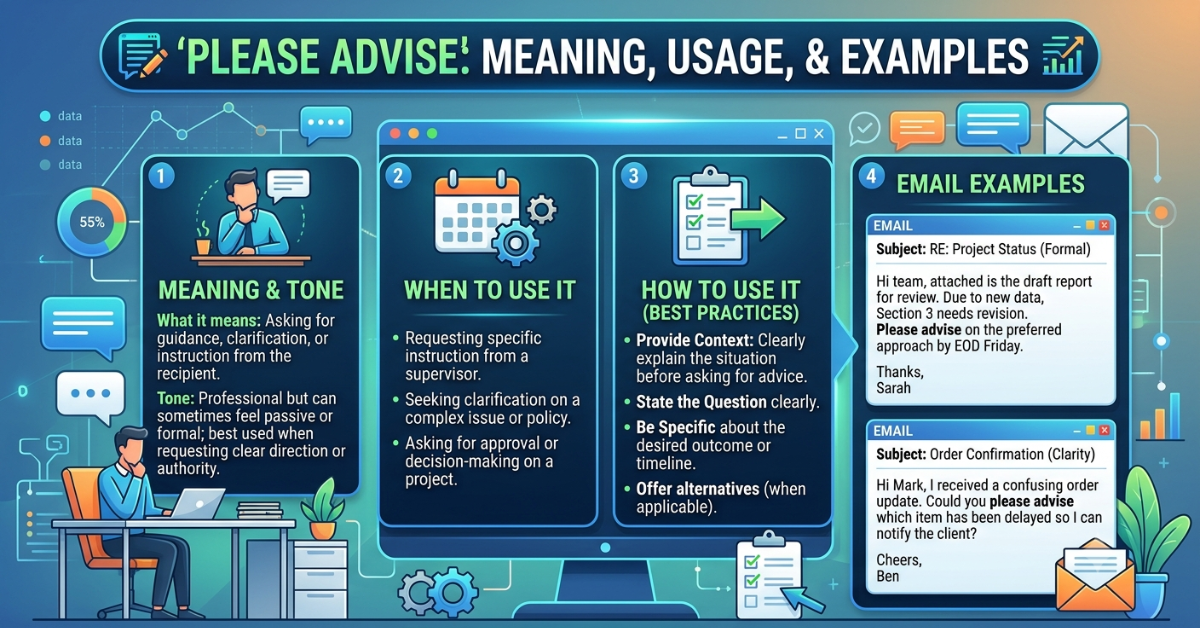
The phrase “please advise” is a polite request asking someone to provide guidance, recommendations, instructions, or a decision regarding a particular issue.
In simple words, it means:
“Please tell me what I should do.”
or
“Please let me know your opinion or recommended course of action.”
It signals that you’re waiting for someone else’s expertise, approval, or direction before moving forward.
Simple examples
- Please advise on the next steps.
- Please advise whether the meeting should be postponed.
- Please advise if additional documents are required.
- Please advise how we should proceed.
In every example, the sender is asking for guidance rather than merely requesting information.
Why Is “Please Advise” Common in Professional Emails?
The phrase has become a standard expression in business communication because it is:
- Short
- Professional
- Direct
- Easy to understand
- Appropriate for formal workplace communication
Managers, clients, HR professionals, customer support teams, consultants, and project coordinators frequently use it when decisions need clarification.
For example:
Employee:
The supplier cannot deliver before Friday. Please advise how you’d like us to proceed.
Here, the employee seeks the manager’s decision before taking action.
Can You Please Advise Meaning
Many people search for can you please advise meaning because the wording feels slightly different.
This phrase means:
“Could you provide your advice or guidance?”
It sounds more conversational than simply writing “Please advise.”
Examples
- Can you please advise whether the payment has been received?
- Can you please advise which package would best suit our needs?
- Can you please advise if there are any updates?
This version feels a bit warmer because it directly addresses the recipient.
Could You Please Advise Meaning
The phrase could you please advise meaning is very similar but is generally considered even more polite.
It means:
“Would you be willing to give me your advice or recommendation?”
Since “could” sounds less demanding than “can,” it’s often preferred in customer service and formal business writing.
Examples
- Could you please advise when the report will be available?
- Could you please advise on the correct procedure?
- Could you please advise whether approval has been granted?
Please Advise Meaning in Email
The please advise meaning in email depends on the context, but it almost always indicates that the sender is waiting for guidance before continuing.
Instead of making assumptions, the sender asks another person to provide direction.
Example 1
We have completed the initial review. Please advise on the next phase.
Meaning:
The sender wants instructions before continuing.
Example 2
The customer requested a refund. Please advise how we should respond.
Meaning:
The sender is requesting the manager’s recommendation.
Example 3
Please advise if any revisions are required.
Meaning:
The sender wants feedback before finalizing the work.
Please Advise Meaning Email Explained
When people search for please advise meaning email, they’re usually trying to understand whether the phrase is polite or appropriate.
In email communication, it simply means:
- Tell me what to do.
- Share your recommendation.
- Give me your decision.
- Provide clarification.
- Confirm the next step.
Although professional, some readers may perceive “Please advise” as abrupt if used without context.
For example:
Incorrect: Please advise.
This sounds incomplete.
A better version is:
Please advise on whether we should proceed with the proposal.
Providing context makes the request clearer and more courteous.
Is “Please Advise” Polite?
Yes—most of the time.
However, politeness depends on:
- Your relationship with the recipient
- The overall tone of the email
- The amount of context provided
Sounds polite
Please advise on the preferred delivery date.
Sounds even better
Please advise when you have a chance.
More courteous
Could you please advise us on the next steps?
Adding appreciation also helps.
Thank you in advance. Please advise if further information is required.
When Should You Use “Please Advise”?
The phrase works best when you’re requesting:
Guidance
- Please advise on the best approach.
Approval
- Please advise whether this proposal can be approved.
Clarification
- Please advise if these instructions are correct.
Decision
- Please advise which option you’d prefer.
Next Steps
- Please advise on how we should proceed.
When Should You Avoid It?
Although common, “Please advise” isn’t suitable for every situation.
Avoid it when:
- You’re emailing close colleagues casually.
- You’re asking a simple yes-or-no question.
- You want to sound more conversational.
- The message already feels very formal.
Instead of:
Please advise.
Try:
- What do you think?
- Could you let me know your preference?
- I’d appreciate your recommendation.
- I’d value your feedback.
These options often sound more natural.
Better Alternatives to “Please Advise”
Here are professional alternatives depending on your purpose.
| Situation | Better Alternative |
|---|---|
| Asking for guidance | Please let me know your recommendation. |
| Requesting feedback | I’d appreciate your feedback. |
| Seeking approval | Please let me know if this is approved. |
| Asking for clarification | Could you clarify this point? |
| Requesting next steps | Please let me know how you’d like to proceed. |
| Seeking confirmation | Could you confirm this for me? |
These alternatives often sound more conversational while remaining professional.
Examples of “Please Advise” in Different Situations
Business Email
The contract has been reviewed. Please advise whether we can proceed with signing.
Customer Service
We were unable to locate your order. Please advise if you have an alternative reference number.
HR Communication
Your leave request overlaps with another scheduled absence. Please advise if you’d like to modify your dates.
Project Management
The development phase has been completed. Please advise on the timeline for testing.
Finance
Payment has not yet been received. Please advise whether we should issue a reminder.
Common Mistakes People Make
Using It Without Context
Instead of:
Please advise.
Write:
Please advise whether we should submit the revised proposal today.
Asking Multiple Questions
Rather than listing several unrelated questions followed by “Please advise,” separate your requests clearly.
Sounding Too Abrupt
Improve the tone by adding:
- Thank you.
- When convenient.
- At your earliest convenience.
- I’d appreciate your guidance.
Tips for Writing Professional Emails
To make your emails more effective:
- Explain the situation first.
- Clearly state what advice you need.
- Keep the request specific.
- Use polite language.
- Thank the recipient.
- Proofread before sending.
A clear email is much more likely to receive a prompt response.
“Please Advise” vs Similar Phrases
| Phrase | Meaning | Best Used For |
|---|---|---|
| Please advise | Request guidance | Formal business emails |
| Please let me know | Request information | General communication |
| Could you clarify? | Ask for explanation | Clarifications |
| What do you recommend? | Request opinion | Collaborative discussions |
| Kindly confirm | Request confirmation | Logistics and scheduling |
Is “Please Advise” Still Modern?
Yes, but many communication experts recommend using more specific language whenever possible.
Instead of simply saying:
Please advise.
You could write:
- Please advise on the preferred timeline.
- Please let me know which option you recommend.
- I’d appreciate your guidance on the next steps.
Specific requests reduce confusion and encourage faster responses.
Key Takeaways
- “Please advise” means asking someone for guidance or recommendations.
- It’s widely used in business and professional emails.
- Can you please advise meaning is essentially a request for advice in a conversational tone.
- Could you please advise meaning is slightly more polite and formal.
- The please advise meaning in email usually refers to requesting instructions or a decision.
- Providing context makes the phrase sound more professional.
- In many situations, specific alternatives create clearer communication.
Frequently Asked Questions
What is the exact please advise meaning?
The phrase means “please provide your advice, guidance, or recommendation.” It is commonly used in professional communication when someone needs direction before taking action.
Is “please advise” rude?
No. It’s generally considered professional. However, using it without context may sound abrupt, so it’s best to explain what advice you’re requesting.
Can you please advise meaning in business emails?
In business communication, it means asking someone to provide instructions, make a decision, or recommend the next step in a process.
Could you please advise meaning compared to “please advise”?
“Could you please advise” is a softer and more polite variation. It often sounds more respectful, especially when communicating with clients or senior professionals.
What is another way to say “please advise” in an email?
You can say:
- Please let me know your thoughts.
- I’d appreciate your guidance.
- Could you clarify?
- Please let me know how you’d like to proceed.
- I’d value your recommendation.
Is “please advise” appropriate in customer service emails?
Yes. Customer support representatives often use it when requesting additional information or asking customers to choose between available options.
Conclusion
Understanding the please advise meaning helps you communicate more confidently in professional settings. Whether you’re writing to a manager, client, colleague, or customer, the phrase simply requests guidance, recommendations, or the next course of action. While it’s perfectly acceptable in formal emails, providing context and using more specific language often makes your message clearer and more engaging.
As you write your next email, consider whether “please advise” fits the situation—or whether a more conversational alternative would better express your request. Small improvements in wording can lead to clearer communication, quicker responses, and stronger professional relationships.
Author
britsx85@gmail.com
Related Posts
TYSM Meaning in Text: What It Means and How to Use It
- 0
- 1,256 word
Have you ever received a message that simply says “TYSM” and wondered what it actually means? You’re not alone. Modern texting is...
Read out all
Happy to Help Meaning: Uses, Replies, and Examples
- 0
- 1,594 word
Have you ever received a message saying, “Happy to help!” after someone answered your question or solved a problem? It’s one of...
Read out all
PU Meaning in Text: What It Means and How to Use It
- 0
- 1,341 word
Have you ever received a message that simply said “PU” and wondered what the sender actually meant? You’re not alone. Text messaging...
Read out all
Have a Safe Journey Meaning: Complete Guide & Examples
- 0
- 1,456 word
Have you ever paused before saying, “Have a safe journey,” and wondered whether it’s the right phrase or what it truly means?...
Read out all
SM Meaning in Chat: What It Really Means in 2026
- 0
- 875 words
Ever received a message like “SM me later” or seen “SM” pop up in a WhatsApp or Instagram chat and felt confused?...
Read out all
EYP Meaning in Text: Slang Explained Simply
- 0
- 810 words
Ever come across the term “EYP” in a chat and paused for a second wondering what it means? You’re not alone. Internet...
Read out all