
×
Tought vs Taught: Meaning, Difference, and Correct Usage
In

Have you ever typed “tought” and wondered whether it was actually a real word? You’re not alone. Thousands of people search for tought vs taught because these words look similar, yet only one is correct in standard English.

In this guide, you’ll learn the difference between tought and taught, discover why the confusion happens, see plenty of examples, and pick up simple memory tricks that will help you avoid this common spelling mistake forever.

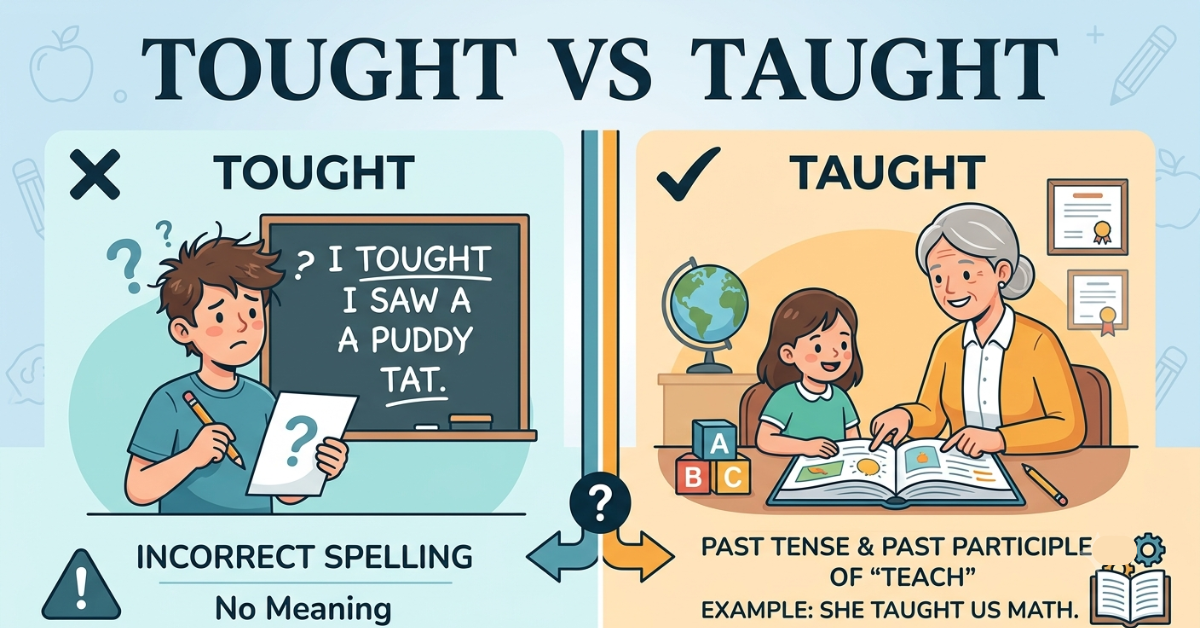
What Is the Difference Between Tought vs Taught?

The simplest answer is:

  • Taught is the correct English word.
  • Tought is not a standard English word and is almost always a spelling mistake.

Here’s a quick comparison:

Word Is it Correct? Meaning
Taught  Yes Past tense and past participle of teach
Tought  No Common misspelling of taught

If you’re writing an essay, email, assignment, or professional document, you should always use taught when referring to someone giving instruction or education.

What Does “Taught” Mean?

Taught is the past tense and past participle of the verb teach.

It refers to giving knowledge, skills, lessons, or instructions to someone.

Examples

  • My mother taught me how to cook.
  • Our professor taught English literature for twenty years.
  • She taught herself graphic design.
  • The coach taught the team new strategies.
  • My grandfather taught me the importance of honesty.

In every example, someone is sharing knowledge or helping another person learn.

Is “Tought” a Real Word?

In modern English, no.

Most dictionaries do not recognize tought as a standard word.

People usually type tought because:

  • they confuse it with taught
  • English spelling is inconsistent
  • pronunciation can be misleading
  • autocorrect doesn’t always catch the mistake immediately

Whenever you mean the past tense of teach, the correct spelling is taught.

Why Do People Confuse Tought and Taught?

English contains many irregular verbs.

For example:

Base Verb Past Tense
Teach Taught
Catch Caught
Buy Bought
Bring Brought

Notice how several words end in -aught or -ought.

Because of this pattern, many learners accidentally create the spelling tought, even though it doesn’t exist in standard English.

How to Remember the Correct Spelling

Here are a few easy tricks.

1. Remember “Teach → Taught”

Simply memorize:

Teach → Taught

Never change it to tought.

2. Think of “Caught”

If you know:

  • Catch → Caught

then you’ll remember:

  • Teach → Taught

Both follow unusual spelling patterns.

3. Associate It With Teachers

Teachers teach.

Yesterday they taught.

This simple connection makes the spelling much easier to remember.

Examples of Taught in Everyday Sentences

Here are common examples you’ll encounter.

Education

  • She taught mathematics in high school.
  • The university taught students practical skills.

Family

  • My parents taught me respect.
  • My grandmother taught me traditional recipes.

Workplace

  • My manager taught me how to use the new software.
  • The trainer taught employees important safety procedures.

Sports

  • The coach taught the players teamwork.
  • She taught swimming during the summer.

Incorrect vs Correct Usage

Learning through comparison makes mistakes easier to spot.

Incorrect Correct
She tought me English. She taught me English.
My father tought me driving. My father taught me to drive.
The teacher tought us science. The teacher taught us science.
He tought the lesson yesterday. He taught the lesson yesterday.

Grammar Rule Behind “Taught”

“Taught” is an irregular verb.

Unlike regular verbs that simply add -ed, irregular verbs change completely.

Examples include:

Present Past Past Participle
Teach Taught Taught
Buy Bought Bought
Think Thought Thought
Bring Brought Brought

This is why “teached” and “tought” are both incorrect.

Common Mistakes English Learners Make

Many learners accidentally write:

  • Tought
  • Teached
  • Teachted
  • Teach’d

The only correct past tense is:

Taught

Learning irregular verbs as complete word pairs is often easier than trying to apply general grammar rules.

Taught in Different Contexts

School

Teachers taught mathematics, science, history, and languages.

Online Learning

Many instructors now teach through virtual classrooms, and they taught millions of students remotely during recent years.

Parents

Parents often teach values, while grandparents may teach family traditions.

Professional Training

Companies teach employees new systems, and experienced mentors taught previous generations of workers valuable skills.

Easy Memory Formula

Remember this sentence:

Teachers teach today. Yesterday they taught.

If you can remember this one line, you’ll rarely confuse the spelling again.

Similar Words That Often Cause Confusion

Many English words look alike but have different meanings.

Thought vs Taught

  • Thought = an idea or the past tense of think
  • Taught = past tense of teach

Example:

  • I thought the lesson was difficult.
  • The teacher taught it very well.

Bought vs Brought

These are also commonly confused.

  • Bought = purchased
  • Brought = carried something

Understanding these irregular verb patterns helps improve both spelling and grammar.

Why Correct Spelling Matters

Using the correct spelling makes your writing:

  • More professional
  • Easier to understand
  • Grammatically accurate
  • More credible in academic and business settings

Whether you’re writing essays, emails, resumes, blog posts, or social media captions, correct spelling leaves a stronger impression.

Practical Tips to Avoid Writing “Tought”

  • Learn irregular verbs together.
  • Proofread before submitting assignments.
  • Use spell-check, but don’t rely on it completely.
  • Read regularly to become familiar with correct spellings.
  • Practice writing example sentences using teach and taught.

Quick Summary

  • Taught is the correct spelling.
  • It is the past tense of teach.
  • Tought is not accepted in standard English.
  • Remember: Teach → Taught.
  • Learning irregular verb patterns helps avoid similar spelling mistakes.

Frequently Asked Questions

Is tought a real English word?

No. Tought is generally considered a misspelling. The correct word is taught, the past tense of teach.

Why do people search for tought vs taught?

Many people confuse the spellings because English irregular verbs can be difficult to remember, especially words ending in -aught and -ought.

What is the correct spelling: tought or taught?

The correct spelling is taught. Use it whenever you’re referring to someone who gave instruction or shared knowledge.

Is taught the past tense of teach?

Yes. Teach becomes taught in both the past tense and the past participle.

Example:

  • Today I teach.
  • Yesterday I taught.

Can I use tought in formal writing?

No. Since tought is not a standard English word, it should never appear in academic, professional, or formal writing.

How can I remember the difference between tought vs taught?

Think of the phrase: “Teachers teach today; yesterday they taught.” Repeating this simple sentence helps reinforce the correct spelling.

Conclusion

Understanding tought vs taught is easier than it first appears. While taught is the correct past tense of teach, tought is simply a common spelling mistake that should be avoided. By recognizing irregular verb patterns, practicing with real examples, and using simple memory techniques, you’ll write with greater confidence and accuracy.

The next time you’re unsure which word to use, remember one simple rule: people teach today, but they taught yesterday. Keep practicing these common grammar distinctions, and your English writing will become clearer, more polished, and more professional.

Leave a Reply

Your email address will not be published. Required fields are marked *

Author

britsx85@gmail.com

Related Posts

Benefited or Benefitted: Which Spelling Is Correct?
In

Benefited or Benefitted: Which Spelling Is Correct?

Have you ever paused mid-sentence and wondered whether to write benefited or benefitted? You are not alone. This is one of those...

Read out all
Dialogue Spelling: Correct Usage, Meaning & Examples
In

Dialogue Spelling: Correct Usage, Meaning & Examples

Have you ever stopped while writing and wondered whether it’s dialogue or dialog? You’re not alone. It’s one of the most common...

Read out all
Cacoon or Cocoon: Which Spelling Is Correct?
In

Cacoon or Cocoon: Which Spelling Is Correct?

Have you ever typed cacoon or cocoon into a search bar and wondered which spelling is actually correct? You’re not alone. It’s...

Read out all
Proportion vs Portion: Meaning, Differences & Easy Examples
In

Proportion vs Portion: Meaning, Differences & Easy Examples

Have you ever paused mid-sentence and wondered whether to write portion or proportion? It happens more often than you might think. Although...

Read out all
Favourite or Favorite: Which Spelling Is Correct?
In

Favourite or Favorite: Which Spelling Is Correct?

Have you ever paused while writing an email or social media post and wondered, “is it favourite or favorite?” You’re not alone....

Read out all
Aswell or As Well: Which One Is Correct?
In

Aswell or As Well: Which One Is Correct?

Have you ever paused while typing and wondered whether you should write aswell or as well? You’re not alone. It’s one of...

Read out all