
- 0
- 1,102 word
Have you ever paused while writing and wondered whether it should be layed or laid? You are not alone. This is one of those English mistakes that looks small but shows up everywhere in emails, resumes, captions, and school writing.
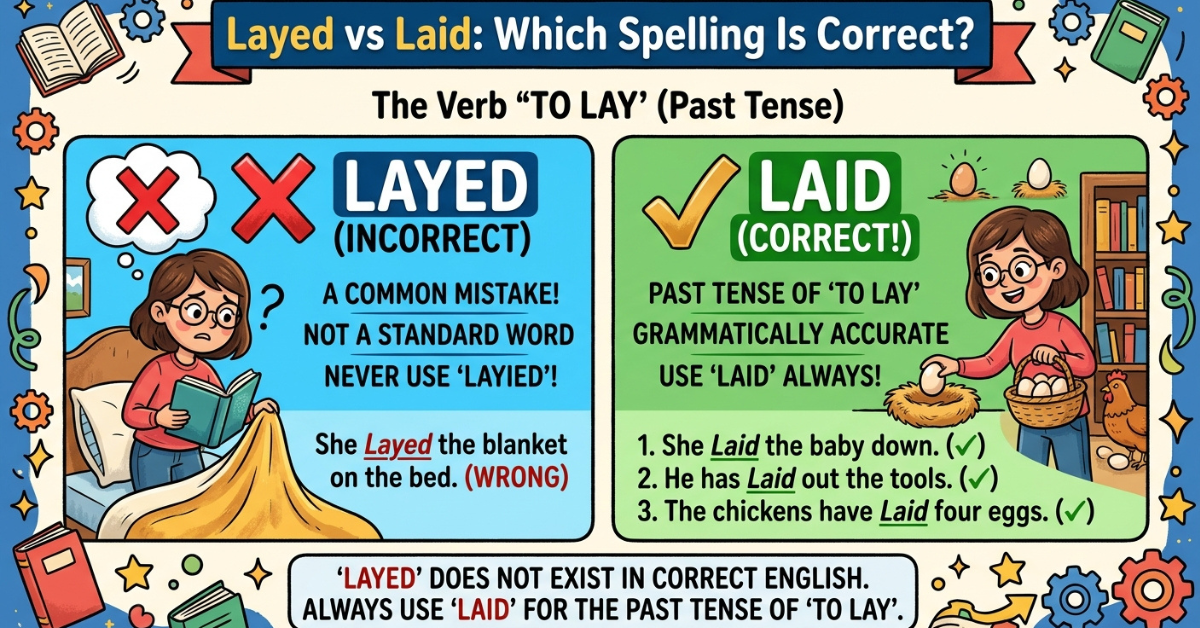
The truth is simple: in modern standard English, laid is usually the correct form, while layed is generally considered incorrect. In this article, we will break down laid vs layed, explain phrases like laid off or layed off and laid out or layed out, and help you use the right word with confidence.
What Does “Laid” Mean?
Laid is the past tense and past participle of the verb lay.
Basic rule
- Present: lay
- Past tense: laid
- Past participle: laid
Examples
- I lay the book on the table.
- Yesterday, I laid the book on the table.
- I have laid the book on the table already.
This is where many people get stuck. Because “lay” and “lie” look and sound similar, it is easy to mix them up. But when you are talking about placing something down, laid is usually the form you want.
Why “Layed” Is Usually Wrong
In everyday modern English, layed is not the standard spelling. Most dictionaries and style guides treat it as a misspelling when people mean the past tense of lay.
That means:
- laid the table is correct
- layed the table is incorrect
The confusion often happens because English verbs do not always follow a neat pattern. People see words like “played,” “stayed,” or “displayed” and assume “lay” should become “layed.” But lay is irregular, so it changes differently.
Laid vs Lay: The Easiest Way to Remember
A simple memory trick helps a lot:
- Lay = action in the present
- Laid = action completed in the past
Compare these:
- Please lay the keys here.
- She laid the keys here earlier.
If the action already happened, choose laid.
Common Phrases People Search for
1) Laid off or layed off
The correct phrase is laid off.
It is used when someone loses a job because of company cuts, downsizing, or reduced work. The correct verb form is laid, not layed.
Examples:
- The company laid off 200 employees.
- She was laid off after the project ended.
This phrase is extremely common in business writing, news reports, and HR communication.
2) Laid out or layed out
The correct phrase is laid out.
This can mean arranged, planned, or explained clearly.
Examples:
- She laid out the fabric on the table.
- The teacher laid out the assignment rules.
- The plan was laid out in detail.
Again, layed out is generally not correct in standard writing.
3) Laid vs layed
When people search laid vs layed, they usually want to know which one is accepted in formal English. The answer is straightforward: laid is the standard choice.
Use laid in:
- professional emails
- academic writing
- job applications
- blog posts
- formal documents
Real-World Examples in Sentences
Here are a few practical examples to make the rule stick.
Correct usage
- I laid my phone on the desk.
- The workers laid the tiles carefully.
- The manager laid off several staff members.
- She laid out the design in a neat grid.
Incorrect usage
- I layed my phone on the desk.
- The workers layed the tiles carefully.
- The manager layed off several staff members.
- She layed out the design in a neat grid.
Seeing the incorrect form beside the correct one makes the difference much easier to remember.
When People Get Confused About “Lay”
English gets tricky because lay can also be a present-tense verb meaning to place something down, while lie means to recline. That is why people often mix up “lay,” “laid,” and “lie.”
Quick comparison
- Lay something down = place something
- Lie down = recline yourself
Examples:
- I lay the bag on the chair.
- I lie down after lunch.
- Yesterday, I laid the bag on the chair.
- Yesterday, I lay down after lunch.
This is one of the most common grammar traps in English.
Simple Grammar Tips to Avoid the Mistake
If you want to stop confusing layed and laid, these tips help:
- Think of the time.
If the action is completed, use laid. - Check the phrase.
Say laid off and laid out, not the misspelled versions. - Read the sentence aloud.
Native speakers almost always say laid in these contexts. - Use a memory anchor.
“Lay today, laid yesterday.” - Proofread job and professional writing carefully.
Mistakes like this stand out in resumes and cover letters.
Why This Matters in Writing
Using the correct form is not just about grammar rules. It affects how polished and credible your writing looks.
A small error like layed off can make a resume, article, or email seem less professional. On the other hand, choosing laid shows attention to detail and strong language control.
That matters especially in:
- business writing
- academic papers
- editorial content
- social media captions
- professional communication
Key Takeaways
- Laid is the standard past tense and past participle of lay.
- Layed is usually incorrect in modern standard English.
- The correct forms are laid off and laid out.
- Remember: lay is present, laid is past.
- Careful usage improves clarity and professionalism.
FAQ: Layed vs Laid
1) Is “layed” ever correct?
In modern standard English, layed is generally not correct when you mean the past tense of lay. Most writers should use laid instead.
2) Which is correct: laid off or layed off?
The correct phrase is laid off. It is the standard expression used for job losses caused by company cuts or restructuring.
3) Which is correct: laid out or layed out?
The correct phrase is laid out. It is used for arranging something, explaining a plan, or presenting information clearly.
4) What is the difference between laid and lay?
Lay is the present tense, while laid is the past tense and past participle. For example: “I lay the book down” becomes “I laid the book down.”
5) Why do people write layed?
People often assume English verbs end in -ed in the past tense, so they add -ed to lay. Since lay is irregular, the correct past form is laid, not layed.
6) Is laid always the right choice?
Not always. The right word depends on the sentence, but when you need the past tense of lay, laid is the correct form in standard English.
Conclusion
The confusion around laid vs layed is common, but the rule is easy once you know it: in most modern writing, laid is correct and layed is not. That applies to everyday sentences as well as phrases like laid off and laid out.
With a little practice, this mistake becomes easy to avoid. Keep the rule in mind, proofread carefully, and your writing will sound clearer, smarter, and more professional.
Author

linguaezone.com@gmail.com
Related Posts

Kill Two Birds With One Stone Alternative: 50 Better Options
- 0
- 1,569 word
Have you ever paused before saying “kill two birds with one stone” because it sounded too violent or simply didn’t fit the...
Read out all
Happy Sabbath Meaning: A Complete Guide to Its Significance
- 0
- 1,632 word
Have you ever received the message “Happy Sabbath” and wondered what it truly means? Is it simply another way of saying “have...
Read out all
I’m So Proud of You in Other Words: 120+ Heartfelt Alternatives
- 0
- 1,562 word
Have you ever wanted to tell someone you’re proud of them but felt like saying “I’m so proud of you” sounded repetitive?...
Read out all
How Do You Spell Happy Anniversary? Correct Spelling Guide
- 0
- 1,221 word
Have you ever paused before writing an anniversary card and wondered, “How do you spell happy anniversary?” You’re not alone. Whether you’re...
Read out all
Waiting for Your Response Email: Best Examples & Tips
- 0
- 1,483 word
Have you ever sent an important email and found yourself wondering whether you should follow up or simply wait? Whether you’re communicating...
Read out all
Great Asset to the Team: Meaning, Examples & Tips
- 0
- 1,494 word
Have you ever wanted to compliment a coworker but struggled to find words that sound professional and sincere? One of the most...
Read out all