
- 0
- 1,125 word
Have you ever paused while writing an email, invitation, or social media post because you couldn’t remember whether it’s occassion or occasion? You’re not alone. This is one of the most common spelling mistakes in English, and thousands of people search for the answer every month.
If you’ve ever wondered about occassion or occasion, this guide will clear up the confusion once and for all. You’ll learn the correct spelling, why the mistake happens, how to remember the right version, and how to use the word correctly in everyday writing.
The Quick Answer: Occassion or Occasion?
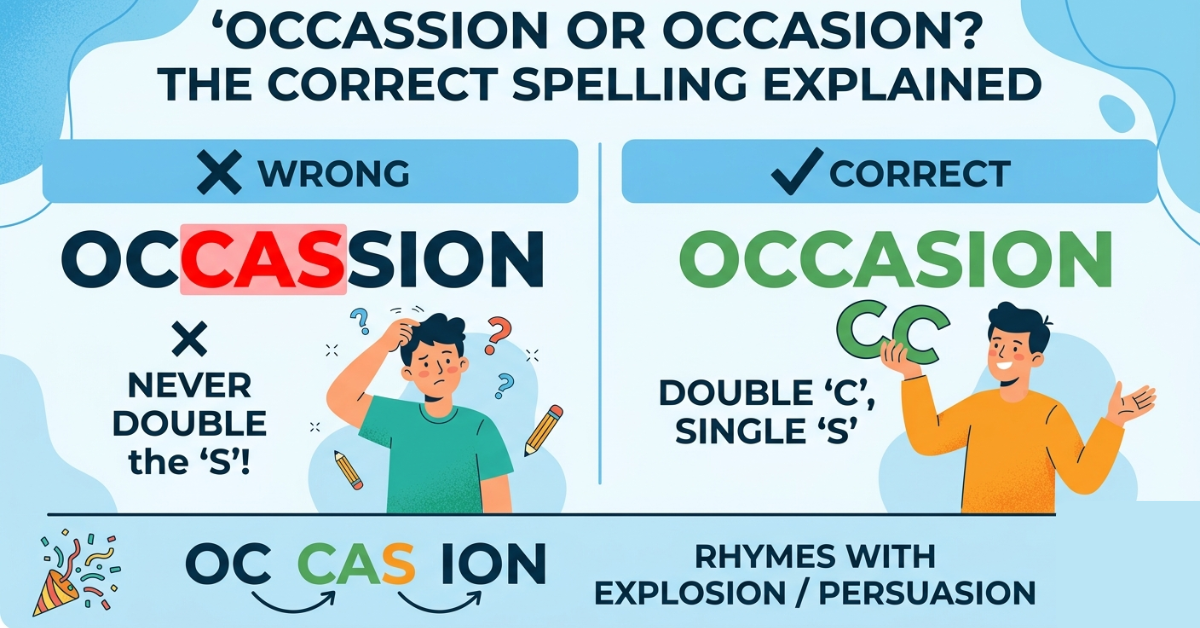
The correct spelling is occasion.
Occassion (incorrect)
Occasion (correct)
The word occasion contains:
- Two “c” letters
- One “s” letter
Many people mistakenly add an extra “s,” creating the incorrect spelling occassion.
Correct Examples
- It was a special occasion for the entire family.
- We dressed formally for the occasion.
- Birthdays are occasions worth celebrating.
Incorrect Examples
- It was a special occassion.
- Thank you for attending the occassion.
What Does Occasion Mean?
The word occasion refers to a particular event, time, reason, or circumstance.
Common Definitions
An occasion can mean:
- A special event or celebration
- A specific time when something happens
- A reason or cause for an action
Examples
- Their wedding was a memorable occasion.
- On one occasion, she arrived early.
- There was no occasion for concern.
The meaning changes slightly depending on context, but the spelling remains the same.
Why Do People Write “Occassion”?
The confusion between occassion or occasion usually comes from pronunciation.
When spoken, the word sounds like it might contain a double “s.” Since English spelling often includes doubled consonants, many writers naturally assume the spelling should be “occassion.”
However, English spelling doesn’t always match pronunciation perfectly, and this is one of those cases.
Commonly Misspelled Words Like Occasion
Many English words create similar confusion:
| Incorrect | Correct |
| Occassion | Occasion |
| Accomodate | Accommodate |
| Seperate | Separate |
| Recieve | Receive |
| Definately | Definitely |
These mistakes happen because English spelling follows patterns that aren’t always obvious.
The Origin of the Word Occasion
Understanding a word’s history can make spelling easier to remember.
The word occasion comes from the Latin word occasio, which means “opportunity,” “chance,” or “event.”
Over time, it entered Old French before becoming part of the English language. Throughout its development, the spelling maintained a single “s” sound in the middle rather than a double “s.”
This historical background helps explain why occasion is the accepted spelling today.
How to Remember the Correct Spelling
If you frequently mix up occassion or occasion, these memory tricks can help.
Trick #1: Think “One S”
Remember:
Occa + s + ion
There is only one “s” between the “c” and “ion.”
Trick #2: Break It Into Parts
Divide the word like this:
oc-ca-sion
Looking at smaller sections often makes spelling easier.
Trick #3: Use Repetition
Write the correct spelling several times:
- occasion
- occasion
- occasion
Repeated exposure helps your brain store the correct version.
Trick #4: Associate It With Common Phrases
Practice using these expressions:
- special occasion
- formal occasion
- on this occasion
- happy occasion
Seeing the word in familiar phrases reinforces the correct spelling.
Common Uses of Occasion in Everyday Writing
The word appears in many forms of communication.
Invitations
- We would be honored by your presence on this special occasion.
Business Writing
- On this occasion, we would like to thank our customers.
Academic Writing
- The event provided an occasion for further research.
Casual Conversation
- It’s not often we get an occasion like this.
Because the word appears so frequently, learning its correct spelling is especially useful.
Occasion as a Noun
Most commonly, occasion functions as a noun.
Examples
- The graduation ceremony was an important occasion.
- Every occasion deserves proper planning.
- The occasion brought everyone together.
In these examples, the word refers to an event or circumstance.
Occasion as a Verb
Although less common, occasion can also be used as a verb.
In this form, it means “to cause” or “to bring about.”
Examples
- The storm occasioned significant delays.
- The policy change occasioned public debate.
This usage appears more often in formal or academic writing.
Common Phrases With Occasion
Learning common expressions can strengthen your understanding.
On Occasion
Meaning: Sometimes
Example:
- We visit the countryside on occasion.
Special Occasion
Meaning: An important event worth celebrating
Example:
- She bought the dress for a special occasion.
Rise to the Occasion
Meaning: To perform well in a challenging situation
Example:
- The team rose to the occasion and won the match.
On This Occasion
Meaning: At this particular time
Example:
- On this occasion, everyone agreed.
Occasion vs Event
People sometimes use these words interchangeably, but there are subtle differences.
| Occasion | Event |
| Often implies significance | Refers to any happening |
| May be formal or celebratory | Can be ordinary or extraordinary |
| Usually carries emotional value | More neutral in tone |
Example
- Wedding = Occasion
- Meeting = Event
An occasion is often viewed as more meaningful or memorable.
Most Common Mistakes to Avoid
When writing the word, watch out for these errors:
Incorrect Spellings
- Occassion
- Ocasion
- Occassionn
- Ocassion
Correct Spelling
- Occasion
Proofreading important documents can help catch these mistakes before publishing or sending them.
Key Takeaways
- Occasion is the correct spelling.
- Occassion is incorrect and should be avoided.
- The word contains two “c” letters and one “s.”
- Occasion refers to an event, circumstance, or reason.
- Memory tricks and regular practice can help eliminate spelling errors.
- The word can function as both a noun and, less commonly, a verb.
Frequently Asked Questions
Is occassion a real word?
No. Occassion is a misspelling. The correct English spelling is occasion.
How do you spell occasion correctly?
The correct spelling is occasion with two “c” letters and one “s.”
Why do people confuse occassion or occasion?
People often confuse the two because the pronunciation can make it sound as though there should be a double “s.”
What does occasion mean?
Occasion refers to a specific event, circumstance, celebration, or reason for something to happen.
Is occasion a noun or a verb?
It can be both. It is most commonly used as a noun, but it can also function as a verb meaning “to cause.”
How can I remember the correct spelling of occasion?
Remember that occasion has two “c” letters but only one “s.” Breaking it into syllables—”oc-ca-sion”—can make it easier to remember.
Conclusion
When it comes to occassion or occasion, the answer is simple: occasion is the only correct spelling. While the mistake is common, understanding the word’s structure, meaning, and usage can help you avoid it in the future.
Whether you’re writing invitations, professional emails, academic papers, or social media posts, using the correct spelling demonstrates attention to detail and strong communication skills. The next time you hesitate, remember: two “c”s, one “s,” and you’re spelling occasion correctly every time.
Author

linguaezone.com@gmail.com
Related Posts
Kill Two Birds With One Stone Alternative: 50 Better Options
- 0
- 1,569 word
Have you ever paused before saying “kill two birds with one stone” because it sounded too violent or simply didn’t fit the...
Read out all
Happy Sabbath Meaning: A Complete Guide to Its Significance
- 0
- 1,632 word
Have you ever received the message “Happy Sabbath” and wondered what it truly means? Is it simply another way of saying “have...
Read out all
I’m So Proud of You in Other Words: 120+ Heartfelt Alternatives
- 0
- 1,562 word
Have you ever wanted to tell someone you’re proud of them but felt like saying “I’m so proud of you” sounded repetitive?...
Read out all
How Do You Spell Happy Anniversary? Correct Spelling Guide
- 0
- 1,221 word
Have you ever paused before writing an anniversary card and wondered, “How do you spell happy anniversary?” You’re not alone. Whether you’re...
Read out all
Waiting for Your Response Email: Best Examples & Tips
- 0
- 1,483 word
Have you ever sent an important email and found yourself wondering whether you should follow up or simply wait? Whether you’re communicating...
Read out all
Great Asset to the Team: Meaning, Examples & Tips
- 0
- 1,494 word
Have you ever wanted to compliment a coworker but struggled to find words that sound professional and sincere? One of the most...
Read out all