
- 0
- 1,921 word
If you’ve ever paused mid-sentence wondering whether to write “seperate” or “separate,” you’re not alone. It’s one of those spelling mistakes that shows up everywhere—emails, essays, social captions, even business documents. The confusion is so common that many people search “seperate or separate uk” or ask “is it seperate or separate” just to make sure they’re not getting it wrong.
Here’s the short answer: the correct spelling is separate. “Seperate” is a misspelling in both British and American English. In this guide, you’ll learn why the confusion happens, what separate actually means, how to use it correctly in sentences, and a few memory tricks that make the spelling stick for good.
The Quick Answer: Is It Seperate or Separate?
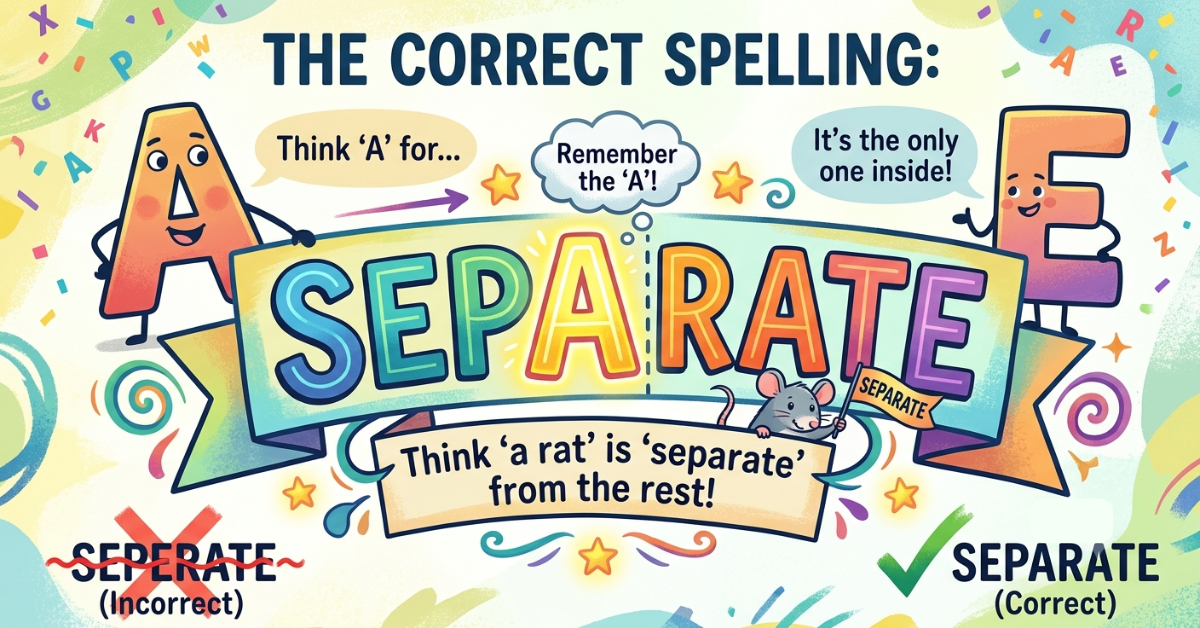
The correct spelling is separate.
- Separate = correct
- Seperate = incorrect spelling
This rule applies in:
- UK English
- US English
- Australian English
- Canadian English
So if you’re asking “is it seperate or separate?”, the answer is simple: always use separate.
Why Do People Spell “Separate” as “Seperate”?
The mistake usually happens because English spelling doesn’t always match pronunciation neatly. Many people say the word in a way that makes the middle vowel sound like an e, which leads to seperate instead of separate.
There are a few reasons this happens:
1. The Pronunciation Can Be Misleading
In fast speech, separate often sounds like:
- sep-rut
- sep-uh-rate
- sep-rit
That weak middle vowel can make people assume the word is spelled with e instead of a.
2. English Has Plenty of Unpredictable Spellings
English is full of words that don’t sound exactly like they’re written. Think of words like:
- definitely (often misspelled as “definately”)
- necessary
- occasion
- embarrass
Separate falls into the same category: common word, common mistake.
3. It’s a Frequently Used Word
Because people use separate in school, work, legal writing, and everyday conversation, the misspelling gets repeated often. The more often a wrong form appears online or in casual writing, the more “normal” it can start to look.
What Does “Separate” Mean?
The word separate can work as an adjective, a verb, and sometimes a noun depending on context. That versatility is one reason it appears so often in English.
Separate as an Adjective
As an adjective, separate means not joined, distinct, or existing independently.
Examples:
- We booked separate hotel rooms.
- Keep raw meat in a separate container.
- The project has three separate stages.
In these examples, separate describes things that are divided or not combined.
Separate as a Verb
As a verb, separate means to divide, disconnect, split, or move apart.
Examples:
- Please separate the white clothes from the dark ones.
- The teacher asked students to separate into groups.
- Oil and water naturally separate over time.
In verb form, the word describes the action of dividing or pulling apart.
Separate as a Noun
Less commonly, separates can refer to clothing items designed to be worn with other pieces rather than as part of a full set.
Example:
- The store sells jackets, skirts, and designer separates.
This usage is more common in fashion and retail contexts.
Is “Seperate” Ever Correct?
No. Seperate is not a standard English word.
It is not accepted in:
- formal writing
- academic writing
- business communication
- British English dictionaries
- American English dictionaries
Whether you’re writing for university, work, social media, or a blog, “seperate” should always be corrected to “separate.”
Seperate or Separate UK: Is There a British Difference?
No—there is no UK spelling difference here.
If you’re specifically searching “seperate or separate uk,” the correct British spelling is still separate. British dictionaries, grammar guides, and style references all use separate, not seperate.
That means:
- UK English: separate
- US English: separate
- Australian English: separate
- Canadian English: separate
Unlike words such as colour/color, centre/center, or organise/organize, separate does not change by region.
How to Remember the Correct Spelling of Separate
If this is one of those words you keep typing wrong, don’t worry—there are a few easy ways to lock it in.
Memory Trick #1: Think “There’s ‘a rat’ in sep-a-rat-e”
One classic memory trick is:
sep + a + rat + e = separate
It sounds silly, but that’s exactly why it works. The phrase helps you remember that the word has A in the middle, not E.
Memory Trick #2: Break It Into Syllables
Try writing it like this:
sep-a-rate
Seeing the a clearly in the middle makes it easier to remember the correct spelling.
Memory Trick #3: Pair It With Meaning
The word separate means to divide things apart. So tell yourself:
“To keep things apart, I need the a in sep-a-rate.”
A memorable phrase often works better than pure memorization.
Common Sentences Using “Separate”
The best way to remember spelling is to see the word used naturally. Here are examples in different contexts.
Everyday Use
- We need separate plates for the guests.
- Please keep these documents in separate folders.
- They decided to live in separate houses.
Work and Business
- Send the invoice as a separate attachment.
- The finance and marketing teams operate as separate departments.
- Please separate personal expenses from business expenses.
Academic Writing
- The report is divided into separate sections.
- Researchers analyzed the samples in separate trials.
- The essay should clearly separate fact from opinion.
Relationships and Social Context
- The couple decided to separate for a while.
- Parents may live in separate homes after a divorce.
- It can be hard to separate emotions from logic in difficult decisions.
Separate vs Similar Commonly Misspelled Words
If you often mix up separate, you may also struggle with other words that sound one way and look another. Here are a few similar examples:
| Incorrect | Correct |
| seperate | separate |
| definately | definitely |
| embarass | embarrass |
| goverment | government |
| untill | until |
These words are tricky because they’re common, frequently spoken, and easy to type from memory rather than from rule.
Why Correct Spelling Matters More Than You Think
A misspelling like seperate may seem minor, but in some contexts it can affect how your writing is perceived.
1. It Affects Professional Credibility
In emails, CVs, proposals, and reports, spelling mistakes can make writing look rushed or unpolished. If someone notices seperate in a professional document, it can distract from your message.
2. It Matters in Academic Writing
Teachers, examiners, and professors usually expect accurate spelling in assignments, essays, and research papers. Repeated spelling errors can affect clarity and, in some cases, grades.
3. It Impacts Search and Content Quality
If you’re writing online content, product descriptions, or blog posts, correct spelling improves readability and trust. It also helps maintain content quality for both readers and search engines.
4. It Reduces Misunderstandings
While most people will guess what you meant, clean spelling makes reading smoother. Good writing removes friction.
Separate in Grammar: Adjective vs Verb
A lot of spelling confusion clears up once you understand how the word behaves in a sentence.
When “Separate” Is an Adjective
Use it to describe something that is distinct or not joined.
Examples:
- They slept in separate rooms.
- We created separate categories for each product.
- The building has separate entrances.
When “Separate” Is a Verb
Use it when something is being divided or split.
Examples:
- Please separate the recyclables from the trash.
- The referee had to separate the players.
- We should separate the data by age group.
A quick test:
- If the word is describing a noun, it’s probably an adjective.
- If the word is showing an action, it’s a verb.
How “Separate” Is Used in Different Fields
Because the word is so versatile, it shows up in many areas of life and work.
In Education
Teachers may ask students to:
- separate ideas into paragraphs
- separate facts from opinions
- separate subjects into folders
In Business
Companies often talk about:
- separate departments
- separate invoices
- separate accounts
- separate contracts
In Science
You’ll see it in phrases like:
- separate compounds
- separate variables
- separate the mixture
- cells separate during division
In Law and Relationships
Common uses include:
- legal separation
- separate property
- separate households
- separate agreements
Seperate or Separate: A Simple Comparison Table
If you just want the difference at a glance, this table makes it easy:
| Word | Correct? | Meaning | Used in UK English? |
| Separate | Yes | To divide, distinct, not together | Yes |
| Seperate | No | Misspelling of separate | No |
How to Stop Writing “Seperate” by Mistake
If this is a recurring typo for you, here are a few practical ways to fix it for good.
1. Add It to Your Personal “Watch List”
Everyone has a few words they consistently misspell. Make a short list in your notes app or notebook with words like:
- separate
- definitely
- necessary
- occurred
Reviewing your own trouble words works surprisingly well.
2. Use Spellcheck—But Don’t Depend on It Blindly
Spellcheck can catch seperate, but it’s better to learn the pattern so you don’t have to rely on software every time.
3. Read Your Writing Out Loud
Reading aloud slows you down enough to catch awkward wording and spelling slips. It’s especially useful for emails, assignments, and captions.
4. Practice the Correct Version in Real Sentences
Write five original sentences using separate. Repetition in context helps more than copying the word twenty times.
Example practice:
- I keep my art supplies in separate boxes.
- The presentation is divided into separate sections.
- We need to separate the data before analysis.
Common Phrases With “Separate”
Learning a word through common phrases makes it easier to remember. Here are some combinations you’ll see often:
- separate room
- separate account
- separate issue
- separate file
- separate category
- separate ways
- separate from
- separate into groups
- completely separate
- legally separate
These phrases show how natural and frequent the word is in daily English.
Key Takeaways
If you only remember a few things from this guide, make them these:
- Separate is the correct spelling.
- Seperate is always a misspelling.
- The spelling is the same in UK and US English.
- Separate can be an adjective or a verb.
- A simple memory trick is sep-a-rat-e.
FAQs About “Seperate or Separate”
Is it seperate or separate?
It is separate. Seperate is a spelling mistake and should not be used in standard English writing.
Is “seperate” ever correct in UK English?
No. If you’re searching seperate or separate uk, the correct British spelling is still separate.
Why do people spell separate as seperate?
Usually because the word’s pronunciation makes the middle vowel sound unclear. People often hear an e sound and write seperate by mistake.
How do I remember how to spell separate?
A popular trick is sep-a-rat-e. It helps you remember the a in the middle of the word.
Is separate a noun, verb, or adjective?
It can be both a verb and an adjective. For example, “Please separate the papers” uses the verb, while “Use separate folders” uses the adjective.
Is there a US vs UK spelling difference for separate?
No. Unlike some British and American spelling differences, separate stays the same in both versions of English.
Final Verdict: Separate Is Always the Correct Spelling
If you’ve been second-guessing seperate or separate, the answer is straightforward: separate is correct, and seperate is not. That doesn’t mean the mistake is unusual—it’s actually one of the most common spelling slips in English—but it’s still worth fixing, especially in professional, academic, or public writing.
The good news is that once you remember sep-a-rat-e, the confusion usually disappears. Keep the correct form in mind, use it in real sentences, and you’ll stop hesitating every time the word shows up. If you’re polishing your writing, mastering small distinctions like this can make a surprisingly big difference.
Author

linguaezone.com@gmail.com
Related Posts

Kill Two Birds With One Stone Alternative: 50 Better Options
- 0
- 1,569 word
Have you ever paused before saying “kill two birds with one stone” because it sounded too violent or simply didn’t fit the...
Read out all
Happy Sabbath Meaning: A Complete Guide to Its Significance
- 0
- 1,632 word
Have you ever received the message “Happy Sabbath” and wondered what it truly means? Is it simply another way of saying “have...
Read out all
I’m So Proud of You in Other Words: 120+ Heartfelt Alternatives
- 0
- 1,562 word
Have you ever wanted to tell someone you’re proud of them but felt like saying “I’m so proud of you” sounded repetitive?...
Read out all
How Do You Spell Happy Anniversary? Correct Spelling Guide
- 0
- 1,221 word
Have you ever paused before writing an anniversary card and wondered, “How do you spell happy anniversary?” You’re not alone. Whether you’re...
Read out all
Waiting for Your Response Email: Best Examples & Tips
- 0
- 1,483 word
Have you ever sent an important email and found yourself wondering whether you should follow up or simply wait? Whether you’re communicating...
Read out all
Great Asset to the Team: Meaning, Examples & Tips
- 0
- 1,494 word
Have you ever wanted to compliment a coworker but struggled to find words that sound professional and sincere? One of the most...
Read out all