
×
Wander vs Wonder: Meaning, Difference, and Examples
In

Have you ever paused mid-sentence and wondered whether to write wander or wonder? These two words sound almost identical, but their meanings are very different, and mixing them up can change the entire message. In this guide to wander vs wonder, you will learn the meaning, definition, usage, examples, and simple memory tricks that make the difference easy to remember.

What Is the Difference Between Wander and Wonder?

At first glance, wander and wonder may seem like close cousins, but they belong to very different ideas.

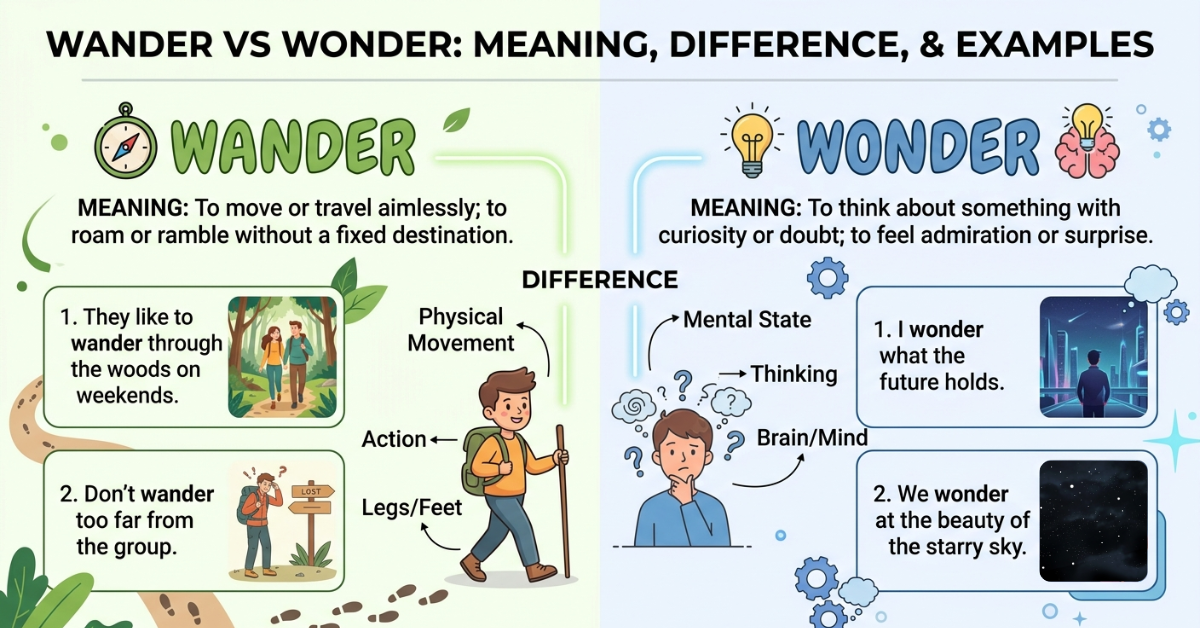
  • Wander means to move around without a fixed direction, purpose, or destination.
  • Wonder means to think curiously about something, feel amazement, or ask questions in your mind.

The easiest way to separate them is this:
wander is about movement, while wonder is about thought or curiosity.

Wander vs Wonder Meaning

Wander Meaning

The word wander usually refers to physical movement without a clear path. A person might wander through a park, wander around a city, or wander aimlessly after lunch.

It can also be used in a more figurative way, such as when someone’s thoughts wander during a boring lecture.

Wonder Meaning

The word wonder is usually connected to curiosity, surprise, or admiration. You might wonder why the sky changes color, wonder what someone is thinking, or wonder at a beautiful sunset.

In short, wonder is about the mind, emotions, and questions.

Wander vs Wonder Definition

Definition of Wander

Wander: to move about casually, slowly, or without a set course.

Example:
She wandered through the market and enjoyed the colorful stalls.

Definition of Wonder

Wonder: to feel curiosity, surprise, or admiration; to think about something with interest.

Example:
He wondered why the train was delayed.

Easy Way to Remember Wander vs Wonder

A simple memory trick can help:

  • Wander has an a, like around — you wander around.
  • Wonder has an o, like observe or observe with curiosity — you wonder about something.

Another helpful hint:

  • If there is movement, use wander.
  • If there is thinking, use wonder.

Wander and Wonder in Sentences

Seeing both words in real sentences makes the difference much clearer.

Sentences with Wander

  • I like to wander along the beach in the evening.
  • The child wandered away from the group.
  • My mind tends to wander when I am tired.

Sentences with Wonder

  • I wonder what will happen next.
  • She wondered whether she had left the door unlocked.
  • We looked at the stars and wondered about the universe.

Common Mistakes People Make

Because the words sound so similar, people often use them incorrectly in writing and speaking.

Mistake 1: Using Wonder for Movement

Incorrect: He wondered into the garden.
Correct: He wandered into the garden.

Mistake 2: Using Wander for Curiosity

Incorrect: I wander why she is upset.
Correct: I wonder why she is upset.

Mistake 3: Mixing Them in Spoken English

In fast speech, the words can sound similar, but the context usually tells you which one is right. Always ask: is this about going somewhere or thinking about something?

Wander vs Wonder in Everyday Life

These words appear in many kinds of writing, from casual conversation to literature and professional communication.

In Travel Writing

Writers often use wander to describe exploring places naturally and freely. It creates a relaxed, curious feeling.

Example:
Tourists wandered through the old streets of the city.

In Emotional or Reflective Writing

Writers use wonder to show curiosity, amazement, or deep thought.

Example:
She wondered how life would change after the move.

In Creative Writing

Both words can be powerful because they create different moods.

  • Wander gives motion, freedom, and exploration.
  • Wonder gives thought, mystery, and imagination.

Wander vs Wonder: Comparison Table

Word Main Meaning Type of Idea Example
Wander Move without a fixed direction Physical movement He wandered through the park.
Wonder Think curiously or feel amazement Mental activity I wonder what she meant.

Why People Search for Wander vs Wonder

People often look up wander vs wonder meaning because the words are nearly identical in sound but not in usage. That makes them a common spelling and vocabulary challenge for students, writers, and English learners.

This topic is especially useful for:

  • students improving English grammar and vocabulary
  • writers checking word choice
  • learners preparing for exams
  • anyone who wants clearer communication

Practical Tips to Use Wander and Wonder Correctly

Here are a few easy rules to follow:

  1. Ask yourself whether the sentence is about movement or thought.
  2. Replace the word with a simpler synonym:
    • wander = roam, drift, move aimlessly
    • wonder = ask, think, marvel, feel curious
  3. Read the sentence aloud and check the meaning.
  4. Use context clues from the rest of the sentence.

Key Takeaways

  • Wander means to move without a clear direction.
  • Wonder means to think curiously or feel amazement.
  • The difference is simple: wander = movement, wonder = thought.
  • A quick context check prevents most mistakes.
  • Both words are useful in everyday English, creative writing, and formal communication.

FAQs About Wander vs Wonder

1. What is the meaning of wander vs wonder?

Wander means to move around without a fixed direction, while wonder means to think curiously or feel amazement. The main difference is that one is about movement and the other is about thought.

2. What is the definition of wander?

Wander means to walk or move without a clear plan or destination. It can also mean for thoughts to drift away.

3. What is the definition of wonder?

Wonder means to feel curiosity, surprise, or admiration. It is often used when someone is thinking about a question or mystery.

4. How do I remember wander and wonder easily?

Remember that wander is linked to walking around, while wonder is linked to thinking with curiosity. Movement points to wander; questioning points to wonder.

5. Is it wander or wonder why?

The correct phrase is wonder why. You use wonder because the sentence is about thinking or asking a question, not movement.

6. Can wander be used for thoughts?

Yes, wander can describe thoughts that drift away, such as “My mind wandered during the meeting.” In that case, it still keeps the idea of movement, but in a mental sense.

Conclusion

The difference between wander and wonder is easier than it first appears. One word describes moving without direction, and the other describes thinking with curiosity or amazement. Once you understand the contrast, you can use both words confidently in speech and writing. Keep the movement-versus-thought rule in mind, and the confusion disappears quickly.

Leave a Reply

Your email address will not be published. Required fields are marked *

Author

britsx85@gmail.com

Related Posts

To Many or Too Many: What's the Correct Usage?
In

To Many or Too Many: What’s the Correct Usage?

Have you ever paused while writing and wondered whether it should be to many or too many? You’re not alone. This is...

Read out all
Shown Synonym: Best Alternatives, Meaning & Examples
In

Shown Synonym: Best Alternatives, Meaning & Examples

Have you ever written the word shown several times in the same paragraph and wondered if there was a better alternative? You’re...

Read out all
To Fast or Too Fast? Learn the Correct Usage Easily
In

To Fast or Too Fast? Learn the Correct Usage Easily

Have you ever paused while typing and wondered, “Is it to fast or too fast?” You’re not alone. It’s one of the...

Read out all
Inter vs Intra: Meaning, Differences & Easy Examples
In

Inter vs Intra: Meaning, Differences & Easy Examples

Have you ever wondered why words like international, interstate, intramural, and intracellular all sound similar but mean completely different things? The secret...

Read out all
Learn the difference between vicious vs viscous with simple definitions, examples, pronunciation, and easy memory tricks to use each word correctly.
In

Vicious vs Viscous: What’s the Difference?

Have you ever read a sentence and wondered whether the correct word was vicious or viscous? You’re not alone. These two words...

Read out all
What Is FAFO? Meaning, Slang, Parenting, and Texting
In

What Is FAFO? Meaning, Slang, Parenting, and Texting

Ever seen FAFO in a comment, text, or parenting discussion and wondered what it means? The short answer is that what is...

Read out all