
- 0
- 1,883 word
Have you ever typed a date like 22th June and then paused, wondering if it looked a little off? You’re not alone. English ordinal numbers can be surprisingly tricky, especially when numbers end in 2, 3, or those confusing teen combinations like 11, 12, and 13.
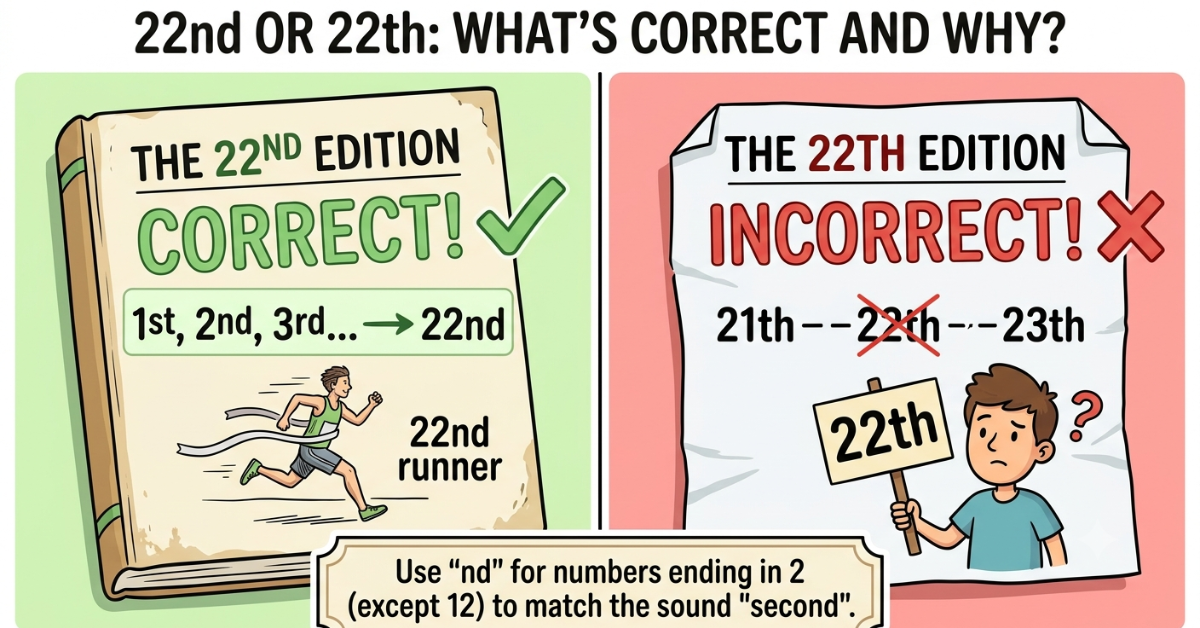
If you’ve been searching for the answer to 22nd or 22th, here’s the short version: 22nd is correct, and 22th is incorrect. But the reason matters too. Once you understand how ordinal numbers work in English, you’ll stop second-guessing yourself in dates, invitations, essays, emails, captions, and formal writing. In this guide, you’ll learn the exact rule, why people make this mistake, how to use ordinal numbers properly, and how to avoid similar errors in the future.
22nd or 22th: Which One Is Correct?
The correct form is 22nd.
- Correct: 22nd
- Incorrect: 22th
So if you’re writing a date, birthday, event, or ranking, you should write:
- 22nd June
- the 22nd day
- her 22nd birthday
- the 22nd chapter
You should not write:
- 22th June
- the 22th day
- her 22th birthday
The confusion usually comes from the fact that many ordinal numbers end in -th, such as 4th, 5th, 6th, 10th, 14th, 20th. But English doesn’t use -th for every number. Some numbers take -st, -nd, or -rd, depending on the last digit and a few important exceptions.
Why 22nd Is Correct: The Rule Behind Ordinal Numbers
To understand 22nd or 22th, you need to know how ordinal numbers work.
What are ordinal numbers?
Ordinal numbers show position, order, sequence, or rank. They answer questions like:
- Which day?
- Which position?
- Which chapter?
- Which floor?
Examples:
- 1st = first
- 2nd = second
- 3rd = third
- 4th = fourth
- 21st = twenty-first
- 22nd = twenty-second
- 23rd = twenty-third
- 24th = twenty-fourth
The core rule
In most cases, ordinal number endings depend on the last digit of the number:
- Numbers ending in 1 usually take -st
- Numbers ending in 2 usually take -nd
- Numbers ending in 3 usually take -rd
- Most other numbers take -th
That’s why:
- 21 → 21st
- 22 → 22nd
- 23 → 23rd
- 24 → 24th
Since 22 ends in 2, it takes -nd, so the correct form is 22nd.
The Quick Answer to “22nd or 22th”
If you want a simple memory trick, use this:
- 22 = twenty-two
- The ordinal form of two is second
- So twenty-two becomes twenty-second
- Therefore, the abbreviation is 22nd
That’s the easiest way to remember it.
You wouldn’t say “twenty-twoth,” so you shouldn’t write 22th either.
Ordinal Number Endings Explained
Here’s the general pattern for ordinal numbers in English.
Numbers ending in 1 → use -st
Examples:
- 1st
- 21st
- 31st
- 41st
Numbers ending in 2 → use -nd
Examples:
- 2nd
- 22nd
- 32nd
- 42nd
Numbers ending in 3 → use -rd
Examples:
- 3rd
- 23rd
- 33rd
- 43rd
Numbers ending in 4, 5, 6, 7, 8, 9, 0 → use -th
Examples:
- 4th
- 5th
- 10th
- 14th
- 19th
- 20th
- 24th
- 30th
At first glance, that rule seems easy enough. But there’s one major exception you need to know.
The Important Exception: 11th, 12th, and 13th
Even though 11, 12, and 13 end in 1, 2, and 3, they do not take -st, -nd, or -rd.
Instead, they are:
- 11th
- 12th
- 13th
This exception also applies to larger numbers ending in 11, 12, or 13:
- 111th
- 112th
- 113th
So the rule is not just about the final digit. You also need to check whether the number ends in 11, 12, or 13.
Simple rule to remember
Use:
- -st for numbers ending in 1
- -nd for numbers ending in 2
- -rd for numbers ending in 3
- -th for everything else
Except when the number ends in 11, 12, or 13 — then always use -th.
That’s why:
- 21st is correct
- 22nd is correct
- 23rd is correct
- 24th is correct
- 11th is correct
- 12th is correct
- 13th is correct
Why “22th” Looks Wrong
The reason 22th looks awkward is because it doesn’t match the spoken form of the number.
We say:
- twenty-second
not - twenty-twoth
English ordinal abbreviations come from the word form of the number.
Compare the full words and abbreviations
| Cardinal Number | Ordinal Word | Correct Abbreviation |
| 21 | twenty-first | 21st |
| 22 | twenty-second | 22nd |
| 23 | twenty-third | 23rd |
| 24 | twenty-fourth | 24th |
Once you think of 22nd as short for twenty-second, the mistake becomes much easier to spot.
22nd in Dates: How to Write It Correctly
One of the most common places people ask about 22nd or 22th is in dates. Here’s how to write dates correctly.
Correct examples
- 22nd June 2026
- June 22nd, 2026
- My exam is on the 22nd
- She was born on the 22nd of April
- The event will take place on the 22nd
Incorrect examples
- 22th June 2026
- June 22th, 2026
- the 22th of April
If you’re writing invitations, academic assignments, blog posts, captions, resumes, or professional emails, 22nd is the correct and polished choice.
22nd in Everyday Writing
Ordinal numbers show up in more places than just dates. You’ll also use them in:
- birthdays
- anniversaries
- rankings
- school grades or chapters
- sports positions
- floors in a building
- competition results
- lists and sequences
Examples of correct use
- She celebrated her 22nd birthday last week.
- He finished in 22nd place.
- We live on the 22nd floor.
- Read the 22nd chapter before class.
- This is the 22nd time I’ve explained it.
In all of these examples, 22nd is the only correct form.
Common Ordinal Number Mistakes Similar to 22th
If someone writes 22th, they often make similar mistakes with other numbers too. Here are some common ones to watch for:
Common mistakes
- 21th (wrong) → 21st (Correct)
- 22th (wrong) → 22nd (Correct)
- 23th (wrong) → 23rd (Correct)
- 31th (wrong) → 31st (Correct)
- 32th (wrong) → 32nd (Correct)
- 33th (wrong) → 33rd (Correct)
Why these mistakes happen
Most people learn early that ordinal numbers often end in -th, so they apply that ending too broadly. It’s a natural mistake, especially when typing quickly or writing informal content online. But in correct English, numbers ending in 1, 2, or 3 often change their suffix.
A Simple Trick to Remember 22nd
If ordinal suffix rules don’t stick easily, use this quick method:
Step 1: Say the number out loud
Say 22 as twenty-two.
Step 2: Turn it into an ordinal word
Ask yourself: what is the ordinal form of twenty-two?
It becomes twenty-second.
Step 3: Match the ending
The word second corresponds to 2nd.
So:
- 22 = twenty-two
- 22nd = twenty-second
This trick works for many ordinal numbers:
- 21 → twenty-first → 21st
- 22 → twenty-second → 22nd
- 23 → twenty-third → 23rd
- 24 → twenty-fourth → 24th
Ordinal Numbers Chart: Quick Reference Guide
Here’s a helpful chart for common ordinal numbers around 22:
| Number | Correct Ordinal |
| 20 | 20th |
| 21 | 21st |
| 22 | 22nd |
| 23 | 23rd |
| 24 | 24th |
| 25 | 25th |
| 26 | 26th |
| 27 | 27th |
| 28 | 28th |
| 29 | 29th |
| 30 | 30th |
This is one of the easiest ways to check yourself when writing dates or numbered positions.
Is “22th” Ever Correct in English?
No. In standard English, 22th is not correct.
It isn’t accepted in formal writing, academic writing, professional communication, edited content, or standard grammar usage. Whether you’re writing in British English or American English, the correct form is still 22nd.
There’s no grammar context in which 22th becomes the standard correct version.
British vs American English: Does the Rule Change?
No — the ordinal suffix rule stays the same in both varieties of English.
British English
You might see dates written as:
- 22nd June 2026
American English
You might see dates written as:
- June 22nd, 2026
The format of the date changes, but the ordinal suffix does not. In both cases, 22nd is correct.
Should You Always Write the Suffix in Dates?
Not necessarily. This depends on the style guide or context.
You may write:
- 22 June 2026
- June 22, 2026
- 22nd June 2026
- June 22nd, 2026
All of these can be acceptable depending on the style, tone, and region.
However, if you do use an ordinal suffix, it must be the correct one. That means:
- Correct: 22nd
- Incorrect: 22th
In formal and modern business writing, many style guides prefer writing dates without superscript-style suffixes, such as 22 June 2026. But in conversational writing, invitations, blogs, captions, and personal messages, ordinal forms are still very common.
How Children and English Learners Can Remember It
If you’re teaching a child, student, or someone learning English, keep it simple:
Use the “1, 2, 3 pattern”
- 1 = st
- 2 = nd
- 3 = rd
- everything else = th
Then teach the special exceptions:
- 11th
- 12th
- 13th
Use speaking practice
Ask them to say the number aloud:
- 22 = twenty-two
- 22nd = twenty-second
If the spoken form sounds like second, the abbreviation should end in -nd.
This approach works well because it links spelling to pronunciation instead of rote memorization.
Practical Tips to Avoid Writing 22th by Mistake
If you often write dates, event posts, assignments, or captions, these habits can help:
1. Say the number out loud before writing it
If you say twenty-second, you’ll naturally choose 22nd.
2. Memorize the three special suffixes
Keep this mini rule in mind:
- 1 → st
- 2 → nd
- 3 → rd
3. Watch out for 11, 12, and 13
These are the main exceptions:
- 11th
- 12th
- 13th
4. Double-check dates in formal writing
Before submitting an essay, sending an email, or posting an invitation, scan your dates for suffix mistakes.
5. Save a quick ordinal reference
If you write frequently, keep a short list of ordinal numbers nearby until the pattern becomes automatic.
22nd or 22th in Social Media, Invitations, and Captions
People often notice grammar mistakes most in short public writing, especially where dates are involved. Think:
- birthday posts
- wedding invitations
- event banners
- Instagram captions
- YouTube thumbnails
- class notices
- digital planners
For example:
- Correct: Join us on 22nd July for our launch event
- Correct: My 22nd birthday dinner
- Incorrect: See you on 22th July
Because these are visible, shareable pieces of writing, using the correct form helps your message look more polished and credible.
Key Takeaways
If you only remember a few things from this article, make them these:
- 22nd is correct
- 22th is incorrect
- Ordinal suffixes depend on the ending of the number
- Numbers ending in 2 usually take -nd
- 22nd comes from twenty-second
- The main exceptions are numbers ending in 11, 12, and 13, which use -th
Frequently Asked Questions
Is it 22nd or 22th?
It is 22nd, not 22th. The number 22 takes the -nd ordinal suffix because it ends in 2 and is written as twenty-second.
Why is 22nd correct instead of 22th?
Because the ordinal form of 22 is twenty-second. In English, numbers ending in 2 usually take -nd, unless they fall into the special teen exceptions like 12.
How do you write 22 in ordinal form?
The ordinal form of 22 is 22nd. Written in words, it is twenty-second.
Is 22th ever acceptable?
No, 22th is not standard English. In formal, informal, academic, and everyday writing, the correct form is 22nd.
How do I know whether to use st, nd, rd, or th?
Look at the last digit of the number:
- 1 → st
- 2 → nd
- 3 → rd
- most others → th
But remember the exceptions: 11th, 12th, and 13th.
How should I write a date with 22?
You can write it as 22nd June or June 22nd, depending on your style and region. Just avoid 22th, which is incorrect.
Conclusion
If you’ve been unsure about 22nd or 22th, the answer is straightforward: 22nd is the correct form, and 22th is wrong. The reason comes down to how ordinal numbers work in English. Since 22 becomes twenty-second, its abbreviation must end in -nd.
Once you understand that ordinal numbers follow patterns — with a few important exceptions like 11th, 12th, and 13th — these choices become much easier. Whether you’re writing dates, birthday captions, event invites, essays, or professional emails, getting small details like this right makes your writing look cleaner and more confident. If you often mix up ordinal numbers, keep a quick reference handy and practice with real examples — it becomes second nature faster than you’d think.
Author

linguaezone.com@gmail.com
Related Posts

Kill Two Birds With One Stone Alternative: 50 Better Options
- 0
- 1,569 word
Have you ever paused before saying “kill two birds with one stone” because it sounded too violent or simply didn’t fit the...
Read out all
Happy Sabbath Meaning: A Complete Guide to Its Significance
- 0
- 1,632 word
Have you ever received the message “Happy Sabbath” and wondered what it truly means? Is it simply another way of saying “have...
Read out all
I’m So Proud of You in Other Words: 120+ Heartfelt Alternatives
- 0
- 1,562 word
Have you ever wanted to tell someone you’re proud of them but felt like saying “I’m so proud of you” sounded repetitive?...
Read out all
How Do You Spell Happy Anniversary? Correct Spelling Guide
- 0
- 1,221 word
Have you ever paused before writing an anniversary card and wondered, “How do you spell happy anniversary?” You’re not alone. Whether you’re...
Read out all
Waiting for Your Response Email: Best Examples & Tips
- 0
- 1,483 word
Have you ever sent an important email and found yourself wondering whether you should follow up or simply wait? Whether you’re communicating...
Read out all
Great Asset to the Team: Meaning, Examples & Tips
- 0
- 1,494 word
Have you ever wanted to compliment a coworker but struggled to find words that sound professional and sincere? One of the most...
Read out all