
- 0
- 594 words
The phrase tiff meaning often confuses people because it can refer to two completely different things depending on context. In everyday language, it describes a small disagreement, while in technology it relates to a high-quality image format used in computers.
In this guide, we’ll break down both tiff meaning and tiff meaning computer in a simple, human-friendly way so you can understand exactly how and when each one is used.
What is Tiff Meaning in Everyday Language?
In general English, tiff meaning refers to a minor argument or a short disagreement between people. It’s not a serious fight—more like a small emotional misunderstanding that usually gets resolved quickly.
Common examples of a “tiff”
- A small disagreement between friends
- A brief argument in a relationship
- A moment of irritation over something minor
Think of it as a “mini fight” that doesn’t last long. People often use the word to soften the seriousness of a disagreement.
TIFF Meaning Computer: What Does It Stand For?
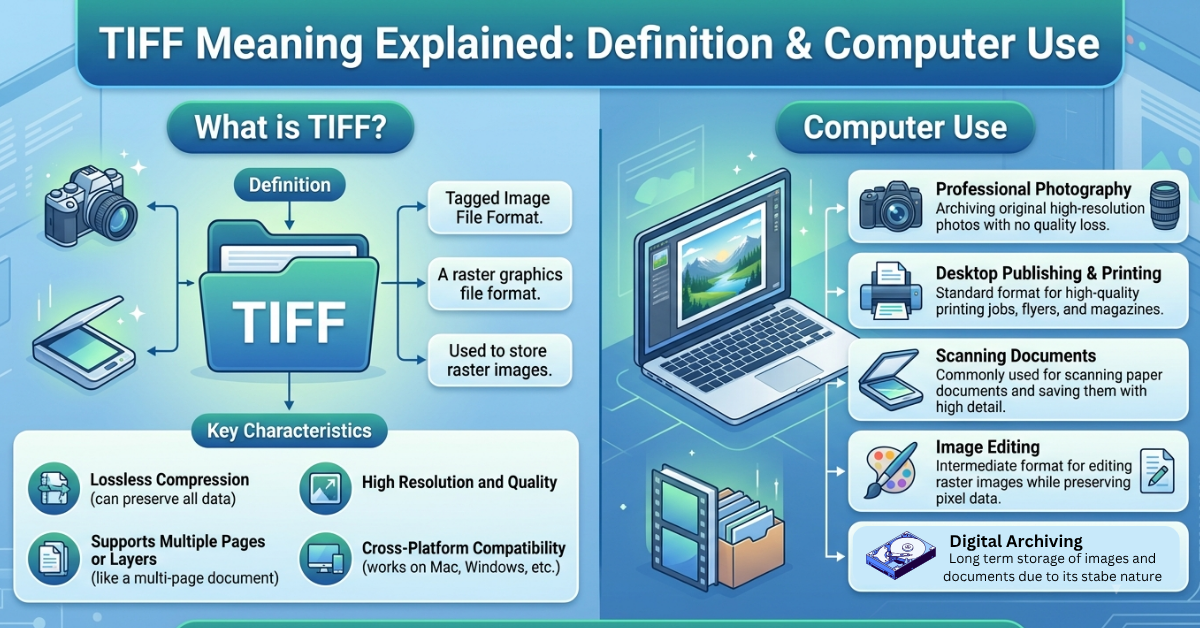
When we talk about tiff meaning computer, we enter the world of digital images. TIFF stands for Tagged Image File Format, which is a high-quality image format used in computers and professional design work.
TIFF=TaggedImageFileFormatTIFF = Tagged Image File Format
This format is widely used because it preserves image quality without losing data, making it ideal for editing and printing.
Key Features of TIFF files
- Lossless image quality (no compression loss)
- High resolution support
- Common in photography and publishing
- Large file size compared to JPEG or PNG
Professionals in graphic design, printing, and publishing often prefer TIFF files because they maintain every detail of an image.
Why TIFF Format is Important in Computers
The tiff meaning computer goes beyond just a file type—it plays a key role in industries where image quality matters.
Where TIFF is commonly used:
- Professional photography
- Magazine and book printing
- Medical imaging (like X-rays and scans)
- Graphic design projects
Because TIFF files keep images sharp and detailed, they are trusted in environments where accuracy is essential.
TIFF vs Other Image Formats
To better understand TIFF, let’s compare it with other popular formats:
- TIFF vs JPEG: TIFF keeps quality, JPEG compresses and reduces size
- TIFF vs PNG: PNG is lighter, TIFF is more detailed
- TIFF vs PDF: PDF is for documents, TIFF is mainly for images
This makes TIFF the preferred choice when quality matters more than file size.
Quick Summary
- In language, a tiff is a small disagreement
- In technology, TIFF is a high-quality image file format
- Both meanings are completely unrelated but commonly searched together
- Understanding context helps you interpret the correct meaning easily
FAQs About TIFF Meaning
1. What does tiff meaning usually refer to?
It usually means a small argument or disagreement in everyday conversation.
2. What is tiff meaning computer?
It refers to TIFF (Tagged Image File Format), a high-quality image format used in computers.
3. Is a tiff a serious argument?
No, a tiff is typically a minor and temporary disagreement.
4. Why is TIFF used in computers?
Because it preserves image quality without losing detail, making it ideal for professional use.
5. Is TIFF better than JPEG?
TIFF offers better quality, but JPEG is smaller and more widely used for everyday images.
Conclusion
Understanding tiff meaning helps you avoid confusion between everyday language and digital technology. While one refers to a small disagreement, the other plays an important role in image processing and professional computing.
If you’re exploring digital file formats or improving your general vocabulary, knowing both meanings gives you a clearer understanding of how context changes interpretation.
Author

linguaezone.com@gmail.com
Related Posts

I’m Patient: Understanding the Meaning, Mindset, and Power of Patience
- 0
- 1,816 word
I’m Patient: What Does It Really Mean? Have you ever found yourself waiting for something important and realized that getting frustrated will...
Read out all
Do and Not: Understanding the Difference and Using Both Correctly
- 0
- 2,303 words
Introduction: Why “Do and Not” Matters in Everyday Communication Have you ever written a sentence and wondered whether you should use “do,”...
Read out all
Proscribed: Meaning, Definition, Examples, and Correct Usage
- 0
- 2,338 words
Introduction: What Does “Proscribed” Mean? Have you ever come across the word proscribed and wondered what it actually means? It is one...
Read out all
Imput: Meaning, Common Usage, and Why People Often Use It Instead of Input
- 0
- 1,592 word
What Does Imput Mean? Have you ever typed “imput” instead of “input” and wondered whether you made a mistake? You are certainly...
Read out all
Emaculate vs Demasculate: Understanding the Difference and Correct Usage
- 0
- 2,156 words
Introduction: Emaculate vs Demasculate Have you ever come across the words emasculate and demasculate and wondered whether they mean the same thing?...
Read out all
What Does LYK Mean in Text? Simple Guide
- 0
- 1,029 word
Ever received a message that says “LYK” and paused for a second? You are not alone. If you have been wondering what...
Read out all