
- 0
- 653 words
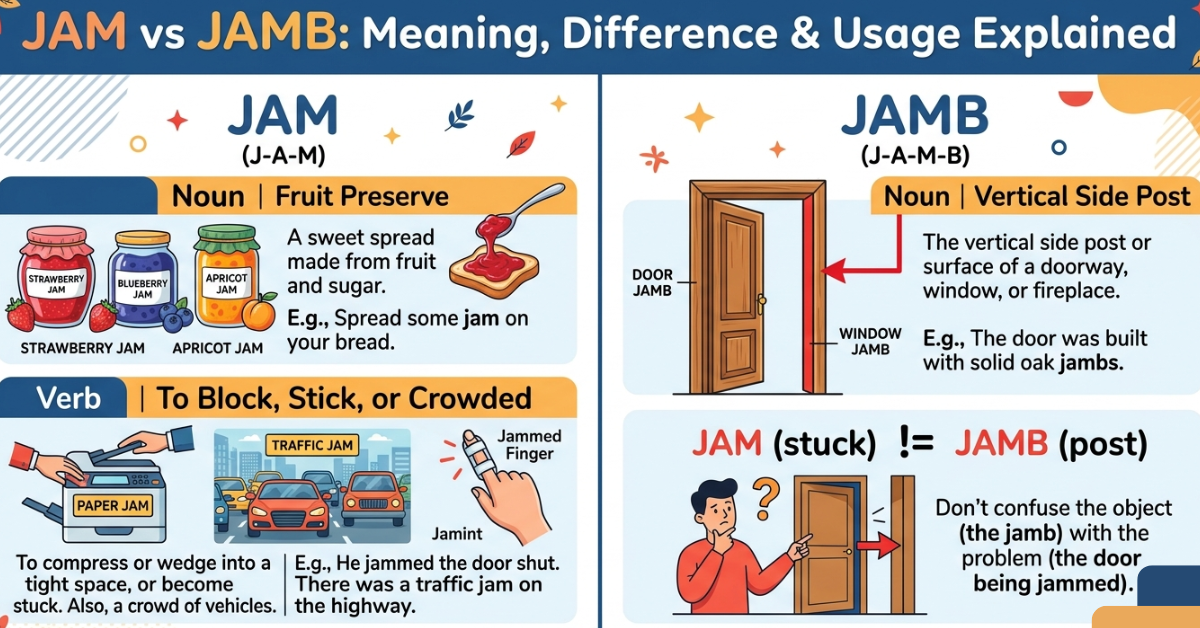
The confusion around jam vs jamb is more common than you might think, especially among English learners and even native speakers. At first glance, they look almost identical, but their meanings are completely different. One refers to something you eat or a traffic situation, while the other is related to architecture and door frames.
Understanding the difference between jam vs jamb can help you avoid embarrassing spelling mistakes in writing, exams, and professional communication. Let’s break it down in a simple, clear, and practical way.
What is Jam?
“Jam” is a familiar word with multiple everyday meanings. Most commonly, it refers to a sweet spread made from fruit and sugar. But it also has other uses in modern English.
Common meanings of jam:
- Food: A sweet spread made from fruits (e.g., strawberry jam)
- Traffic: A situation where vehicles are stuck (traffic jam)
- Music: An informal session of playing music together (jam session)
- Crowded situation: When something is tightly packed or stuck
Example:
- I had toast with strawberry jam this morning.
- We were late because of a traffic jam.
What is Jamb?
“Jamb” is a much less commonly used word, but it has a very specific meaning in architecture and construction. It refers to the vertical sides of a door or window frame.
Simple explanation:
- The jamb is the flat surface on either side of a door or window
- It supports the structure of the frame
- It is part of building and interior design terminology
Example:
- The carpenter fixed the door jamb before installing the door.
Jam vs Jamb: Key Differences Between Jam and Jamb
The confusion between these two words mainly comes from their similar spelling and pronunciation. However, their meanings and usage are completely unrelated.
Key differences:
- Meaning: Jam = food/traffic; Jamb = part of a door frame
- Usage: Jam is everyday language; jamb is technical (construction)
- Context: Jam is informal/common; jamb is professional/specialized
Quick tip:
If you’re talking about food or traffic, it’s “jam.” If you’re talking about doors or windows, it’s “jamb.”
Common Mistakes with Jam vs Jamb
Many people accidentally confuse jam vs jamb in writing, especially when typing quickly or relying on autocorrect.
Typical errors include:
- Writing “door jam” instead of “door jamb”
- Mixing spelling in construction or interior design notes
- Using “jamb” when referring to food or traffic
Being aware of context is the easiest way to avoid these mistakes.
Examples in Sentences
Here are some clear examples to help you understand the correct usage of jam vs jamb:
- The traffic jam lasted for two hours.
- She spread homemade jam on her bread.
- The carpenter repaired the wooden jamb of the door.
- A crack appeared in the window jamb after the renovation.
These examples show how different the two words really are despite their similar appearance.
FAQs
1. What is the main difference between jam vs jamb?
The main difference is meaning: “jam” refers to food or traffic, while “jamb” refers to a door or window frame part.
2. Why do people confuse jam vs jamb?
They are spelled almost the same and sound similar, but their meanings are completely different, leading to common confusion.
3. Is “door jam” correct spelling?
No, the correct term is “door jamb,” which refers to the side frame of a door.
4. Can “jam” have multiple meanings?
Yes, it can refer to food, traffic congestion, or even informal music sessions.
5. Is “jamb” used in everyday English?
Not really. It is mostly used in construction, architecture, and interior design contexts.
Conclusion
Understanding jam vs jamb is a simple but important step in improving your English spelling and vocabulary. While “jam” is widely used in everyday situations like food and traffic, “jamb” is a technical term related to door and window structures.
By remembering their context and usage, you can easily avoid mistakes and write with more confidence. Keep practicing with real-life examples, and soon this confusion will disappear completely.
Author

linguaezone.com@gmail.com
Related Posts

Kill Two Birds With One Stone Alternative: 50 Better Options
- 0
- 1,569 word
Have you ever paused before saying “kill two birds with one stone” because it sounded too violent or simply didn’t fit the...
Read out all
Happy Sabbath Meaning: A Complete Guide to Its Significance
- 0
- 1,632 word
Have you ever received the message “Happy Sabbath” and wondered what it truly means? Is it simply another way of saying “have...
Read out all
I’m So Proud of You in Other Words: 120+ Heartfelt Alternatives
- 0
- 1,562 word
Have you ever wanted to tell someone you’re proud of them but felt like saying “I’m so proud of you” sounded repetitive?...
Read out all
How Do You Spell Happy Anniversary? Correct Spelling Guide
- 0
- 1,221 word
Have you ever paused before writing an anniversary card and wondered, “How do you spell happy anniversary?” You’re not alone. Whether you’re...
Read out all
Waiting for Your Response Email: Best Examples & Tips
- 0
- 1,483 word
Have you ever sent an important email and found yourself wondering whether you should follow up or simply wait? Whether you’re communicating...
Read out all
Great Asset to the Team: Meaning, Examples & Tips
- 0
- 1,494 word
Have you ever wanted to compliment a coworker but struggled to find words that sound professional and sincere? One of the most...
Read out all