
- 0
- 744 words
Have you ever stumbled while writing and wondered whether to use incite vs insight? You’re not alone. These two words sound similar but carry completely different meanings, and mixing them up can change the entire message of your sentence.
The confusion around incite vs insight is common in English because both words are pronounced almost alike, yet one relates to provoking action while the other relates to understanding or clarity. In this guide, we’ll break down their meanings, differences, real-life usage, and simple tricks to never confuse them again.
What Does “Incite” Mean?
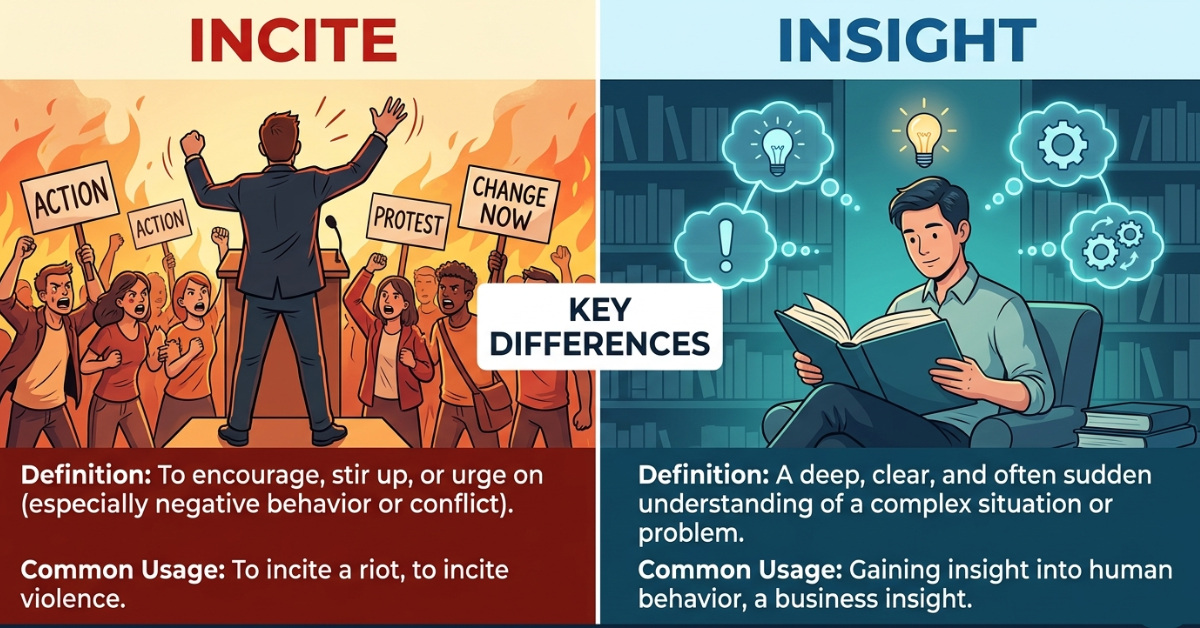
The word incite is a verb. It means to encourage, provoke, or stir someone to take action—often something strong or even negative.
Meaning of Incite:
- To encourage or stir up action
- To provoke emotions or behavior
- Often used in legal or serious contexts
Examples of Incite:
- The speaker tried to incite the crowd to protest.
- Rumors can incite fear among people.
- The post was removed because it could incite violence.
In simple terms, incite is about pushing someone toward action—usually emotionally charged or intense.
What Does “Insight” Mean?
On the other hand, insight is a noun. It refers to a deep understanding or clear perception of something.
Meaning of Insight:
- A clear understanding of a situation
- Deep knowledge or awareness
- Ability to see beyond the obvious
Examples of Insight:
- The report gave valuable insight into customer behavior.
- She has great insight into human psychology.
- His experience provided deep insight into the problem.
So, insight is about understanding, clarity, and awareness—not action.
Incite vs Insight: Key Differences Explained
To make things even clearer, here’s a simple comparison:
| Feature | Incite | Insight |
| Part of Speech | Verb | Noun |
| Meaning | To provoke or encourage action | Deep understanding or awareness |
| Tone | Often intense or negative | Neutral or positive |
| Usage Context | Actions, emotions, behavior | Knowledge, analysis, learning |
Understanding incite vs insight becomes easy when you remember:
- Incite = Ignite action
- Insight = Inner sight (understanding)
How to Remember the Difference Easily
If you often confuse incite vs insight, here are some memory tricks:
1. “Incite” = “In + Cite (Call to action)”
Think of incite as pushing someone into action.
2. “Insight” = “Inward sight”
It means seeing or understanding something deeply from within.
3. Quick Tip:
- If it involves action → incite
- If it involves understanding → insight
Common Mistakes People Make
Many learners mix up incite vs insight in writing and speech. Here are common errors:
- Incorrect: The book gave me incite into history.
Correct: The book gave me insight into history. - Incorrect: The leader shared his insight the crowd.
Correct: The leader tried to incite the crowd.
Being careful with context will help you avoid these mistakes easily.
Why This Confusion Happens
The confusion between incite vs insight mainly happens because:
- They sound similar when spoken
- Both are used in formal English
- Typing errors often go unnoticed
- Auto-correct may not always catch mistakes
Understanding context is the key to solving this confusion permanently.
Real-Life Usage Examples
Incite in real life:
- Political speeches may sometimes incite strong reactions.
- Social media posts can unintentionally incite arguments.
Insight in real life:
- Business analysts use data to gain insight into trends.
- Therapy sessions often provide emotional insight.
Quick Recap of Incite vs Insight
- Incite = To provoke action or emotion
- Insight = Deep understanding or clarity
- One leads to action, the other leads to awareness
Once you understand this difference, incite vs insight becomes easy to remember and use correctly.
FAQs About Incite vs Insight
1. What is the main difference between incite and insight?
Incite means to provoke action, while insight means understanding or awareness.
2. Is incite always negative?
Not always, but it is often used in contexts involving strong emotions or actions.
3. Can insight be used in business?
Yes, insight is commonly used in business to describe understanding customer behavior or data trends.
4. How do I avoid confusing incite vs insight?
Focus on context: action = incite, understanding = insight.
5. Are incite and insight related words?
No, they only sound similar but have completely different meanings and origins.
Conclusion
Understanding incite vs insight is essential for clear and accurate English communication. While incite deals with provoking action or emotion, insight focuses on gaining understanding and clarity.
Once you remember the simple rule—action versus awareness—you’ll never mix them up again. Keep practicing with real examples, and your confidence in using both words will grow naturally.
If you’re improving your English vocabulary, mastering such word pairs can significantly enhance your writing and speaking skills.
Author

linguaezone.com@gmail.com
Related Posts
Kill Two Birds With One Stone Alternative: 50 Better Options
- 0
- 1,569 word
Have you ever paused before saying “kill two birds with one stone” because it sounded too violent or simply didn’t fit the...
Read out all
Happy Sabbath Meaning: A Complete Guide to Its Significance
- 0
- 1,632 word
Have you ever received the message “Happy Sabbath” and wondered what it truly means? Is it simply another way of saying “have...
Read out all
I’m So Proud of You in Other Words: 120+ Heartfelt Alternatives
- 0
- 1,562 word
Have you ever wanted to tell someone you’re proud of them but felt like saying “I’m so proud of you” sounded repetitive?...
Read out all
How Do You Spell Happy Anniversary? Correct Spelling Guide
- 0
- 1,221 word
Have you ever paused before writing an anniversary card and wondered, “How do you spell happy anniversary?” You’re not alone. Whether you’re...
Read out all
Waiting for Your Response Email: Best Examples & Tips
- 0
- 1,483 word
Have you ever sent an important email and found yourself wondering whether you should follow up or simply wait? Whether you’re communicating...
Read out all
Great Asset to the Team: Meaning, Examples & Tips
- 0
- 1,494 word
Have you ever wanted to compliment a coworker but struggled to find words that sound professional and sincere? One of the most...
Read out all