
- 0
- 1,374 word
Say your company needs AED 2 million. Maybe for expansion, new equipment, or to buy out a competitor. You’ve got two obvious paths: borrow it, or bring in an investor. Here’s the catch: the cheaper-looking option often isn’t. And the path that keeps your ownership intact can still choke your cash flow six months down the line. This is the exact problem corporate finance advisory Dubai firms spend their days untangling, because the decision looks simple until you actually sit down and run the numbers.
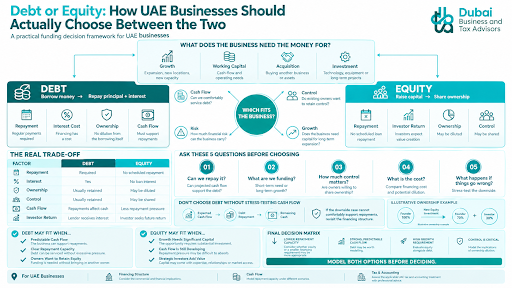
Debt means repayments. Equity means giving up a piece of the company. That’s the short version. The real answer depends on your cash flow, what the money’s actually for, your tax position, and what you’ll need to raise next year. No two businesses land on the same answer here. Don’t trust anyone who tells you otherwise.
What Are You Actually Giving Up?
Debt is straightforward on paper. You borrow money, pay it back with interest, on a schedule. Lenders might want security. There could be covenants limiting what you can do next. But your ownership? Untouched.
Equity flips the whole thing. You sell a slice of the business instead of borrowing against it. No fixed repayments, that’s the appeal. But existing owners get diluted, and investors usually want a say in how things run.
| Debt | Equity |
| Repayment obligation | Ownership dilution |
| Interest and financing costs | Share of future upside |
| May require security | Investor rights may apply |
| Preserves ownership | Reduces repayment pressure |
| Covenants can restrict flexibility | Governance gets more complex |
Start With One Question: What’s the Money Actually For?
This comes before “debt or equity,” not after. Working capital needs to turn back into cash fast enough to cover repayments so debt usually makes sense here. Buying equipment? Asset-backed finance often fits, since the asset’s lifespan roughly matches the loan term.
Expansion and acquisitions are trickier. An acquisition should be judged on the target’s cash flow, not just yours. And if you’re funding something with a genuinely uncertain payback period a new product line, say fixed monthly repayments can turn into a real problem fast. Match the funding to how quickly it pays for itself. Do that, and half this decision makes itself.
Can You Actually Afford the Debt?
Revenue alone won’t tell you. A company billing AED 20 million a month can still struggle with a loan if margins are thin and clients pay in 60 days instead of 30.
Here’s a better test: debt service coverage. It measures how comfortably your cash flow covers the repayments, not whether you qualify for the loan, but whether you can actually live with it once it’s approved.
So run the downside case. What if revenue drops 20%? What if margins slip, or customers slow down, or rates climb? A bank saying yes doesn’t mean your business can comfortably carry the debt. Those are two different questions. Mixing them up is how good businesses end up in bad positions.
How Much Can You Realistically Borrow?
There’s no formula. Anyone quoting you a fixed percentage of revenue is guessing. Borrowing capacity comes down to profitability, existing debt, available security, credit history, and how much of your revenue sits with one or two big clients.
Asset-light businesses, consultancies, tech firms, e-commerce often hit borrowing limits faster than asset-heavy ones, simply because there’s less to put up as collateral. New companies face it worse still. Limited trading history usually means personal guarantees, detailed projections, or both.
What Will a Lender Actually Look At?
Before approving anything, expect them to want:
Financial statements and management accounts
Bank statements
Existing debt schedule
Cash-flow forecast
A clear funding requirement
A modelled repayment plan
Security or guarantees
A downside scenario, already tested
Show up prepared, and things move quickly. Show up without these, and expect delays or a worse rate.
What Does Debt Really Cost?
The interest rate is just the headline. Arrangement fees, legal fees, valuation costs, commitment fees, early repayment charges they stack up, sometimes past the interest itself.
Then there’s the fine print. Covenants can restrict further borrowing, dividends, even asset sales. Breach one, and the lender can call in the whole facility. Read the default clause before signing. Not after.
What Does Equity Really Cost?
Picture a business worth AED 10 million before a AED 2 million raise. Post-money, that’s AED 12 million so the investor walks away with roughly a sixth of the company. Simple enough.
The real cost shows up later. Double the company’s value, and that sixth is now worth far more than the AED 2 million paid for it. And the percentage isn’t the full story anyway. Voting rights, board seats, information rights, exit clauses often matter more than the headline stake.
How UAE Corporate Tax Changes the Math?
Interest on business loans is generally deductible under UAE Corporate Tax but there’s a cap. Net interest above the AED 12 million threshold gets limited to 30% of tax-adjusted EBITDA. Anything disallowed can usually be carried forward.
Shareholder loans need extra care. Pricing has to reflect arm’s-length terms, and the paperwork matters more than most founders expect. Equity isn’t automatically the “tax-free” option either; distributions carry their own treatment. Model both properly. Don’t assume one route wins before you’ve actually checked.
A Practical Decision Framework
| Question | Points toward debt | Points toward equity |
| Cash flow | Predictable | Uncertain |
| Repayment capacity | Strong | Limited |
| Ownership priority | Retain control | Willing to dilute |
| Collateral | Available | Limited |
| Growth timing | Fast payback | Long payback |
| Funding purpose | Working capital/assets | Higher-risk growth |
Use this to spot which questions need more digging. It’s not a scoreboard.
A Worked Example
A UAE company needs AED 2 million to expand. Debt at 8% over five years runs about AED 40,000 a month, ownership stays put, but cash flow feels it immediately. Equity at a AED 10 million valuation skips the monthly repayment entirely, but hands over roughly 17% of the company. Permanently, and on whatever terms the investor negotiates.
Often, a blend works best. Debt for the predictable working-capital piece, equity for the riskier growth bet. Nobody “wins” outright here. It comes down to your cash flow, your valuation, your appetite for risk, and what you’ll need to raise next.
When Should You Bring in Professional Advice?
Once tax, dilution, and covenants are all in play at the same time, this stops being a spreadsheet exercise. That’s where corporate finance advisory Dubai specialists earn their fee stress-testing what you can borrow, modelling out dilution, preparing the paperwork lenders and investors actually want to see, and working through the tax angle before you sign anything irreversible.
Frequently Asked Questions
Is debt or equity better for a UAE business?
Neither wins outright, no matter what generic advice sites claim. It comes down to your cash flow, how much ownership you’re willing to give up, and the true cost once fees and dilution are counted. What you’ll need to raise next year matters too.
How much can a UAE company borrow?
There’s no standard percentage of revenue that applies to everyone. Lenders weigh security, credit history, and repayment capacity together, and the number shifts case by case. Asset-heavy businesses usually borrow more easily than asset-light ones.
Is business-loan interest tax deductible in the UAE?
Mostly, yes but not without limits under Corporate Tax rules. Net interest above AED 12 million gets capped at 30% of tax-adjusted EBITDA. Whatever gets disallowed can typically carry forward to later years.
Does equity financing mean giving up control?
Not necessarily, though plenty of founders assume it does. Ownership percentage and investor rights get negotiated separately, so a 20% stake can look very different deal to deal. Read the shareholder agreement closely before you assume anything.
Can a business combine debt and equity?
Yes, and many UAE companies do just that. Debt often covers the predictable stuff working capital, equipment while equity funds the riskier growth push. Done well, it eases both repayment pressure and dilution at once.
Conclusion
Don’t open with “debt or equity.” Open with what the money needs to do, what your cash flow can actually handle, and what things look like after your next raise. Purpose, real cost, tax, ownership, future flexibility they all belong in this decision, and getting it right the first time costs far less than fixing it later. That’s the groundwork Dubai Business & Tax Advisors (DBTA) works through with founders every day before the paperwork, not after.
Author

eliteguestpostsagency@gmail.com
Related Posts

AI-Powered Productivity Tools for Remote Workers
- 0
- 1,331 word
As a developer, landing a remote work job was a dream. I mean, why leave the bed when you work from bed,...
Read out all
UAE VAT Registration Guide: Thresholds, TRN & FTA Requirements
- 0
- 2,256 words
In the early days of the United Arab Emirates’ economic boom, “tax” was a word rarely whispered in the hallways of Dubai’s...
Read out all
The 8 Best Workers’ Compensation Law Firms in 2026, Compared
- 0
- 1,992 word
This guide is for the people who run hospitals, clinics and provider groups and who have to make sense of a carrier...
Read out all
Key Benefits of Prefabricated Industrial Buildings for Growing Businesses
- 0
- 647 words
Growing businesses often face the challenge of space constraints as operations expand and demand increases. Finding a balance between speed, quality, and...
Read out all
Professional Pilates Reformer vs. Home Pilates Reformer: What Are the Key Differences?
- 0
- 2,307 words
Choosing the right Pilates reformer involves more than comparing prices or appearance. A machine designed for occasional home workouts may not provide...
Read out all
What Makes QILEE Containerized Wastewater Treatment Systems Highly Efficient?
- 0
- 1,208 word
Efficiency in a wastewater treatment system isn’t just about “shrinking” the treatment unit into a shipping container. Efficient system operation occurs when...
Read out all