
- 0
- 976 words
English is full of words that sound almost identical but carry completely different meanings. One pair that often confuses writers and students is troop and troupe. Since they are pronounced similarly, many people accidentally swap them in writing, leading to embarrassing mistakes.
If you’ve ever paused while typing and wondered which spelling is correct, you’re not alone. Understanding troop vs troupe is easier than it seems once you know what each word represents and how they are commonly used.
In this guide, we’ll break down the meanings, examples, origins, and simple memory tricks that will help you use both words confidently.
Understanding the Word “Troop”
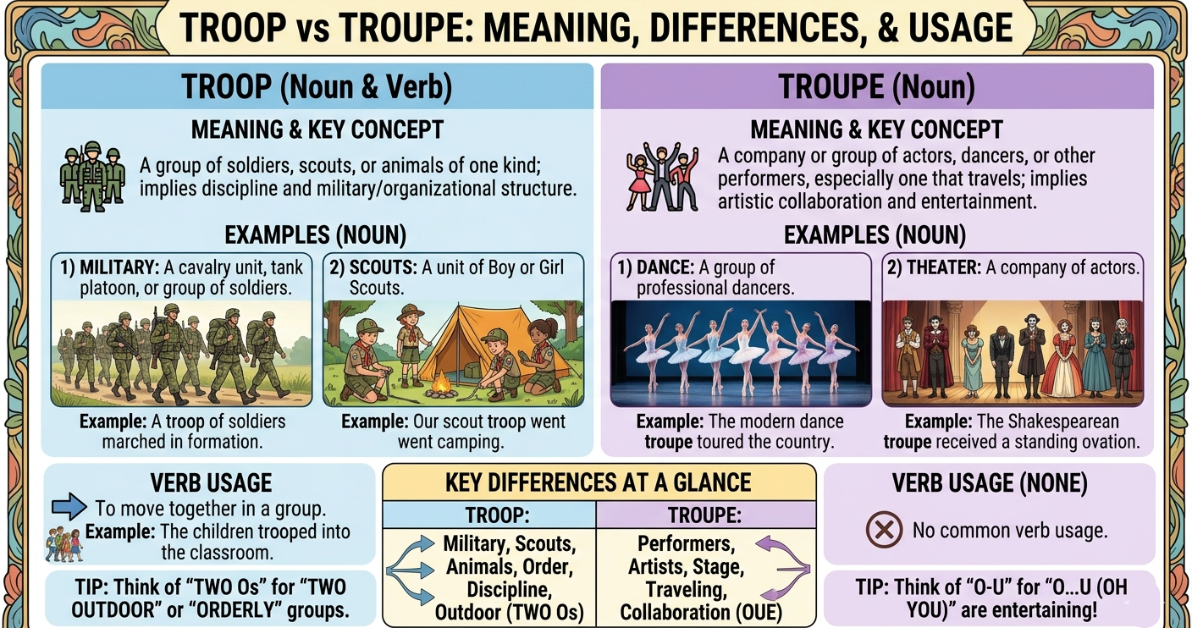
The word “troop” usually refers to a group of soldiers or scouts. It is connected to organized groups that work, travel, or operate together.
Common Meanings of Troop
Here are the most common ways the word is used:
- A military unit or soldiers
- A group of scouts, especially Boy Scouts or Girl Scouts
- A large collection of people or animals moving together
Examples of Troop in Sentences
- The troop marched across the training field.
- Our scout troop went camping last weekend.
- A troop of monkeys climbed through the trees.
In most cases, the word suggests discipline, movement, teamwork, or organization.
Understanding the Word “Troupe”
“Troupe” has a completely different meaning. It refers to a group of performers, entertainers, dancers, or actors who work together.
The word is strongly connected to theater, performance arts, and entertainment.
Common Meanings of Troupe
A troupe may include:
- Actors
- Dancers
- Singers
- Comedians
- Traveling performers
Examples of Troupe in Sentences
- The theater troupe performed a comedy show.
- A dance troupe entertained the audience at the festival.
- The traveling troupe visited several cities during summer.
Whenever performance or entertainment is involved, “troupe” is usually the correct choice.
Troop vs Troupe: The Key Difference
Although the words sound alike, their meanings belong to very different worlds.
| Word | Meaning | Common Context |
| Troop | A group of soldiers, scouts, or people | Military, scouts, groups |
| Troupe | A group of performers or entertainers | Theater, dance, entertainment |
A simple way to remember it is this:
- Troop = troops in the army
- Troupe = performers on stage
Why People Confuse These Words
There are several reasons why these terms are often mixed up.
Similar Pronunciation
Both words are pronounced almost exactly the same. This makes them homophones in English.
Similar Spelling
The only difference is the extra “u” in “troupe,” which can easily go unnoticed while writing quickly.
Autocorrect and Typing Errors
Modern typing habits sometimes make people rely too heavily on spellcheck tools. Since both words are real English terms, spellcheck may not catch the mistake.
Easy Memory Tricks to Remember the Difference
Learning a few memory techniques can help you avoid confusion forever.
Remember the “U” in Troupe
The word “troupe” contains the letter “u,” just like:
- mUsic
- actOrs
- perfOrmance grOUp
This can remind you that troupe relates to entertainment.
Associate Troop with Troops
“Troop” is closely connected to military troops. Since the spelling is shorter and stronger-looking, many learners find it easier to associate with soldiers.
Origin of the Words
Understanding word origins can also make the meanings clearer.
Origin of Troop
The word comes from old French and military traditions. It originally referred to groups of cavalry soldiers traveling together.
Origin of Troupe
“Troupe” also comes from French but developed specifically in relation to acting companies and performers.
Even though the words share historical roots, their meanings evolved differently over time.
Common Mistakes in Writing
Here are examples of incorrect and correct usage.
Incorrect:
- The dance troop performed beautifully.
Correct:
- The dance troupe performed beautifully.
Incorrect:
- The scout troupe organized a hiking trip.
Correct:
- The scout troop organized a hiking trip.
These small spelling differences can completely change the meaning of a sentence.
When to Use Troop
Use “troop” when discussing:
- Soldiers
- Scouts
- Organized groups
- Groups of animals
- Military movements
Example Situations
- Army training exercises
- Scout camping activities
- Wildlife documentaries
When to Use Troupe
Use “troupe” when talking about:
- Theater companies
- Dance performers
- Entertainers
- Traveling artists
- Stage productions
Example Situations
- Ballet performances
- Comedy groups
- Musical theater productions
Troop vs Troupe in Everyday English
While “troop” appears more often in news reports and daily conversation, “troupe” is commonly found in arts and entertainment writing.
For example:
- News channels may discuss military troops.
- Entertainment magazines may feature acting troupes.
Recognizing the context quickly helps you choose the correct spelling.
Quick Comparison Checklist
If you’re unsure which word to use, ask yourself this:
Is the group performing?
Use: Troupe
Is the group serving, traveling, or organizing?
Use: Troop
This simple check works in most situations.
FAQs
Is troop or troupe used for dancers?
“Troupe” is correct for dancers because it refers to performers and entertainers.
What does troop mean in the military?
In military terms, a troop is a unit or group of soldiers operating together.
Can troop refer to animals?
Yes. The word can describe groups of animals, especially primates like monkeys or baboons.
Why are troop and troupe pronounced similarly?
They are borrowed from related French roots, which is why they sound nearly identical.
Is a scout group called a troop or troupe?
A scout group is called a troop.
What is a theater troupe?
A theater troupe is a group of actors or performers who work together in productions.
Conclusion
Understanding troop vs troupe becomes simple once you connect each word to its purpose. “Troop” relates to soldiers, scouts, and organized groups, while “troupe” belongs to the world of performers and entertainment.
Because the words sound alike, they are easy to confuse, but context makes the difference clear. If the sentence involves acting, dancing, or performing, choose “troupe.” If it involves military units, scouts, or organized groups, “troop” is the right option.
The next time you encounter these commonly confused words, you’ll know exactly which spelling fits the situation.
Author

linguaezone.com@gmail.com
Related Posts

Kill Two Birds With One Stone Alternative: 50 Better Options
- 0
- 1,569 word
Have you ever paused before saying “kill two birds with one stone” because it sounded too violent or simply didn’t fit the...
Read out all
Happy Sabbath Meaning: A Complete Guide to Its Significance
- 0
- 1,632 word
Have you ever received the message “Happy Sabbath” and wondered what it truly means? Is it simply another way of saying “have...
Read out all
I’m So Proud of You in Other Words: 120+ Heartfelt Alternatives
- 0
- 1,562 word
Have you ever wanted to tell someone you’re proud of them but felt like saying “I’m so proud of you” sounded repetitive?...
Read out all
How Do You Spell Happy Anniversary? Correct Spelling Guide
- 0
- 1,221 word
Have you ever paused before writing an anniversary card and wondered, “How do you spell happy anniversary?” You’re not alone. Whether you’re...
Read out all
Waiting for Your Response Email: Best Examples & Tips
- 0
- 1,483 word
Have you ever sent an important email and found yourself wondering whether you should follow up or simply wait? Whether you’re communicating...
Read out all
Great Asset to the Team: Meaning, Examples & Tips
- 0
- 1,494 word
Have you ever wanted to compliment a coworker but struggled to find words that sound professional and sincere? One of the most...
Read out all