
- 0
- 2,589 words
Language is constantly evolving, and people often encounter unfamiliar words while writing emails, reading articles, preparing assignments, or communicating online. One term that can cause confusion is re-evalue. Although it may look like a standard English word, its spelling and intended meaning deserve closer attention. Understanding this term can help writers choose the correct expression and communicate their ideas more clearly.
In many situations, people use the word re-evalue when they actually mean reevaluate or re-evaluate. These established English words describe the process of examining something again to determine whether a previous judgment, decision, or assessment remains appropriate. Learning the distinction can prevent spelling mistakes and improve the quality of written communication.
This article explores the meaning of re-evalue, its relationship to reevaluate, common spelling mistakes, practical examples, and situations in which reassessing something becomes necessary.
What Does Re-Evalue Mean?
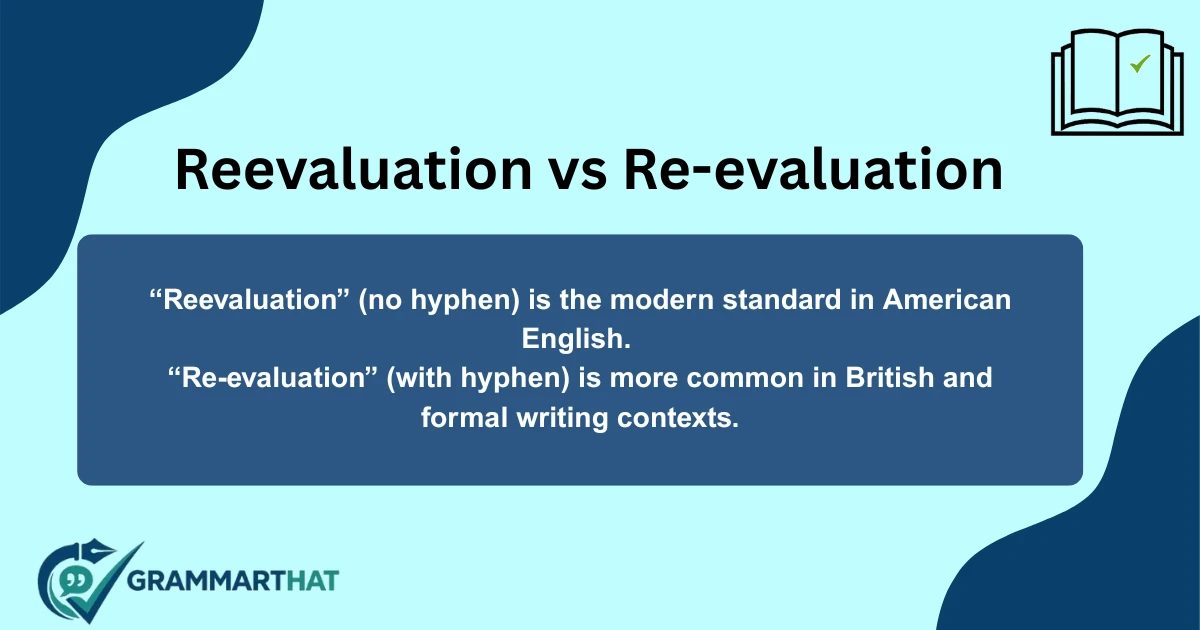
The term re-evalue is generally encountered as a nonstandard spelling or a mistaken form of the verb reevaluate. In standard English, the preferred spelling is usually reevaluate, although re-evaluate is also widely accepted.
The intended meaning is to examine, assess, or consider something again. This process often occurs when new information becomes available, circumstances change, or an earlier judgment needs to be reviewed.
For example, imagine that a business owner chooses a particular marketing strategy after researching customer behavior. Several months later, the campaign produces disappointing results. The owner may need to reevaluate the strategy to identify weaknesses and consider better alternatives.
In this situation, the goal is not simply to repeat the original assessment. Instead, the person examines the available evidence again and decides whether the original conclusion still makes sense.
Although someone might write re-evalue intending to express this idea, using the standard spelling makes the message clearer and more professional.
Re-Evalue vs. Reevaluate: Understanding the Difference
The most important distinction is that re-evalue is not the standard spelling of the commonly intended verb. Reevaluate and re-evaluate are recognized forms in English.
The word reevaluate combines the prefix re-, meaning again, with evaluate, meaning to assess the quality, value, importance, or effectiveness of something.
Together, these parts create a word that means to evaluate again.
Consider the following examples:
- Nonstandard: We need to re-evalue our current business plan.
- Standard: We need to reevaluate our current business plan.
- Standard: We need to re-evaluate our current business plan.
Both standard alternatives communicate the same basic idea. The version without a hyphen is common in modern American English, while the hyphenated form remains acceptable in many contexts.
Consistency matters when writing for a company, academic institution, publication, or website. If an organization follows a particular style guide, writers should use the spelling recommended by that guide.
The Origin and Structure of the Word
Understanding how a word is formed can make its spelling easier to remember. The word reevaluate consists of two main elements: the prefix re- and the verb evaluate.
The prefix re- appears in many familiar English words, including reconsider, rebuild, reread, reorganize, and reconsideration. In these examples, it indicates that an action is being performed again or that something is being returned to an earlier state.
The verb evaluate refers to examining something to determine its quality, significance, performance, or value. It is frequently used in education, business, healthcare, research, and everyday decision-making.
When these elements are combined, reevaluate means to perform an evaluation again.
The spelling re-evalue can arise when someone incorrectly shortens or changes the ending of reevaluate. Because evaluate ends with the letters associated with the sound in -ate, writers sometimes confuse the correct form when typing quickly or relying on pronunciation alone.
Recognizing the original word evaluate provides a useful memory aid. Adding the prefix re- produces reevaluate, not re-evalue.
Why Do People Search for Re-Evalue?
People search for unfamiliar spellings for several reasons. Sometimes they have encountered a word in an online discussion, a workplace document, a school assignment, or a message from another person. In other cases, they want to confirm whether a particular expression is grammatically correct.
The search term re-evalue may reflect uncertainty about English spelling rather than an intention to use a separate technical term.
1. Confusion About English Spelling
English contains many words that look or sound similar but have different spellings. Words with prefixes can be particularly confusing because writers must determine whether the prefix should be attached directly, separated with a hyphen, or written as a distinct word.
For example, reconsider and reorganize are generally written as single words. Meanwhile, certain expressions involving prefixes may use hyphens depending on meaning, pronunciation, or editorial style.
This variation can make writers question whether re-evalue is correct.
2. Typing Errors
Typing quickly can produce accidental spelling changes. A person who intends to write reevaluate might omit letters or stop before completing the word.
Such errors are common in text messages, online searches, social media posts, and informal notes. Search engines may still understand the intended meaning, but that does not make the original spelling standard.
3. Learning English as a Second Language
People learning English may understand the concept of evaluating something again but remain uncertain about its correct written form.
Breaking words into meaningful parts is an effective learning strategy. By remembering that reevaluate contains the complete word evaluate, learners can identify the correct spelling more easily.
4. Workplace and Academic Writing
Professional communication requires accurate spelling because small mistakes can affect credibility. A misspelled word in a report, proposal, application, or research paper may distract readers from the writer’s main point.
Checking uncertain words before publishing or submitting a document is therefore a useful habit.
How to Use Reevaluate Correctly in Sentences
The easiest way to understand a word is to see it used in realistic situations. The following examples demonstrate how reevaluate functions in different contexts.
Business and Management
Businesses frequently review their strategies to determine whether they remain effective.
Examples:
- The company decided to reevaluate its marketing strategy after sales declined.
- Managers should reevaluate their goals whenever market conditions change.
- We need to reevaluate the project budget before approving additional expenses.
In each sentence, reevaluate indicates that an earlier plan or judgment is being examined again.
Education and Learning
Students and teachers often reconsider their approaches when results do not meet expectations.
Examples:
- The teacher will reevaluate the assignment after reviewing the students’ feedback.
- I need to reevaluate my study schedule before the final examinations.
- The school plans to reevaluate its teaching methods next semester.
These examples show that reevaluation can support better learning and more effective teaching.
Personal Decisions
People also reassess their priorities, habits, and goals as their circumstances change.
Examples:
- She decided to reevaluate her career goals after completing her degree.
- I need to reevaluate how I spend my free time.
- He began to reevaluate his priorities after moving to a new city.
In personal contexts, reevaluation often involves reflection and a willingness to consider alternatives.
Technology and Research
Researchers and technology professionals regularly revisit earlier findings when new evidence becomes available.
Examples:
- Scientists may reevaluate their conclusions after collecting additional data.
- The engineering team must reevaluate the software’s security requirements.
- Researchers decided to reevaluate the results using a larger sample.
These uses emphasize the importance of evidence, accuracy, and continuous improvement.
Synonyms of Reevaluate
Sometimes, a different word can communicate the intended meaning more naturally. Choosing the right synonym depends on the context and the degree of reconsideration involved.
| Word | Meaning | Example |
|---|---|---|
| Reassess | Assess something again | We must reassess the project’s risks. |
| Reconsider | Think about a decision again | She agreed to reconsider the proposal. |
| Review | Examine something again | The manager will review the report. |
| Reexamine | Inspect or analyze again | Investigators will reexamine the evidence. |
| Reappraise | Estimate value or importance again | The owner decided to reappraise the property. |
| Revisit | Return to a topic or decision | We should revisit this issue next week. |
| Analyze again | Examine information more closely | The team will analyze the results again. |
These expressions overlap with reevaluate, but they are not always interchangeable.
For instance, review can describe reading a document again without necessarily making a new judgment. Reconsider often emphasizes thinking about a decision, while reassess highlights making another assessment based on available information.
Choosing a precise synonym can make writing more natural and prevent unnecessary repetition.
When Should You Reevaluate Something?
Reevaluation can be valuable whenever the information, circumstances, or goals behind an earlier decision have changed.
However, it does not mean that every decision must be questioned repeatedly. Constantly revisiting settled matters without new information can waste time and create unnecessary uncertainty.
Several situations make reevaluation particularly useful.
When New Information Becomes Available
A decision that was reasonable yesterday may no longer be appropriate after important facts emerge.
For example, a company might select a supplier based on competitive pricing. If the supplier later develops a record of delayed deliveries, the company may need to reevaluate the agreement.
New evidence gives decision-makers a reason to revisit their original conclusions.
When Results Are Disappointing
If an action repeatedly fails to produce the expected outcome, reassessment can reveal what needs to change.
A student who receives lower grades than expected might reevaluate their study methods. A business experiencing declining sales might examine its pricing, customer service, or advertising strategy.
The purpose is to identify the causes of the problem rather than continue repeating an ineffective approach.
When Priorities Change
People’s goals can change over time. A career path that once seemed ideal may become less suitable after a person develops new interests or responsibilities.
Reevaluating priorities allows individuals to determine whether their current activities still support their long-term objectives.
When Circumstances Become Different
External factors such as economic conditions, technology, regulations, and customer expectations can influence decisions.
A strategy designed for one set of circumstances may require modification when those circumstances change. Regular reevaluation helps individuals and organizations remain adaptable.
A Simple Process for Reevaluating a Decision
Reevaluation becomes more useful when it follows a clear process. Rather than relying entirely on instinct, decision-makers can use a structured approach.
Step 1: Identify the original decision.
Begin by clarifying what was decided and why. Review the goals, assumptions, and evidence that influenced the original choice.
Step 2: Gather current information.
Collect relevant facts, performance results, feedback, and other evidence. Make sure the information is reliable and sufficiently up to date.
Step 3: Compare expectations with reality.
Determine whether the original decision achieved its intended results. Identify the differences between what was expected and what actually happened.
Step 4: Consider alternatives.
Explore whether another approach could produce better results. Avoid assuming that the original decision must remain unchanged simply because time and effort have already been invested in it.
Step 5: Make an informed decision.
Use the available evidence to decide whether to maintain, modify, or replace the original approach.
Step 6: Monitor the outcome.
After making adjustments, observe the results. This helps determine whether the revised decision is working as intended.
Following these steps makes reevaluation a practical tool for improvement rather than an endless cycle of uncertainty.
Common Mistakes When Using Reevaluate
Even experienced writers can make mistakes when using words with prefixes. Understanding the most common problems helps prevent them.
Using Re-Evalue Instead of Reevaluate
The most direct mistake is writing re-evalue when the intended word is reevaluate.
Incorrect: The committee will re-evalue the application.
Correct: The committee will reevaluate the application.
Remember that the word evaluate remains intact when the prefix re- is added.
Confusing Reevaluate With Evaluate
Although the two verbs are related, they have different meanings.
Evaluate means to assess something for the first time or to perform an assessment without specifying that an earlier one is being repeated.
Reevaluate means to evaluate again.
For example, a manager might evaluate a new employee’s performance after the first month. If the manager reviews that assessment again later, the manager may reevaluate the employee’s progress.
Adding Unnecessary Words
Writers sometimes use repetitive expressions such as “reevaluate again.” Because reevaluate already means to evaluate again, the additional word may be unnecessary.
Instead of writing, “We need to reevaluate the decision again,” a more concise sentence is, “We need to reevaluate the decision.”
However, repetition may occasionally be used for emphasis in informal speech. In formal writing, concise phrasing is usually preferable.
Ignoring Consistency
Using both reevaluate and re-evaluate in the same document can make the writing look inconsistent.
Although both spellings are accepted, selecting one form and using it consistently improves presentation. Proofreading tools and dictionaries can help identify uncertain forms.
The Importance of Reevaluation in Everyday Life
Reevaluation is more than a vocabulary concept. It is a useful practice that supports learning, better judgment, and personal growth.
People sometimes continue following a particular approach simply because they have used it for a long time. However, experience alone does not guarantee that a decision remains effective.
For example, someone might follow the same daily routine for years without considering whether it still fits their responsibilities. Reevaluating that routine can reveal opportunities to improve time management, reduce stress, or focus on more important goals.
Similarly, organizations benefit from reviewing their methods rather than assuming that past success guarantees future results. Customer preferences change, new competitors appear, and technologies develop. Regular assessment allows businesses to respond more effectively.
The key is to balance reflection with action. Reevaluation should help people make clearer decisions, not prevent them from making decisions at all.
Frequently Asked Questions About Re-Evalue
Is re-evalue a correct English word?
Re-evalue is not the standard spelling of the common verb meaning to evaluate something again. In most situations, the intended word is reevaluate or re-evaluate.
What is the correct spelling: re-evalue or reevaluate?
The preferred standard spelling is generally reevaluate. The hyphenated form re-evaluate is also accepted. For consistent writing, follow the spelling conventions of your chosen style guide.
What does reevaluate mean in simple English?
Reevaluate means to look at something again and decide whether your original opinion, judgment, or decision is still correct.
For example, if you change your mind about a plan after learning new information, you have reevaluated that plan.
Is reevaluate the same as reconsider?
The meanings are similar, but they are not identical in every context. Reevaluate usually emphasizes assessing something again, while reconsider emphasizes thinking about a decision or possibility again.
How can I remember the correct spelling?
Remember the original word evaluate. Add the prefix re- to indicate that the action is being performed again. This gives you reevaluate.
Reading the word in example sentences and using it in your own writing can also reinforce the correct spelling.
Can I use reevaluate in formal writing?
Yes. Reevaluate is appropriate for academic papers, professional reports, business documents, and everyday communication. It is a standard English verb and clearly expresses the idea of reviewing an assessment or decision.
Conclusion
The keyword re-evalue highlights a common challenge in English spelling: recognizing when an unfamiliar-looking term is actually a misspelling of a standard word. When the intended meaning is to assess something again, reevaluate and re-evaluate are the appropriate forms.
Understanding the structure of the word makes it easier to remember. The prefix re- means again, while evaluate means to assess or judge. Together, they describe the process of reviewing an earlier assessment in light of current information or changing circumstances.
Whether you are writing a business report, completing a school assignment, reviewing a personal goal, or communicating online, choosing the correct word improves clarity and professionalism.
Ultimately, reevaluation is also a valuable habit beyond writing. It encourages people to question outdated assumptions, respond to new evidence, and make thoughtful decisions. By understanding the correct spelling and applying the concept appropriately, you can communicate more accurately and approach important choices with greater confidence.
Author

blowouttaper.co.uk@gmail.com
Related Posts
Bad Rep: Meaning, Origin, Examples, and How to Use It Correctly
- 0
- 2,941 words
Language is full of expressions that people use in everyday conversations without always understanding their complete meaning. One common expression is bad...
Read out all
Unorganized or Disorganized: Understanding the Difference and How to Use Each Word Correctly
- 0
- 2,624 words
English contains many words that appear to have the same meaning but differ slightly in their usage, tone, and context. One common...
Read out all
Too Early or To Early: Which Spelling Is Correct?
- 0
- 2,707 words
English can be confusing, especially when two expressions sound exactly the same but have different meanings and uses. One common example is...
Read out all
Dry Snitching: Meaning, Examples, Signs, and How to Handle It
- 0
- 2,804 words
Introduction Language plays an important role in how people communicate, build relationships, and maintain trust. In everyday conversations, slang terms often describe...
Read out all
Damnit or Dammit: Which Spelling Is Correct and When Should You Use It?
- 0
- 2,614 words
English contains many words and expressions that people use every day without thinking much about their spelling. However, some words create confusion...
Read out all
Reevaluation: Meaning, Importance, Benefits, and How to Reevaluate Decisions Effectively
- 0
- 2,568 words
Introduction to Reevaluation Reevaluation is an important process that involves examining something again to determine whether it is still accurate, effective, valuable,...
Read out all