
- 0
- 2,624 words
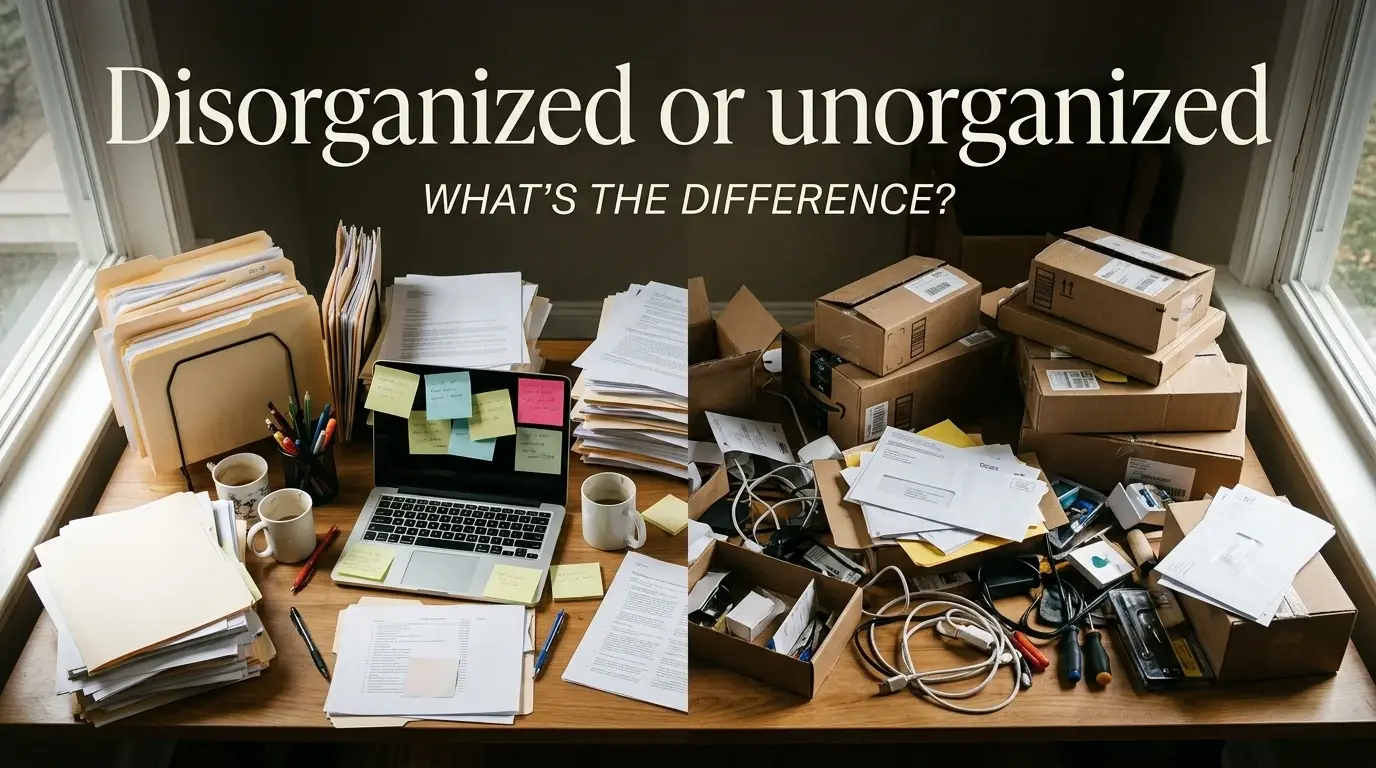
English contains many words that appear to have the same meaning but differ slightly in their usage, tone, and context. One common example is the choice between unorganized or disorganized. Both words describe situations in which things lack order, structure, or proper arrangement. However, they are not always interchangeable, and understanding their differences can help you communicate more clearly in everyday conversations, professional writing, academic work, and online communication.
Whether you are describing a messy room, an inefficient workplace, a poorly planned event, or a person who struggles with organization, choosing the appropriate word can make your message more precise. Although both terms are grammatically correct, each can emphasize a different aspect of the situation.
In this article, we will explore the meanings of unorganized and disorganized, examine their differences, provide practical examples, and explain how to choose the right word in different situations.
What Does Unorganized Mean?
The word unorganized or disorganized describes something that has not been arranged, structured, or coordinated in an orderly way. It often suggests that a system, group, collection, or activity lacks a formal structure or organized arrangement.
For example, imagine opening a drawer filled with papers, pens, receipts, and miscellaneous objects. If these items have never been sorted into categories, you might describe the drawer as unorganized.
The word can also describe people, groups, businesses, and activities that lack established plans or systems. An unorganized team, for instance, may not have clear responsibilities, written procedures, or a coordinated approach to completing its work.
Here are several examples:
- The students submitted an unorganized collection of research notes.
- Our community group is unorganized and needs a clear plan for its next event.
- The documents remained unorganized because nobody had sorted them.
- She keeps an unorganized collection of photographs on her computer.
- The project started as an unorganized effort involving several volunteers.
In these examples, the word highlights the absence of structure or a systematic arrangement.
Unorganized does not necessarily mean that something was previously orderly and then became messy. It can describe something that never had a clear organizational system in the first place.
What Does Disorganized Mean?
Disorganized generally describes something that lacks order, coordination, or an effective arrangement. It frequently emphasizes confusion, disorder, inefficiency, or a breakdown in an existing system.
For example, consider a business that normally maintains detailed records but suddenly allows documents to accumulate in different departments. Employees cannot find important files, deadlines are missed, and responsibilities become unclear. In this situation, describing the business as disorganized emphasizes the disorder affecting its operations.
The word is also commonly used to describe people who struggle to manage their time, belongings, responsibilities, or daily activities.
Consider these examples:
- The office became disorganized after several employees left.
- His disorganized schedule caused him to miss two important appointments.
- The presentation was disorganized, making the main argument difficult to follow.
- The kitchen looked disorganized after the family finished preparing dinner.
- A disorganized filing system made it difficult to locate customer records.
Disorganized can suggest that things have become disorderly, although it does not always imply that they were previously organized. The word can describe a situation that is chaotic or poorly coordinated from the beginning.
In everyday English, disorganized is particularly common when discussing messy spaces, confusing processes, ineffective management, and difficulties with personal organization.
Unorganized or Disorganized: What Is the Difference?
The main difference between unorganized and disorganized lies in the emphasis each word creates.
Unorganized often emphasizes the absence of a proper system, arrangement, or formal structure. Disorganized often emphasizes disorder, confusion, poor coordination, or an ineffective arrangement.
However, these meanings overlap considerably. In many everyday situations, either word is acceptable.
For example, you could describe a collection of unsorted documents as unorganized or disorganized. The first description may emphasize that the documents have not been arranged systematically, while the second may suggest that the collection is difficult to navigate or has become disorderly.
Consider the following comparison:
Unorganized: A group of volunteers has no formal schedule, assigned roles, or established procedures.
Disorganized: The same group repeatedly misses deadlines, loses important materials, and struggles to coordinate its activities.
The distinction is useful rather than absolute. English speakers frequently use both words in similar contexts, and neither term is automatically incorrect simply because the other might sound more natural in a particular sentence.
When choosing between them, consider whether you want to emphasize a missing organizational system or the disorder resulting from poor organization.
Examples of Unorganized and Disorganized in Everyday Life
Understanding how these words work in practical situations makes their differences easier to remember.
1. Describing a Room
Imagine that you have just moved into a new apartment. Your belongings are still inside boxes, your books have not been placed on shelves, and your clothes remain in suitcases.
You might say, “My room is unorganized because I have not arranged my belongings yet.”
This sentence emphasizes that the room has not been properly arranged.
Now imagine that your room was previously tidy, but you have spent several weeks leaving clothes on the floor, piling books on your desk, and placing objects wherever there is space.
You could say, “My room has become disorganized.”
This sentence emphasizes the disorder that has developed over time.
Both descriptions can be correct, depending on the circumstances and the intended meaning.
2. Describing a Workplace
In a professional environment, unorganized and disorganized can describe different aspects of a company’s operations.
An unorganized workplace may lack written policies, clear reporting structures, established workflows, or a consistent method for assigning tasks.
A disorganized workplace may have employees working on conflicting priorities, missing deadlines, duplicating work, and struggling to locate essential information.
For example:
“Our department is unorganized because nobody has established a standard procedure for handling requests.”
“The department has become disorganized because employees frequently lose requests and forget important deadlines.”
These examples illustrate how context influences the choice of word.
3. Describing a Person
Both adjectives can describe a person’s habits or approach to everyday responsibilities.
An unorganized person may not use a calendar, maintain a filing system, or follow a consistent routine.
A disorganized person may frequently misplace belongings, forget appointments, or struggle to complete tasks in a logical sequence.
For instance:
“Mark is unorganized and rarely plans his daily activities.”
“Mark is disorganized and often loses the documents he needs for meetings.”
The first sentence emphasizes a lack of planning, while the second emphasizes practical difficulties caused by disorder.
However, neither word should automatically be treated as a judgment about someone’s intelligence, ability, or character. People can struggle with organization in certain areas while remaining highly capable in others.
4. Describing Writing and Presentations
These words are also useful when discussing communication.
An unorganized essay may lack a clear outline, well-defined sections, or a logical progression of ideas.
A disorganized presentation may jump between unrelated topics, repeat information, or introduce important points in confusing ways.
For example:
“The essay is unorganized because the writer did not arrange the arguments into clear sections.”
“The presentation is disorganized because the speaker moves between topics without explaining the connections.”
In academic and professional writing, disorganized is often a natural choice when the reader or audience experiences confusion. Unorganized can also work when the emphasis is on the lack of a planned structure.
Which Word Is More Common: Unorganized or Disorganized?
Both words are established English adjectives, but their naturalness depends on the noun they describe and the situation being discussed.
Disorganized is especially common in everyday descriptions of messy rooms, people who misplace things, poorly coordinated activities, and confusing work processes.
For example, expressions such as “a disorganized office,” “a disorganized person,” and “a disorganized schedule” are widely understood and sound natural.
Unorganized is also common, particularly when discussing groups, collections, activities, or systems that lack formal structure.
For example, “an unorganized group,” “unorganized records,” and “an unorganized effort” can be appropriate depending on the context.
There is no universal rule stating that one word is always better than the other. Instead, consider the specific meaning you want to communicate and the expression that sounds most natural to your intended audience.
If you are unsure, disorganized is often a useful choice when you mean messy, confusing, or poorly coordinated. Unorganized can be particularly effective when you mean that a system or activity has not been properly structured.
Is Unorganized Grammatically Correct?
Yes, unorganized is grammatically correct.
The word is formed by adding the negative prefix “un-” to “organized.” This construction creates an adjective that describes something that is not organized.
Similarly, disorganized is formed using the prefix “dis-” and the word “organized.”
Both forms are accepted in standard English and appear in dictionaries and ordinary writing.
Examples include:
- The files are unorganized and need to be sorted.
- The files are disorganized and difficult to search.
- Our team is unorganized because we lack a planning process.
- Our team is disorganized because communication has broken down.
The important consideration is not whether one word is grammatically valid. Both are valid. The question is which word expresses your intended meaning most accurately.
Common Mistakes When Using Unorganized and Disorganized
Although these words are straightforward, writers sometimes use them without considering the context.
Mistake 1: Assuming the Words Have Completely Different Meanings
Some people believe that unorganized describes something that has never been organized, while disorganized describes something that was once organized but became messy.
This distinction can be useful as a memory aid, but it is not a strict grammatical rule.
A person can be disorganized from the beginning, and an unorganized collection can result from a previously organized system breaking down.
Therefore, avoid treating this distinction as an absolute requirement.
Mistake 2: Assuming Unorganized Is Incorrect
Unorganized is a legitimate English word. It is not simply a spelling mistake or an incorrect substitute for disorganized.
For example, the sentence “The volunteers worked together in an unorganized effort” is grammatically acceptable.
You could also describe their work as disorganized if you want to emphasize confusion or poor coordination.
Mistake 3: Choosing a Word Without Considering the Intended Meaning
Although the words overlap, the choice can affect the tone of a sentence.
Calling a project unorganized may suggest that its planning process was incomplete. Calling it disorganized may suggest that its activities were confusing or inefficient.
Think about the specific problem before selecting a word. This small step can improve the clarity of your writing.
Mistake 4: Confusing the Adjectives With Other Forms
The adjectives unorganized and disorganized should not be confused with the verb “organize” or the noun “organization.”
For example:
- Correct: “The documents are disorganized.”
- Correct: “We need to organize the documents.”
- Correct: “The organization of the documents needs improvement.”
Understanding the grammatical role of each word helps you construct clear and accurate sentences.
Synonyms for Unorganized and Disorganized
Several English words can communicate similar ideas, although each has its own nuance.
Messy: Usually describes a space or collection that is untidy.
Example: “The kitchen is messy after dinner.”
Chaotic: Suggests a high level of confusion, disorder, or unpredictability.
Example: “The event became chaotic when the schedule changed.”
Untidy: Primarily describes something that is not neat or orderly.
Example: “His desk is untidy because papers are scattered everywhere.”
Unstructured: Emphasizes the absence of a defined framework or organized format.
Example: “The discussion was unstructured and lacked a clear direction.”
Unsystematic: Describes an approach that does not follow a consistent method.
Example: “The researcher used an unsystematic method to collect information.”
Disorderly: Emphasizes a lack of order, sometimes suggesting unruly behavior or confusion.
Example: “The files were stored in a disorderly manner.”
Choosing a synonym can help you communicate more precisely. For example, unstructured may be better than unorganized when discussing an essay without a clear outline, while messy may be more natural when describing a bedroom full of clothes.
How to Become More Organized
Whether you describe your habits as unorganized or disorganized, practical strategies can help you improve your daily routines.
Create a Simple Plan
Start by identifying the most important tasks you need to complete. Write them down in a notebook, calendar, or digital task manager.
Organize the tasks according to their importance and deadlines. A simple plan can reduce uncertainty and help you focus on one responsibility at a time.
You do not need an elaborate productivity system. A short daily list can be enough to improve your sense of control.
Keep Frequently Used Items in Consistent Places
One common source of disorder is the habit of placing objects wherever convenient.
Choose specific locations for essential belongings, such as keys, documents, chargers, and work supplies. Returning items to their designated places makes them easier to find later.
This strategy is especially useful for maintaining a tidy home or efficient workplace.
Break Large Tasks Into Smaller Steps
Large projects can feel overwhelming when they have no clear structure.
Instead of writing “organize the office” on your task list, divide the project into smaller activities. You might sort documents, label folders, clear the desk, and create a system for incoming paperwork.
Smaller steps are easier to manage and make progress more visible.
Review Your Routine Regularly
Organization is not a one-time achievement. Schedules change, new responsibilities appear, and systems that once worked well may become less effective.
Spend a few minutes reviewing your routine each week. Identify what is working, what is causing confusion, and what adjustments would make your activities easier to manage.
Consistent small improvements can prevent minor problems from becoming larger ones.
Frequently Asked Questions
Is it unorganized or disorganized?
Both words are correct. Unorganized often emphasizes the absence of a proper system or structure, while disorganized often emphasizes disorder, confusion, or poor coordination. The best choice depends on the context.
Is unorganized a real word?
Yes. Unorganized is a standard English adjective used to describe something that lacks an orderly arrangement or established structure.
Is disorganized more negative than unorganized?
Disorganized can sound more critical when it suggests confusion, inefficiency, or disorder. However, neither word is inherently negative in every context. The tone depends on the sentence and the situation being described.
Can you use unorganized to describe a person?
Yes. You can describe someone as unorganized when they do not maintain consistent systems or plans for their responsibilities. Disorganized is also common when describing someone who frequently loses things, forgets appointments, or struggles to manage tasks.
What is the opposite of unorganized or disorganized?
The most common opposite is organized. Other possible alternatives include orderly, structured, systematic, and well-arranged, depending on the context.
Which word should I use in formal writing?
Both words are acceptable in formal writing. Choose unorganized when emphasizing a lack of established structure and disorganized when emphasizing confusion or poor coordination. In some cases, a more specific term, such as unstructured or unsystematic, may communicate your meaning more effectively.
Conclusion
Choosing between unorganized or disorganized becomes easier when you understand the subtle difference in emphasis between the two words. Both are grammatically correct adjectives that describe a lack of order or effective organization.
Unorganized often highlights the absence of a formal system, planned arrangement, or clear structure. Disorganized often emphasizes confusion, disorder, inefficiency, or problems with coordination. Nevertheless, their meanings overlap, and either word can be appropriate in many everyday situations.
When writing about a messy room, an inefficient workplace, an unclear presentation, or a person’s daily habits, consider what you want your reader to understand. Focus on whether the main issue is a missing structure or the disorder associated with poor organization.
Ultimately, good word choice depends on context rather than rigid rules. By understanding how these adjectives work and practicing them in different sentences, you can improve your English vocabulary, write more naturally, and express your ideas with greater confidence.
Add a quick comparison tableReduce repeated explanations
Author

blowouttaper.co.uk@gmail.com
Related Posts
Re-Evalue: Meaning, Correct Spelling, Examples, and How to Use It Properly
- 0
- 2,589 words
Language is constantly evolving, and people often encounter unfamiliar words while writing emails, reading articles, preparing assignments, or communicating online. One term...
Read out all
Bad Rep: Meaning, Origin, Examples, and How to Use It Correctly
- 0
- 2,941 words
Language is full of expressions that people use in everyday conversations without always understanding their complete meaning. One common expression is bad...
Read out all
Too Early or To Early: Which Spelling Is Correct?
- 0
- 2,707 words
English can be confusing, especially when two expressions sound exactly the same but have different meanings and uses. One common example is...
Read out all
Dry Snitching: Meaning, Examples, Signs, and How to Handle It
- 0
- 2,804 words
Introduction Language plays an important role in how people communicate, build relationships, and maintain trust. In everyday conversations, slang terms often describe...
Read out all
Damnit or Dammit: Which Spelling Is Correct and When Should You Use It?
- 0
- 2,614 words
English contains many words and expressions that people use every day without thinking much about their spelling. However, some words create confusion...
Read out all
Reevaluation: Meaning, Importance, Benefits, and How to Reevaluate Decisions Effectively
- 0
- 2,568 words
Introduction to Reevaluation Reevaluation is an important process that involves examining something again to determine whether it is still accurate, effective, valuable,...
Read out all