
- 0
- 2,707 words
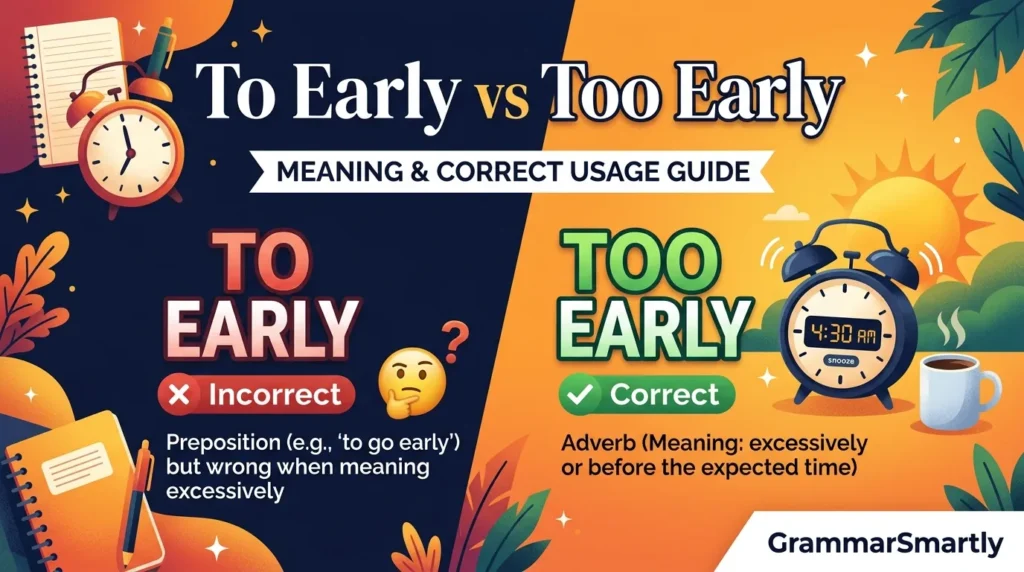
English can be confusing, especially when two expressions sound exactly the same but have different meanings and uses. One common example is “too early or to early.” Many people wonder which spelling is correct when writing messages, emails, social media posts, school assignments, or professional documents. Although both expressions look similar, only one is correct when you want to describe something that happens before the expected or appropriate time.
The correct phrase is “too early.” The word “too” means excessively, additionally, or more than is necessary, depending on the context. In this expression, it indicates that something is happening before the right time. The word “to,” on the other hand, is commonly used to indicate direction, purpose, or an action’s relationship to another word.
Understanding the difference between these two words can help you improve your grammar, write more confidently, and avoid common spelling mistakes. In this article, we will explore the meaning of “too early,” explain why “to early” is incorrect in standard English for this purpose, and provide practical examples to help you remember the correct spelling.
Too Early or To Early: What Is the Correct Answer?
When choosing between “too early or to early,” the correct answer is “too early.” You should use this phrase whenever you want to say that something happens before the appropriate, expected, or desired time.
For example:
- I arrived too early for the meeting.
- It is too early to make a final decision.
- She woke up too early this morning.
- We reached the airport too early for our flight.
- You are never too early when preparing for an important examination.
In each sentence, “too early” describes timing. It suggests that an event happens before a suitable time or that a person arrives earlier than necessary.
The phrase “to early” is generally a grammatical mistake when used with this meaning. The word “to” does not express the idea of something happening before the right time. Therefore, if you are writing about arriving, waking up, starting, or doing something before the expected time, always choose “too early.”
Remembering this simple distinction can help you avoid a mistake that frequently appears in informal writing and online conversations.
What Does Too Early Mean?
The expression “too early” means before the appropriate, expected, or convenient time. It can describe an event that takes place sooner than necessary or an action performed before someone is ready.
For example, imagine that your class begins at nine o’clock, but you arrive at seven thirty. You might say, “I arrived too early for class.” Your sentence communicates that you reached the location earlier than needed.
The phrase can also describe situations in which something happens before the right moment. For instance, a person might say, “It is too early to celebrate.” This means that the circumstances are not yet suitable for celebrating because something important remains unresolved.
Similarly, someone might say, “It is too early to judge the results.” In this case, the speaker believes that more time or information is necessary before making a fair assessment.
The meaning can change slightly depending on the situation. Sometimes, being too early is inconvenient, such as arriving at a restaurant before it opens. In other situations, it may simply mean that a decision or activity should wait until more information becomes available.
Although the phrase often suggests that something happens sooner than necessary, being early is not always a problem. The word “too” adds the idea that the timing is earlier than appropriate for that particular situation.
Understanding the Difference Between Too and To
To understand why “too early” is correct, it is important to learn how the words “too” and “to” function in English.
Although they sound alike, they have different grammatical roles.
The Meaning of Too
“Too” is an adverb that commonly means “more than necessary” or “excessively.” It can also mean “in addition” or “also.”
Consider these examples:
- The coffee is too hot to drink.
- This suitcase is too heavy for me to carry.
- She arrived too early for the appointment.
- I want to come too.
In the first two sentences, “too” indicates an excessive degree. In the third sentence, it describes timing that is earlier than suitable. In the final sentence, it means “also.”
When “too” appears before the adjective “early,” it modifies that adjective and expresses the idea of being earlier than appropriate.
The Meaning of To
“To” is a preposition in many sentences and also functions as part of the infinitive form of a verb.
Examples include:
- I am going to school.
- She gave the book to her brother.
- We need to leave soon.
- He wants to learn English.
- They decided to start early.
Notice the difference in the last example. The sentence says, “They decided to start early,” not “They decided to start too early.” Both expressions can be grammatical in different contexts, but they communicate different ideas.
“To” can introduce an action, indicate direction, or show a relationship between people or objects. It does not replace “too” when expressing that something happens earlier than the appropriate time.
Understanding these grammatical roles makes it easier to select the right word without memorizing every sentence individually.
Why Is To Early Incorrect?
The phrase “to early” is incorrect when someone intends to express the meaning of “too early” because the word “to” does not function as an adverb expressing excess or degree.
In standard English, “early” is an adjective or adverb, depending on how it is used. The word “too” can modify it to communicate that something occurs sooner than is appropriate.
For example, consider this sentence:
“I arrived to early for my appointment.”
The intended meaning is clear, but the spelling is incorrect. The correct version is:
“I arrived too early for my appointment.”
The difference is only one letter, but that letter changes the grammatical function of the word.
This mistake often happens because “to” and “too” are homophones. Homophones are words that sound the same but have different meanings and spellings. Since pronunciation does not help distinguish them in ordinary speech, writers must rely on their understanding of meaning and grammar.
The best way to avoid this error is to pay attention to the role of the word in the sentence. If you mean “earlier than necessary” or “before the appropriate time,” use “too early.”
Examples of Too Early in Everyday English
The expression “too early” appears in many everyday situations. Learning how people use it in different contexts can make the correct spelling easier to remember.
1. Arriving Somewhere
People frequently use “too early” when discussing appointments, meetings, classes, or social events.
Examples:
- I arrived too early for the job interview.
- We were too early to enter the concert hall.
- He came too early for the dinner party.
- They reached the station too early for the train.
These examples describe situations in which someone arrives before the expected or convenient time.
2. Waking Up or Going to Bed
The phrase is also useful when discussing sleep schedules and daily routines.
Examples:
- I woke up too early today.
- She went to bed too early and woke up before sunrise.
- The children got up too early on Saturday morning.
- I think it is too early to start my day.
In these sentences, “too early” communicates that the timing is earlier than the person would prefer or considers appropriate.
3. Making Decisions
People sometimes need more information before making an important choice. In these situations, “too early” can indicate that a decision should be delayed.
Examples:
- It is too early to decide whether the project has succeeded.
- We are too early in the process to make a final judgment.
- It is too early to predict the outcome.
- The company believes it is too early to announce its plans.
Here, the phrase does not necessarily refer to a specific clock time. Instead, it refers to a stage in a process or situation.
4. Starting an Activity
The expression can also describe beginning something before the appropriate moment.
Examples:
- We started too early and had to wait for everyone else.
- It is too early to begin preparing dinner.
- The team arrived too early for practice.
- I think we are too early to start discussing the next stage.
These examples show that the phrase can be used naturally in casual conversations and professional communication.
Too Early in Questions and Negative Sentences
The phrase “too early” can appear in questions, statements, and negative constructions. Its spelling remains the same regardless of the sentence structure.
For example, you might ask, “Is it too early to call her?” This question asks whether the current time is suitable for making a phone call.
Another example is, “Am I too early for the appointment?” Here, the speaker wants to know whether they have arrived before the expected time.
You can also use the phrase in a negative sentence. Consider the statement, “It is never too early to prepare for an examination.” This means that preparing in advance is always acceptable or beneficial.
Similarly, “You are not too early to begin learning a new skill” suggests that the timing is appropriate rather than excessively early.
These examples demonstrate that “too early” works in many grammatical structures. The essential rule remains unchanged: use “too” when expressing an excessive or inappropriate degree of earliness.
Common Mistakes People Make With Too and To
Many English learners and native speakers occasionally confuse “too,” “to,” and “two.” Although these words sound alike, their meanings are different.
Mistake 1: Using to instead of too
Incorrect: It is to early to leave.
Correct: It is too early to leave.
The correct version uses “too” to indicate that the timing is earlier than appropriate.
Mistake 2: Using too when to is required
Incorrect: I want too learn English.
Correct: I want to learn English.
In this example, “to” introduces the verb “learn.” The sentence is not describing something excessive.
Mistake 3: Confusing too with two
Incorrect: I arrived two early for the meeting.
Correct: I arrived too early for the meeting.
“Two” refers to the number 2. It does not express the idea of arriving before the expected time.
Mistake 4: Assuming that every sentence containing early needs too
Incorrect: I arrived too early yesterday, although I intended to arrive early.
This sentence is not necessarily wrong, but the use of “too early” changes the meaning. It suggests that the arrival was earlier than suitable, while “early” simply means before the expected time.
Correct usage depends on the intended meaning. If arriving before the scheduled time is desirable, “early” may be sufficient. If the timing is inconvenient or excessive, “too early” is more appropriate.
Easy Tricks to Remember Too Early or To Early
You do not need to memorize complicated grammar rules to distinguish these expressions. A few simple techniques can help you remember the correct spelling.
Trick 1: Replace Too With Very
When deciding whether to use “too early,” try replacing “too” with “very” or “excessively” to see whether the sentence makes sense.
For example:
“It is too early to leave.”
You can understand this as “It is excessively early to leave.” The meaning is clear, so “too” is appropriate.
This technique is especially useful when describing timing, temperature, weight, speed, or other qualities.
Trick 2: Remember That Too Has an Extra O
The word “too” contains an additional letter “o” compared with “to.” You can associate this extra letter with the idea of “more than necessary.”
For example, if you arrive too early, you have arrived earlier than necessary. If something is too expensive, it costs more than you consider reasonable.
Although this memory trick is not a formal grammar rule, it can make the distinction easier to recall.
Trick 3: Learn the Phrase as a Complete Expression
Instead of learning the word “too” in isolation, practice common expressions such as:
- Too early to tell
- Too early to decide
- Too early to leave
- Too early to celebrate
- Too early in the morning
Repeated exposure to these expressions helps you recognize the correct spelling automatically.
Trick 4: Read Your Sentence Aloud and Check Its Meaning
Reading a sentence aloud will not reveal the difference in pronunciation because “to” and “too” generally sound alike. However, reviewing what you mean can help.
Ask yourself whether you are describing something that happens before the appropriate time. If the answer is yes, “too early” is usually the correct choice.
Practice Exercise: Choose the Correct Expression
Test your understanding by choosing the correct word in each sentence.
- I arrived ___ early for the appointment.
- It is ___ early to know the final result.
- She woke up ___ early this morning.
- We decided ___ leave before sunset.
- Is it ___ early to contact the manager?
Answers:
- Too
- Too
- Too
- To
- Too
The fourth sentence is different because “to” introduces the verb “leave.” The other sentences use “too” to describe timing that is earlier than appropriate or to express that it is premature to do something.
Practicing with short exercises like these can strengthen your understanding and reduce spelling mistakes in everyday writing.
Why Correct Grammar Matters in Everyday Communication
Correct grammar helps readers understand your message without confusion. Although confusing “too” and “to” may seem like a small mistake, repeated errors can affect the clarity and professionalism of your writing.
In professional emails, for example, accurate spelling can make your communication look more polished. In academic assignments, correct word choice demonstrates attention to detail. Even in social media posts and text messages, proper spelling can help you express your thoughts clearly.
However, making occasional grammatical mistakes is a normal part of learning a language. The important thing is to recognize common errors and practice correcting them.
The distinction between “too early” and “to early” is a useful example of how a small spelling difference can affect grammatical accuracy. Once you understand the meaning of “too,” choosing the correct expression becomes much easier.
Frequently Asked Questions
Is too early or to early correct?
“Too early” is correct when you mean before the appropriate, expected, or desired time. “To early” is incorrect when used with this intended meaning.
What does too early mean?
“Too early” means that something happens sooner than necessary or before the right time. For example, “It is too early to make a decision” means that more time or information may be needed.
Can I use too early in a formal email?
Yes. “Too early” is appropriate in formal and informal writing. For example, you could write, “It may be too early to confirm the final schedule.”
Is it too early to say or to early to say?
The correct expression is “too early to say.” It means that there is not enough information or time to reach a reliable conclusion.
For example: “It is too early to say whether the new strategy will succeed.”
What is the difference between early and too early?
“Early” means before the expected time. “Too early” suggests that the timing is earlier than necessary, convenient, or appropriate.
For example, arriving ten minutes early for an appointment may be helpful. Arriving three hours early might be considered too early, depending on the circumstances.
Why do people confuse to and too?
People confuse these words because they have similar pronunciations but different meanings and grammatical functions. Remembering that “too” can mean “excessively” or “more than necessary” helps distinguish it from “to.”
Conclusion
Choosing between “too early or to early” becomes simple when you understand the meaning of each word. “Too early” is the correct expression when describing something that happens before the appropriate or desired time. The phrase can refer to arriving somewhere, waking up, beginning an activity, or making a decision before sufficient time has passed.
The word “to” serves different grammatical purposes, such as indicating direction or introducing an infinitive verb. It cannot replace “too” when expressing that something happens earlier than appropriate.
To remember the difference, consider whether you mean “earlier than necessary.” If that is your intended meaning, use “too early.” Practice common examples, review your sentences, and pay attention to context whenever you write.
With regular practice, you can avoid this common mistake and improve the accuracy of your English communication. Whether you are writing a professional email, completing an assignment, or sending a quick message, choosing “too early” instead of “to early” will help you communicate your meaning correctly and confidently.
Author

blowouttaper.co.uk@gmail.com
Related Posts
Re-Evalue: Meaning, Correct Spelling, Examples, and How to Use It Properly
- 0
- 2,589 words
Language is constantly evolving, and people often encounter unfamiliar words while writing emails, reading articles, preparing assignments, or communicating online. One term...
Read out all
Bad Rep: Meaning, Origin, Examples, and How to Use It Correctly
- 0
- 2,941 words
Language is full of expressions that people use in everyday conversations without always understanding their complete meaning. One common expression is bad...
Read out all
Unorganized or Disorganized: Understanding the Difference and How to Use Each Word Correctly
- 0
- 2,624 words
English contains many words that appear to have the same meaning but differ slightly in their usage, tone, and context. One common...
Read out all
Dry Snitching: Meaning, Examples, Signs, and How to Handle It
- 0
- 2,804 words
Introduction Language plays an important role in how people communicate, build relationships, and maintain trust. In everyday conversations, slang terms often describe...
Read out all
Damnit or Dammit: Which Spelling Is Correct and When Should You Use It?
- 0
- 2,614 words
English contains many words and expressions that people use every day without thinking much about their spelling. However, some words create confusion...
Read out all
Reevaluation: Meaning, Importance, Benefits, and How to Reevaluate Decisions Effectively
- 0
- 2,568 words
Introduction to Reevaluation Reevaluation is an important process that involves examining something again to determine whether it is still accurate, effective, valuable,...
Read out all