
- 0
- 697 words
If you’ve ever paused while writing and wondered whether it’s stare or stair, you’re not alone. The confusion between stare vs stair is extremely common because both words sound exactly the same but mean totally different things.
In this guide, we’ll break down the difference in a simple, human way so you’ll never mix them up again. By the end, you’ll clearly understand how to use each word correctly in everyday writing and speech.
What Does “Stare” Mean?
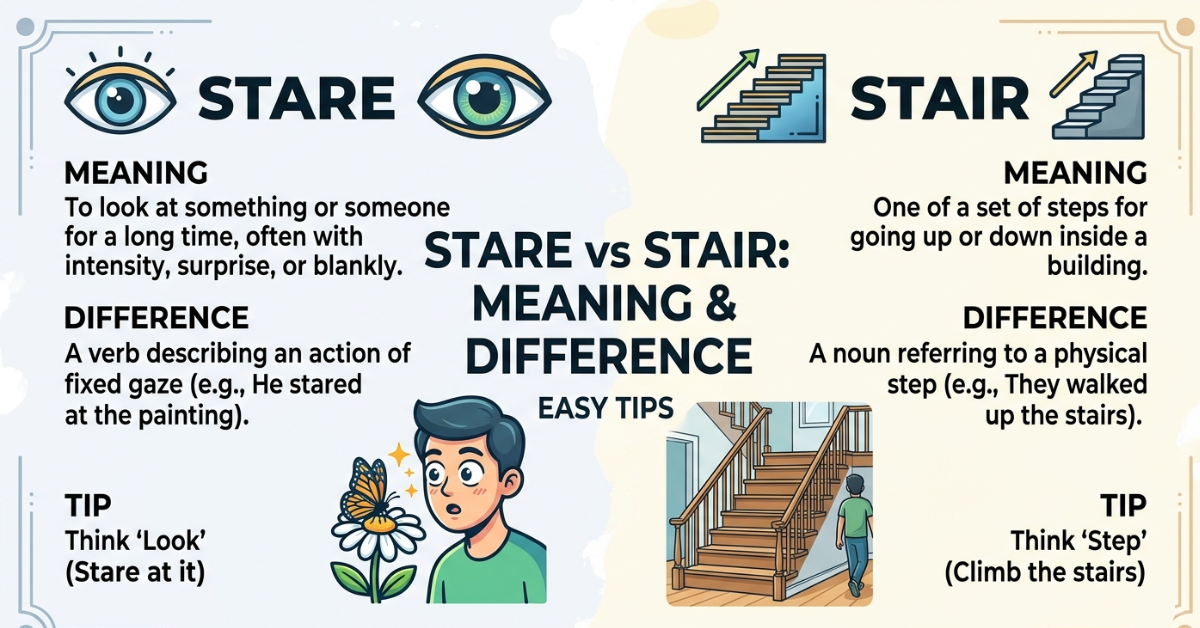
Let’s start with stare. To stare means to look at something or someone for a long time, often with strong attention or emotion.
It can show curiosity, surprise, confusion, or even discomfort.
Examples of “stare”:
- She didn’t mean to stare at him, but she was surprised.
- Don’t stare at people; it can make them uncomfortable.
- He continued to stare out of the window for hours.
Key idea:
A stare is all about looking intensely.
What Does “Stair” Mean?
Now let’s talk about stair. A stair is a step you use to go up or down between floors in a building.
It is a physical structure, not an action.
Examples of “stair”:
- She walked up the stair to her apartment.
- The wooden stair creaked loudly at night.
- Be careful on the broken stair.
Key idea:
A stair is something you step on while moving vertically.
Stare vs Stair: Key Differences Explained
Here’s the simplest way to understand stare vs stair:
| Word | Meaning | Type | Example |
| Stare | To look fixedly at something | Action (verb) | I stare at the stars |
| Stair | A step in a staircase | Object (noun) | I climbed the stair |
Even though they sound identical, their meanings are completely unrelated.
Why Do People Confuse Stare and Stair?
The confusion happens because they are homophones—words that sound the same but have different meanings and spellings.
Other reasons include:
- Similar pronunciation in fast speech
- Lack of visual spelling practice
- Typing errors in a hurry
- Limited exposure in reading
Once you understand their meanings, the confusion disappears quickly.
Easy Memory Tricks to Remember the Difference
Here are some simple tricks to help you never mix them again:
1. “A” in Stair = “Ascending”
Think of the letter A in stair as going upwards, just like climbing stairs.
2. “E” in Stare = “Eyes”
The word stare has E, just like eyes, because staring involves looking.
3. Quick Visualization Trick
- Stare = eyes fixed on something
- Stair = steps you walk on
These mental pictures make the difference stick instantly.
Common Usage Mistakes
Many learners accidentally swap these words in sentences like:
Incorrect: I will stair at you from far away.
Correct: I will stare at you from far away.
Incorrect: She climbed the stare to her room.
Correct: She climbed the stair to her room.
These small mistakes can change the meaning completely, so attention matters.
Stare vs Stair in Everyday Writing
Understanding stare vs stair is especially important in:
- Academic writing
- Emails and professional messages
- Social media captions
- Creative storytelling
Using the correct word improves clarity and makes your writing look more polished.
FAQs About Stare vs Stair
1. What is the main difference between stare and stair?
Stare is an action meaning to look at something intensely, while stair is a step in a staircase.
2. Why are stare and stair confusing?
They are homophones, meaning they sound the same but have different meanings and spellings.
3. Can stare and stair be used in the same sentence?
Yes, for example: “I stare at the broken stair before stepping on it.”
4. Is stare a verb or noun?
Stare is mainly a verb, though it can also be used as a noun.
5. What is an easy way to remember stare vs stair?
Remember: stare = eyes, stair = steps.
Conclusion
The confusion between stare vs stair is common, but once you understand their meanings, it becomes easy to use them correctly. Stare is about looking, while stair is about stepping.
Next time you write or speak, take a second to think about whether you’re referring to eyes or steps—that’s all it takes to get it right. If you enjoyed this guide, explore more grammar differences to sharpen your English even further.
Author

linguaezone.com@gmail.com
Related Posts
Kill Two Birds With One Stone Alternative: 50 Better Options
- 0
- 1,569 word
Have you ever paused before saying “kill two birds with one stone” because it sounded too violent or simply didn’t fit the...
Read out all
Happy Sabbath Meaning: A Complete Guide to Its Significance
- 0
- 1,632 word
Have you ever received the message “Happy Sabbath” and wondered what it truly means? Is it simply another way of saying “have...
Read out all
I’m So Proud of You in Other Words: 120+ Heartfelt Alternatives
- 0
- 1,562 word
Have you ever wanted to tell someone you’re proud of them but felt like saying “I’m so proud of you” sounded repetitive?...
Read out all
How Do You Spell Happy Anniversary? Correct Spelling Guide
- 0
- 1,221 word
Have you ever paused before writing an anniversary card and wondered, “How do you spell happy anniversary?” You’re not alone. Whether you’re...
Read out all
Waiting for Your Response Email: Best Examples & Tips
- 0
- 1,483 word
Have you ever sent an important email and found yourself wondering whether you should follow up or simply wait? Whether you’re communicating...
Read out all
Great Asset to the Team: Meaning, Examples & Tips
- 0
- 1,494 word
Have you ever wanted to compliment a coworker but struggled to find words that sound professional and sincere? One of the most...
Read out all