- 0
- 609 words
When writing essays, articles, or analysis, you often need to explain what a quote means. Many people repeatedly use the phrase “this quote shows,” but there are actually much better and more expressive options.
If you’re searching for another way to say this quote shows, you’re in the right place. This guide will help you understand natural alternatives that make your writing sound more fluent, professional, and engaging. Whether you’re a student or a content writer, improving this small phrase can make a big difference in your clarity and style.
Why You Should Avoid Repeating “This Quote Shows”
Relying too much on the phrase “this quote shows” can make your writing feel repetitive and basic. While it is correct, it doesn’t always express depth or analysis.
Instead of repeating it, using varied expressions helps you:
- Improve academic writing quality
- Sound more natural and fluent
- Strengthen your argument or explanation
- Avoid redundancy in essays and reports
That’s why learning another way to say this quote shows is so useful for better communication.
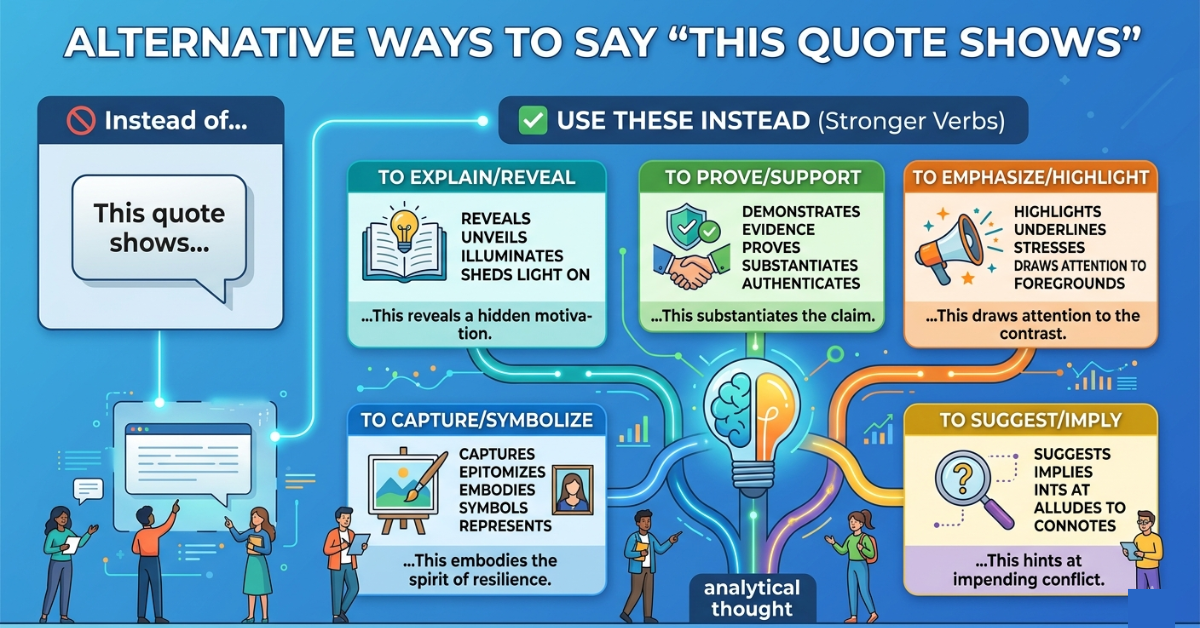
Better Alternatives for “This Quote Shows”
If you’re looking, here are natural and effective alternatives you can use:
H3: Analytical Alternatives
These are great for essays and formal writing:
- This quote suggests that…
- This quote highlights…
- This quote indicates…
- This quote demonstrates…
- This quote reveals…
H3: Interpretive Alternatives
These help when explaining deeper meaning:
- This quote implies that…
- This quote reflects…
- This quote conveys the idea that…
- This quote points to…
- This quote expresses…
Using these variations instead of repeating this will instantly improve your writing style.
How to Use These Alternatives in Sentences
Let’s see how these phrases work in real writing examples:
- Original: This quote shows that courage is important.
Improved: This quote suggests that courage is important. - Original: This quote shows the author’s belief in justice.
Improved: This quote highlights the author’s belief in justice. - Original: This quote shows a deep emotional struggle.
Improved: This quote reflects a deep emotional struggle.
By practicing these patterns, you’ll naturally stop relying and start writing more confidently.
Common Mistakes to Avoid
Even when using alternatives, writers sometimes make mistakes. Here’s what to avoid:
- Using overly complicated words unnecessarily
- Repeating the same alternative repeatedly
- Using incorrect tone in formal writing
- Forcing synonyms where simplicity works better
The goal is not to sound complex, but to sound clear and natural.
Quick Tips to Improve Quote Analysis
To improve your writing beyond try these tips:
- Always explain why the quote matters
- Connect the quote to your main argument
- Use varied transition words
- Keep sentences clear and concise
- Practice rewriting the same sentence in different ways
These small habits improve overall writing quality significantly.
FAQs
1. What is another way to say “this quote shows” in essays?
You can use phrases like this quote suggests, highlights, indicates, or reflects depending on the context.
2. Is “this quote shows” grammatically correct?
Yes, it is grammatically correct, but it can sound repetitive if overused.
3. How can I improve my quote analysis skills?
Focus on explaining meaning, using varied vocabulary, and connecting quotes to your argument.
4. Why should I learn alternatives to “this quote shows”?
It improves writing quality, makes your analysis stronger, and helps avoid repetition.
Conclusion
Learning another way to say this quote shows is a simple but powerful step toward improving your writing. Instead of repeating the same phrase, using varied expressions like suggests, highlights, or reflects makes your analysis clearer and more engaging.
With practice, these alternatives will become natural in your writing style. Keep experimenting with sentence structures, and your academic or content writing will instantly feel more polished and professional.
Author

linguaezone.com@gmail.com
Related Posts
Kill Two Birds With One Stone Alternative: 50 Better Options
- 0
- 1,569 word
Have you ever paused before saying “kill two birds with one stone” because it sounded too violent or simply didn’t fit the...
Read out all
Happy Sabbath Meaning: A Complete Guide to Its Significance
- 0
- 1,632 word
Have you ever received the message “Happy Sabbath” and wondered what it truly means? Is it simply another way of saying “have...
Read out all
I’m So Proud of You in Other Words: 120+ Heartfelt Alternatives
- 0
- 1,562 word
Have you ever wanted to tell someone you’re proud of them but felt like saying “I’m so proud of you” sounded repetitive?...
Read out all
How Do You Spell Happy Anniversary? Correct Spelling Guide
- 0
- 1,221 word
Have you ever paused before writing an anniversary card and wondered, “How do you spell happy anniversary?” You’re not alone. Whether you’re...
Read out all
Waiting for Your Response Email: Best Examples & Tips
- 0
- 1,483 word
Have you ever sent an important email and found yourself wondering whether you should follow up or simply wait? Whether you’re communicating...
Read out all
Great Asset to the Team: Meaning, Examples & Tips
- 0
- 1,494 word
Have you ever wanted to compliment a coworker but struggled to find words that sound professional and sincere? One of the most...
Read out all