
- 0
- 2,338 words
Introduction: What Does “Proscribed” Mean?
Have you ever come across the word proscribed and wondered what it actually means? It is one of those English words that can look confusing at first because it sounds very similar to another common word, “prescribed.” However, the two words have completely different meanings. Understanding that difference is important because using the wrong word can change the meaning of an entire sentence.
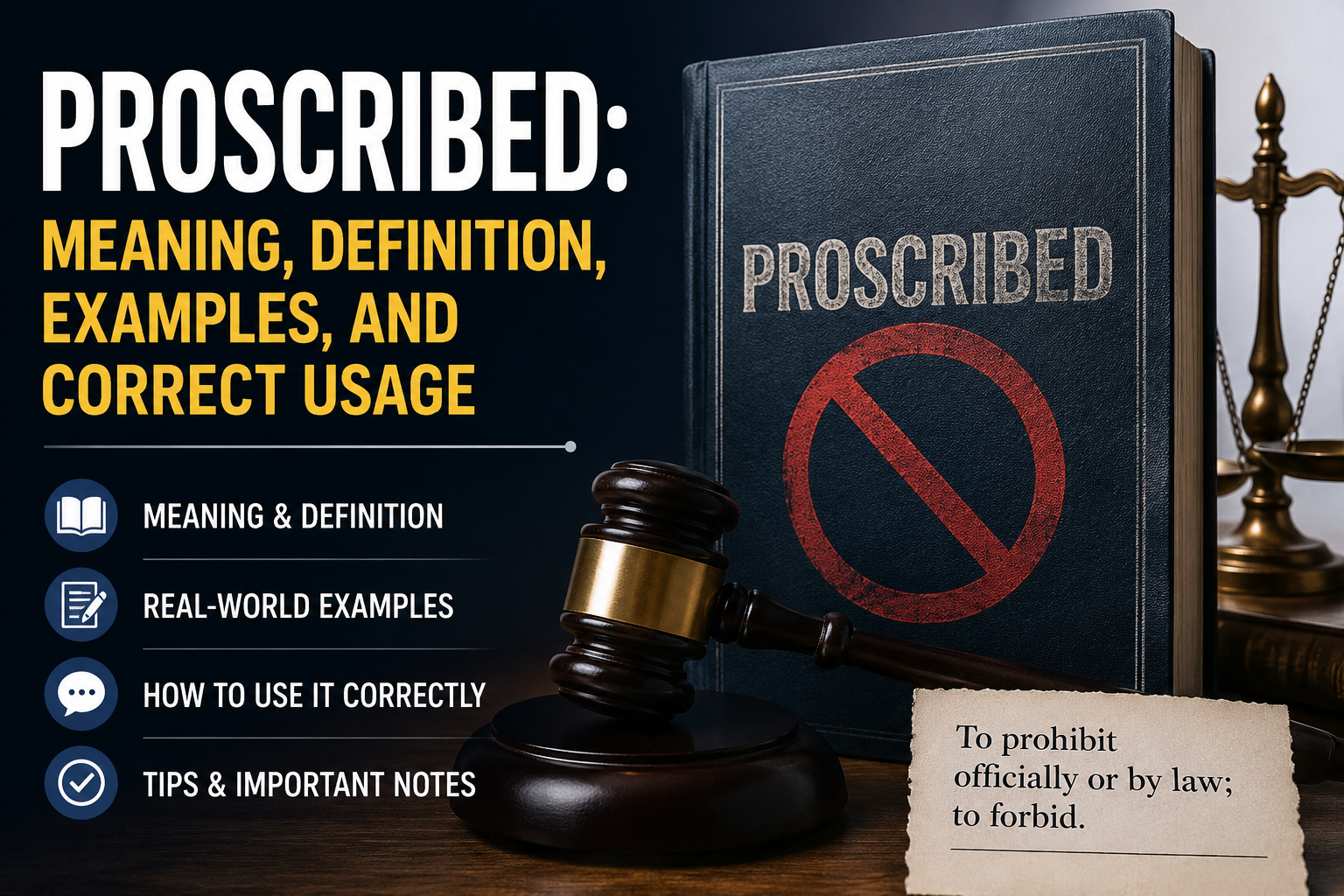
The word proscribed is generally used to describe something that has been officially forbidden, prohibited, or banned. When an activity, organization, practice, or behavior is proscribed, it means that an authority has formally said that it should not be done. The authority could be a government, institution, organization, court, or another body with the power to establish rules.
For example, a government may proscribe a particular activity because it considers that activity illegal or harmful. Likewise, a school might proscribe certain forms of behavior through its official rules. In both cases, the basic idea is the same: something has been formally declared unacceptable or forbidden.
The word can sometimes sound formal because it is more common in legal, political, academic, and official writing than in everyday conversation. In casual speech, people usually say “banned,” “forbidden,” or “not allowed.” Still, proscribed is a useful word to know because it appears frequently in newspapers, legal documents, government statements, and serious discussions.
Proscribed Meaning and Definition
The simplest definition of proscribed is “officially forbidden” or “formally prohibited.” It is the past participle and past-tense form of the verb “proscribe.” When something is proscribed, an authority has placed a restriction on it and has made clear that it is not permitted.
For instance, consider the sentence, “The organization was proscribed by the government.” This means the government officially banned or prohibited the organization. The sentence does not simply suggest that people disliked the organization. Instead, it indicates that an official decision was made against it.
The word can apply to many different situations. Certain actions may be proscribed by law. Certain substances may be proscribed by regulations. A particular practice may be proscribed by an institution. The exact subject changes, but the central meaning remains the same: something has been formally prohibited.
It is also useful to understand that proscribed usually carries a stronger sense than simply saying something is “discouraged.” If an activity is discouraged, people are advised not to do it, but they may still be free to do so. If something is proscribed, however, there is generally a formal rule, prohibition, or authoritative restriction involved.
Proscribed vs. Prescribed: The Important Difference
One of the biggest sources of confusion is the difference between proscribed and prescribed. The words look and sound similar, but their meanings are almost opposite in many situations. Learning this distinction can help prevent one of the most common vocabulary mistakes.
Proscribed means officially forbidden or prohibited. Prescribed, on the other hand, generally means officially recommended, ordered, or established. A doctor may prescribe medicine for a patient. A law may prescribe a particular procedure. A regulation may prescribe how something should be done.
Consider two simple examples. “The doctor prescribed antibiotics” means the doctor officially recommended or ordered the antibiotics as part of the patient’s treatment. In contrast, “The government proscribed the activity” means the government officially prohibited that activity.
A useful memory trick is to associate “proscribed” with “prohibited.” Both words begin with a strong “pro” sound, and both can relate to something being banned. For “prescribed,” think of a doctor writing a prescription or an authority setting out what should be done.
This distinction matters especially in professional writing. Writing “the practice was prescribed” when you mean that it was banned would communicate the opposite idea. Likewise, saying that something was “proscribed” when you mean that it was officially recommended can create serious confusion.
How to Use Proscribed in a Sentence
Using proscribed correctly is relatively simple once its meaning is clear. The word is usually followed by the thing that has been forbidden. For example, “The law proscribed the use of the device in public areas.” Here, the word tells us that the law formally prohibited the use of the device.
Another example is, “Several activities were proscribed under the new regulations.” In this sentence, the specific activities are not mentioned, but the meaning is still clear. The regulations established a formal prohibition against them.
The passive form is also very common. You might see sentences such as, “The group was proscribed under national law.” This construction focuses on the organization that was banned rather than the authority that imposed the ban.
Although the word is grammatically straightforward, its formal tone should be considered. In a casual conversation, saying “That behavior is proscribed” may sound unnecessarily official. A more natural phrase might be “That behavior isn’t allowed.” In a legal article, government report, academic paper, or formal news story, however, proscribed can be an appropriate choice.
Examples of Proscribed in Everyday and Formal Contexts
Examples are often the easiest way to understand vocabulary. Imagine a company has a written policy that forbids employees from sharing confidential customer information. A formal document might say, “The disclosure of confidential information is proscribed under company policy.” In ordinary conversation, someone might simply say, “Company policy doesn’t allow employees to share confidential information.”
A legal example could involve a law that bans a particular activity. A sentence might read, “The legislation proscribed the unauthorized use of protected material.” Here, proscribed indicates that the legislation formally prohibited the action.
The word can also appear in historical writing. A historian might write, “The ruler proscribed certain religious practices.” This means the ruler officially prohibited those practices. The word works well in this context because historical and academic writing often uses formal vocabulary.
Another example could come from institutional rules: “The university proscribed the use of unauthorized recording equipment during examinations.” This means the university officially prohibited students from using such equipment during exams.
These examples demonstrate an important point: proscribed is not limited to government laws. Any recognized authority can potentially proscribe something if it has the power to establish and enforce a prohibition.
Why the Word Proscribed Sounds So Formal
The word proscribed has a formal tone because it is closely associated with law, regulation, government, and institutional authority. People rarely use it in ordinary conversations when simpler alternatives are available. Instead of saying, “Smoking is proscribed in this area,” most people would probably say, “Smoking isn’t allowed here.”
Formal vocabulary becomes useful when precision matters. A legal writer may choose “proscribed” because it communicates that something is not merely disliked or discouraged but formally prohibited. The word can therefore make a statement more precise.
You will often encounter it in serious journalism as well. News reports may describe an organization as “proscribed” when a government has officially banned it. In such situations, replacing the word with “unpopular” would completely change the meaning.
Academic writers may also use proscribed when discussing rules, social practices, historical restrictions, or institutional policies. The word gives the writing a precise and authoritative tone without requiring a longer explanation.
That does not mean you should use proscribed everywhere. Good writing is not about choosing the most complicated word available. It is about choosing the word that communicates the intended meaning naturally. When “banned” or “forbidden” is clearer for your audience, those words may be better.
Common Mistakes With Proscribed
One common mistake is confusing proscribed with prescribed. As discussed earlier, these words should not be treated as interchangeable. Their meanings are fundamentally different, and using one instead of the other can reverse the intended message.
Another mistake is assuming that “proscribed” simply means “not recommended.” The word is stronger than that in most contexts. If something is merely discouraged, there may be no formal prohibition. If it is proscribed, there is generally an explicit or authoritative restriction.
Writers sometimes also use the word in situations where there is no authority involved. For example, saying “My friends proscribed that restaurant” would sound unnatural unless those friends actually had some recognized authority to ban or prohibit the restaurant. If your friends simply disliked the restaurant, “criticized,” “avoided,” or “disapproved of” would be more appropriate.
A final mistake is overusing formal vocabulary. A sentence can be grammatically correct and still sound unnatural. If you are writing for a general audience, consider whether readers will understand proscribed immediately. If not, “prohibited” or “banned” may be a clearer alternative.
Proscribed, Prohibited, Forbidden, and Banned
Several English words have meanings that are close to proscribed, including “prohibited,” “forbidden,” and “banned.” Although they can often be used in similar contexts, they have slightly different tones.
“Prohibited” is probably the closest everyday synonym. It means that something is officially or explicitly not allowed. For example, “Parking is prohibited in this area” is a normal and clear statement.
“Forbidden” can sound stronger or more personal. It is often used for rules and restrictions but can also appear in literary or emotional contexts. “Visitors are forbidden from entering the restricted area” is perfectly natural.
“Banned” is more direct and common in everyday English. It usually means that an authority has decided that something cannot be used, sold, performed, or participated in. It is particularly common in news and casual writing.
“Proscribed” is more formal. It emphasizes the official nature of the prohibition and is especially suitable for legal, governmental, historical, and academic contexts. Choosing among these words depends largely on the audience and tone of the writing.
The History and Origin of Proscribed
The word proscribed comes from the verb “proscribe,” which has roots in Latin. The Latin verb proscribere combined ideas associated with publicly writing or announcing something and eventually developed the sense of officially declaring something prohibited or condemning someone.
Historically, the concept of proscription was particularly significant in ancient Rome. Roman political authorities used formal lists and declarations to identify individuals who had been condemned or placed outside legal protection. This historical background helped shape the modern sense of the word.
Over time, the meaning became more broadly associated with officially forbidding activities, practices, or organizations. Today, the word does not necessarily carry the same historical meaning. Instead, it is generally used to describe something that an authority has formally prohibited.
Understanding the history is not necessary to use the word correctly, but it explains why proscribed has such a strong connection with formal authority. The word has developed over centuries in contexts where governments and institutions publicly established restrictions.
Proscribed in Legal and Government Writing
Legal and government documents frequently use proscribed because these fields require precise language. When a government proscribes an activity, it is making a formal decision rather than merely expressing an opinion.
For example, a regulation might state that certain conduct is proscribed under a particular law. The wording tells readers that the conduct is subject to an official prohibition. This can be important because legal writing often needs to distinguish between something that is illegal, something that is discouraged, and something that is simply considered undesirable.
The term can also be used when discussing organizations. In some countries, authorities may officially designate certain organizations as prohibited. News reports and government statements may describe such organizations as “proscribed organizations.”
However, the exact legal consequences of being proscribed vary by jurisdiction. In one country, proscription may prohibit membership or fundraising. In another, it may impose different restrictions. Therefore, the word itself should not be assumed to describe identical legal consequences everywhere.
When reading legal or government material, it is useful to look at the surrounding explanation. Proscribed tells you that an official prohibition exists, but the document should explain what that prohibition actually means.
How to Remember the Meaning of Proscribed
A simple way to remember proscribed is to connect it with “prohibited.” Both words communicate the idea of something being officially forbidden.
Another useful approach is to create a mental contrast between “proscribed” and “prescribed.” A doctor prescribes medicine because the medicine is recommended or ordered. An authority proscribes an activity because the activity is prohibited.
You can also remember the word through a simple sentence: “If it is proscribed, it is not permitted.” This short association captures the essential meaning without requiring you to memorize a dictionary definition.
Practice also helps. Try creating your own examples involving laws, workplace rules, school policies, or public regulations. The more often you see the word in context, the easier it becomes to recognize its meaning.
Frequently Asked Questions About Proscribed
What does proscribed mean?
Proscribed means officially forbidden, prohibited, or banned. It usually refers to something that an authority has formally declared unacceptable or not permitted.
Is proscribed the same as prohibited?
They are very close in meaning. Both can describe something that is officially not allowed. “Proscribed” is generally more formal and is particularly common in legal, governmental, and academic writing.
What is the difference between proscribed and prescribed?
Proscribed means forbidden or prohibited, while prescribed generally means officially recommended, ordered, or established. A doctor prescribes medicine, while an authority may proscribe an activity.
Can proscribed be used for people?
Yes, although its use depends on context. Historically, people could be proscribed through formal declarations. In modern usage, the word is more commonly encountered when discussing prohibited organizations, activities, practices, or conduct.
Is proscribed a common word?
It is not especially common in casual conversation. However, it appears regularly in formal writing, including legal documents, government material, academic texts, and serious journalism.
What are some synonyms for proscribed?
Common synonyms include prohibited, forbidden, banned, outlawed, restricted, and disallowed. The best choice depends on the context and the level of formality you want.
How can I remember proscribed?
Associate proscribed with prohibited. Also remember the contrast: prescribed = officially recommended or ordered, while proscribed = officially forbidden.
Final Thoughts on Proscribed
The word proscribed may seem complicated at first, but its basic meaning is straightforward: something that is officially forbidden or prohibited. Once you connect it with the word “prohibited,” it becomes much easier to recognize and use.
Author

linguaezone.com@gmail.com
Related Posts

I’m Patient: Understanding the Meaning, Mindset, and Power of Patience
- 0
- 1,816 word
I’m Patient: What Does It Really Mean? Have you ever found yourself waiting for something important and realized that getting frustrated will...
Read out all
Do and Not: Understanding the Difference and Using Both Correctly
- 0
- 2,303 words
Introduction: Why “Do and Not” Matters in Everyday Communication Have you ever written a sentence and wondered whether you should use “do,”...
Read out all
Imput: Meaning, Common Usage, and Why People Often Use It Instead of Input
- 0
- 1,592 word
What Does Imput Mean? Have you ever typed “imput” instead of “input” and wondered whether you made a mistake? You are certainly...
Read out all
Emaculate vs Demasculate: Understanding the Difference and Correct Usage
- 0
- 2,156 words
Introduction: Emaculate vs Demasculate Have you ever come across the words emasculate and demasculate and wondered whether they mean the same thing?...
Read out all
What Does LYK Mean in Text? Simple Guide
- 0
- 1,029 word
Ever received a message that says “LYK” and paused for a second? You are not alone. If you have been wondering what...
Read out all
Thank You for Your Prompt Response Meaning Explained
- 0
- 1,172 word
Have you ever received a quick reply and wanted to sound polite, professional, and appreciative in return? That is exactly where thank...
Read out all