
- 0
- 2,156 words
Introduction: Emaculate vs Demasculate
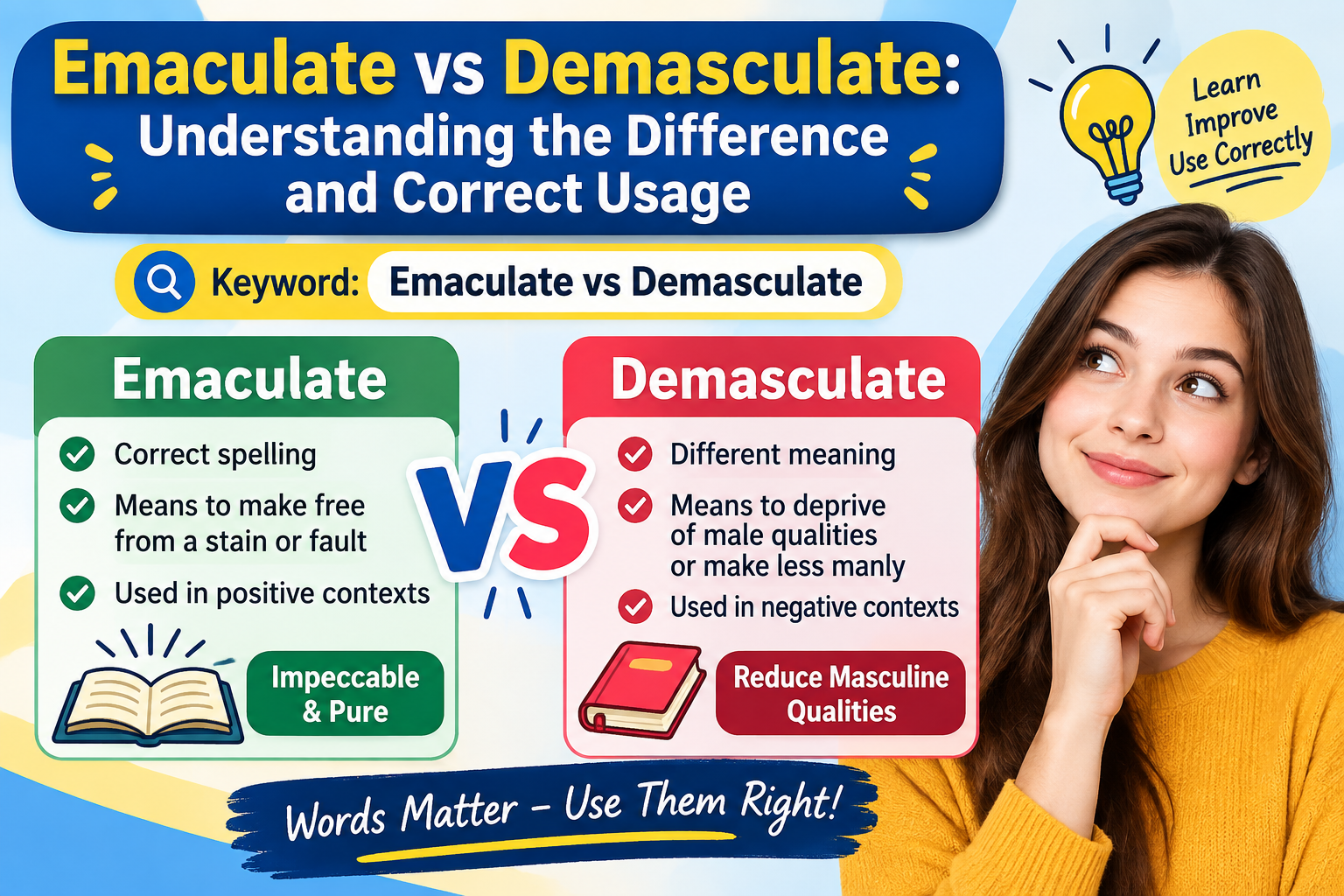
Have you ever come across the words emasculate and demasculate and wondered whether they mean the same thing? At first glance, the two words look almost identical. Both seem to describe the idea of taking away something associated with masculinity. However, there is an important difference between them: emasculate is the established and standard English word, while demasculate is uncommon and generally considered nonstandard or unnecessary in ordinary English.
The confusion is understandable because English contains many pairs of words that differ only by a prefix. People may naturally assume that adding “de-” to “masculate” creates a normal opposite or variation. In this case, however, that assumption can lead to awkward writing. If you are choosing between the two terms for an article, essay, conversation, or professional document, emasculate is overwhelmingly the safer and more widely recognized choice.
The word emasculate has a long history in English and can be used both literally and figuratively. Literally, it can refer to removing the reproductive organs of a male animal or person. Figuratively, it can describe something that makes a man feel less powerful, confident, authoritative, or masculine. Because the figurative meaning is much more common in modern everyday writing, context matters when using the word.
So, what about demasculate? The term occasionally appears in writing, usually when someone is attempting to express the idea of removing masculine qualities or making something less masculine. Yet it is not nearly as established as emasculate. Understanding this distinction can help you avoid using a word that sounds plausible but may seem unusual to readers.
What Does “Emasculate” Mean?
Emasculate is a standard English verb with both literal and figurative meanings. In its literal sense, it traditionally means to castrate a male or remove the testicles. Because of that meaning, the word has a direct historical connection to male reproductive anatomy. However, modern usage frequently employs the term figuratively rather than literally.
In a figurative sense, emasculate means to make a man feel less masculine, powerful, confident, independent, or capable. It can describe a situation in which someone believes their authority or sense of strength has been diminished. For example, a person might say that being publicly criticized by a colleague made him feel emasculated. In this context, the word does not refer to physical castration. Instead, it describes an emotional or psychological experience.
The word can also be applied to organizations, systems, institutions, or ideas. If a policy removes the authority from an organization, someone might describe that policy as emasculating the organization. This broader figurative use demonstrates how English words can move beyond their original physical meanings. The central idea becomes a loss of strength, effectiveness, authority, or power.
It is also worth noting that emasculate can carry a strong emotional charge. When someone says that another person was emasculated, they are usually describing more than simple embarrassment. The statement often suggests that the person experienced a meaningful blow to their confidence, identity, status, or perceived competence. Therefore, writers should use the word carefully and consider whether a less loaded alternative would communicate the idea more precisely.
What Does “Demasculate” Mean?
Demasculate is much less common than emasculate. People sometimes use it to mean making someone or something less masculine, removing masculine characteristics, or reducing a person’s perceived masculinity. The construction may seem logical because the prefix “de-” can indicate removal or reversal in English.
However, the fact that a word looks logically constructed does not automatically make it standard or widely accepted. English vocabulary contains many forms that appear grammatically reasonable but have little established usage. Demasculate falls into this category for many readers. Someone may understand what you mean, but the word can still sound unusual, forced, or incorrect in polished English.
There are situations where you might encounter demasculate in informal writing, specialized discussions, or texts where the writer deliberately distinguishes it from emasculate. Even then, it is important to recognize that the word does not have the same level of acceptance or familiarity as emasculate. If your goal is clear communication, especially in professional or academic writing, the conventional term is usually the better choice.
Instead of using demasculate, writers can often say exactly what they mean with more familiar expressions. Depending on context, alternatives include “make less masculine,” “reduce masculine characteristics,” “undermine his confidence,” “weaken his authority,” or “make him feel less masculine.” These phrases may be longer, but they eliminate ambiguity and sound natural to a broad audience.
Emaculate vs Demasculate: Which One Is Correct?
When comparing emasculate vs demasculate, the clearest answer is that emasculate is the standard and established English word. It has recognized dictionary definitions, a long history of usage, and both literal and figurative meanings. Demasculate, by contrast, is rare and is not generally the preferred term in standard English.
This does not necessarily mean that every appearance of demasculate is impossible to understand. Language is constantly evolving, and speakers sometimes create new words by combining prefixes and roots. Some invented forms eventually become accepted. Nevertheless, uncommon word formation should not be confused with established vocabulary.
For everyday writing, choosing emasculate avoids unnecessary uncertainty. If you are writing an essay, blog post, report, article, or formal message, readers are much more likely to recognize it immediately. Using an uncommon alternative may distract readers from the actual point you are trying to make.
The distinction becomes especially important when you are writing for search engines or a broad online audience. A reader searching for information about emasculate vs demasculate may expect an explanation of why the two terms differ. A strong article should therefore explain that the familiar and standard term is emasculate, while demasculate is a rare formation that should generally be avoided unless a specific context requires it.
Why Do People Confuse Emasculate and Demasculate?
One major reason for the confusion is the structure of the words. English uses prefixes such as “de-” to indicate removal, reduction, reversal, or separation. Words such as deactivate, devalue, deconstruct, and decentralize make it easy to assume that “demasculate” must be a normal English construction.
Another source of confusion is the word masculine. Since emasculate contains a form related to “masculine,” people may instinctively believe that demasculate is simply another version of the same idea. The visual similarity between the terms makes the distinction even harder for people who encounter them only occasionally.
There is also the influence of informal language. Speakers regularly create words when they cannot immediately recall the conventional term. Sometimes these new forms spread through conversation, online discussions, or social media. A person who hears demasculate may assume it is established vocabulary simply because it follows a familiar pattern.
Finally, English has many irregularities. Not every word behaves according to a predictable rule. Knowing the individual vocabulary item is often more useful than trying to determine correctness solely from its construction. In this case, remembering that emasculate is the established term will save you from unnecessary confusion.
Emasculate in Everyday and Figurative Language
The figurative meaning of emasculate is particularly common in discussions about confidence, relationships, careers, competition, and social expectations. For example, someone might feel emasculated after losing a job that was closely connected to their identity or status. The word describes the emotional effect of the situation rather than simply stating that the person is upset.
Relationships are another common context. A person may describe repeated criticism, controlling behavior, or public humiliation as emasculating. Here, the term suggests that the individual feels their independence, competence, or sense of masculinity has been challenged. However, it is important to remember that people experience these situations differently.
The workplace provides another useful example. Imagine an employee who has responsibility for a major project but is repeatedly ignored when decisions are made. That employee might describe the experience as emasculating if they believe their authority has been undermined. In this case, the word connects masculinity with perceptions of professional competence and status.
The term can also be used more broadly. A government agency, institution, or organization can be described as emasculated when its powers are significantly reduced. This figurative extension is useful because it demonstrates that emasculate does not always have to describe a man’s personal feelings. It can describe the weakening of power or effectiveness more generally.
Examples of “Emasculate” in Sentences
Seeing the word in context makes its meaning much easier to understand. Consider the sentence, “The public criticism left him feeling emasculated.” Here, emasculated describes a psychological response. The person feels that his confidence or sense of masculinity has been damaged.
Another example is, “The new regulations emasculated the agency by removing many of its enforcement powers.” In this sentence, the word is clearly figurative. No physical or biological meaning is intended. Instead, emasculated means weakened or deprived of authority.
A third example could be, “He worried that asking for help would make him feel emasculated.” Again, the word refers to a perceived threat to confidence or masculinity. The sentence does not suggest that asking for assistance actually changes the person’s masculinity.
For a literal use, a sentence might refer to the historical or biological meaning of the term. However, because the literal sense can be sensitive, writers should make sure their context is clear. In most modern conversations, readers are likely to encounter emasculate in its figurative form.
When Should You Avoid the Word “Emasculate”?
Although emasculate is a correct word, correctness does not mean it is always the best choice. The term can sound harsh because of its historical connection to castration. If you simply mean “make someone feel embarrassed,” then emasculate may be unnecessarily strong.
Similarly, if you are describing someone losing authority, words such as “undermine,” “weaken,” “disempower,” or “diminish” may be more precise. These alternatives allow you to communicate the specific problem without automatically connecting it to masculinity.
The same principle applies when discussing gender. If your intended meaning is simply that someone has become less confident, there is no need to describe the experience as emasculation unless masculinity is genuinely part of the situation. Precise writing means choosing the word that communicates the intended idea rather than selecting the most dramatic word available.
In sensitive discussions, neutral language can also make communication easier. Instead of saying, “The experience emasculated him,” a writer might say, “The experience seriously undermined his confidence.” The second sentence is often clearer because it identifies the specific emotional effect without assuming that masculinity is the central issue.
Better Alternatives to “Demasculate”
If you are tempted to use demasculate, first ask what you actually mean. If you mean “make less masculine,” simply saying “make less masculine” is often the clearest option. There is no rule requiring a single-word replacement.
If you mean “take away someone’s confidence,” then “undermine his confidence” is more natural. If you mean “reduce someone’s authority,” “weaken his authority” or “strip him of authority” may be more accurate. If you mean “make someone feel less powerful,” “disempower” or “make him feel powerless” may work better.
If the context is specifically about gender identity or cultural expectations, you can also use phrases such as “challenge his sense of masculinity” or “make him feel less masculine.” These expressions are direct and allow readers to understand exactly what is being discussed.
This approach is especially helpful for professional and academic writing. Rather than relying on a rare term that may cause readers to pause, use language that communicates your meaning immediately. Good writing is not about choosing the most complicated word. It is about choosing the most appropriate one.
Common Mistakes When Using Emasculate and Demasculate
One common mistake is assuming that demasculate is simply the opposite of emasculate. Prefixes do not always work in predictable ways, so this kind of word formation can produce unusual vocabulary. When a standard term already exists, creating a second form may make writing less clear.
Another mistake is using emasculate when the intended meaning is merely “embarrass.” Although an embarrassing experience can make someone feel emasculated, the two concepts are not identical. Emasculation usually implies a deeper perceived loss of masculinity, confidence, power, or status.
Writers also sometimes use emasculate without considering its tone. Because the word carries strong historical and cultural associations, it can make a sentence sound more dramatic than intended. Before using it, consider whether words such as “weaken,” “undermine,” or “discourage” would communicate the idea more effectively.
A final mistake is treating dictionary recognition and common usage as exactly the same thing. A rare or technically understandable word may still be a poor choice for general communication. In the case of emasculate vs demasculate, familiarity and established usage strongly favor emasculate.
Final Verdict: Emaculate vs Demasculate
When it comes to emasculate vs demasculate, the choice is relatively straightforward. Emasculate is the established English word. It can be used literally to refer to castration and figuratively to describe the weakening of someone’s perceived masculinity, confidence, power, or authority.
Author

linguaezone.com@gmail.com
Related Posts

I’m Patient: Understanding the Meaning, Mindset, and Power of Patience
- 0
- 1,816 word
I’m Patient: What Does It Really Mean? Have you ever found yourself waiting for something important and realized that getting frustrated will...
Read out all
Do and Not: Understanding the Difference and Using Both Correctly
- 0
- 2,303 words
Introduction: Why “Do and Not” Matters in Everyday Communication Have you ever written a sentence and wondered whether you should use “do,”...
Read out all
Proscribed: Meaning, Definition, Examples, and Correct Usage
- 0
- 2,338 words
Introduction: What Does “Proscribed” Mean? Have you ever come across the word proscribed and wondered what it actually means? It is one...
Read out all
Imput: Meaning, Common Usage, and Why People Often Use It Instead of Input
- 0
- 1,592 word
What Does Imput Mean? Have you ever typed “imput” instead of “input” and wondered whether you made a mistake? You are certainly...
Read out all
What Does LYK Mean in Text? Simple Guide
- 0
- 1,029 word
Ever received a message that says “LYK” and paused for a second? You are not alone. If you have been wondering what...
Read out all
Thank You for Your Prompt Response Meaning Explained
- 0
- 1,172 word
Have you ever received a quick reply and wanted to sound polite, professional, and appreciative in return? That is exactly where thank...
Read out all