
- 0
- 1,464 word
Have you ever looked at a record player and wondered what the long arm holding the needle is actually called? It may seem like a simple part of a turntable, but it plays one of the biggest roles in how your vinyl records sound.
Understanding tonearm meaning is essential whether you’re buying your first record player, upgrading your audio setup, or simply curious about how vinyl playback works. The tonearm isn’t just a holder for the stylus—it is a carefully engineered component that helps the needle track the grooves accurately while protecting your records from unnecessary wear.
In this guide, you’ll learn what a tonearm is, how it works, the different types available, common problems, and tips for choosing and maintaining one.
What Is the Tonearm Meaning?
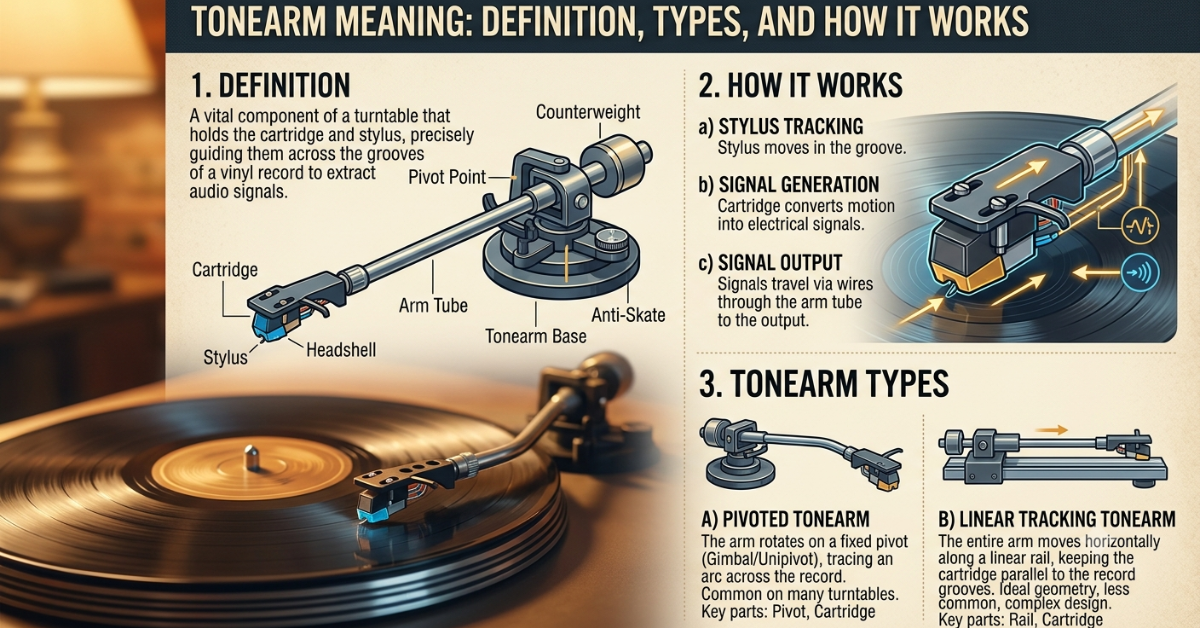
The tonearm meaning refers to the movable arm on a turntable that supports the cartridge and stylus (needle). Its primary purpose is to keep the stylus in the record groove while allowing it to move smoothly from the outer edge of the record toward the center as the music plays.
A well-designed tonearm balances several important factors:
- Stability
- Precision
- Low friction
- Proper tracking force
- Minimal vibration
Without a properly functioning tonearm, even an expensive cartridge cannot deliver high-quality sound.
What Does a Tonearm Do?
The tonearm performs much more than simply holding the needle.
Its main functions include:
- Holding the cartridge securely
- Guiding the stylus through record grooves
- Applying the correct tracking force
- Reducing unwanted vibrations
- Maintaining the correct angle between the stylus and record
- Preventing excessive record wear
Every movement of the stylus depends on the tonearm’s ability to remain balanced and controlled.
How Does a Tonearm Work?
When a vinyl record spins, tiny grooves contain the audio information. The stylus sits inside these grooves and vibrates according to their shape.
Here’s the process:
- The record rotates.
- The stylus follows the grooves.
- The cartridge converts vibrations into electrical signals.
- The amplifier boosts those signals.
- The speakers reproduce the sound.
Throughout this process, the tonearm ensures the stylus stays aligned with the grooves while applying the proper amount of pressure.
If the pressure is too high, records wear out faster.
If it’s too low, the stylus may skip across the record.
Main Parts of a Tonearm
Understanding each component makes the overall concept much easier.
Cartridge
The cartridge contains the mechanism that converts stylus vibrations into electrical signals.
Stylus
Also called the needle, the stylus directly touches the record groove.
Headshell
The headshell connects the cartridge to the front of the tonearm.
Some tonearms have removable headshells, making cartridge replacement easier.
Counterweight
Located at the rear of the tonearm, the counterweight balances the arm and allows users to adjust tracking force.
Anti-Skate Mechanism
As records spin, a natural inward pulling force develops. Anti-skate counteracts this force to keep pressure equal on both groove walls.
Bearings
Precision bearings allow the tonearm to move smoothly with minimal resistance.
Why Is the Tonearm So Important?
Many beginners focus only on speakers or cartridges.
However, the tonearm greatly influences sound quality because it affects how accurately the stylus tracks the grooves.
A quality tonearm provides:
- Better detail
- Lower distortion
- Improved stereo imaging
- Less skipping
- Longer record life
- Reduced stylus wear
Even subtle improvements in tonearm design can produce noticeable differences during playback.
Different Types of Tonearms
Not every tonearm looks or performs the same.
Straight Tonearm
Straight tonearms are commonly found on DJ turntables and many modern record players.
Advantages:
- Excellent tracking stability
- Lightweight
- Good resistance to skipping
Disadvantages:
- May require specialized cartridges on some models.
S-Shaped Tonearm
The S-shaped design has remained popular for decades.
Benefits include:
- Better compatibility with many cartridges
- Balanced tracking
- Classic appearance
These are commonly found on vintage turntables.
J-Shaped Tonearm
Less common today, J-shaped arms offer performance similar to S-shaped designs while reducing certain tracking errors.
Tangential (Linear Tracking) Tonearm
Instead of pivoting, these tonearms move in a perfectly straight line across the record.
Advantages include:
- Extremely accurate tracking
- Lower distortion
- Minimal tracking error
However, they are more complex, expensive, and require precise engineering.
Tonearm Materials
Manufacturers use different materials to improve rigidity while reducing unwanted vibrations.
Common materials include:
- Aluminum
- Carbon fiber
- Magnesium
- Stainless steel
- Titanium
- Composite materials
Carbon fiber has become especially popular because it combines low weight with excellent vibration control.
Tonearm Length Explained
Tonearms usually come in three general sizes.
9-Inch Tonearm
The industry standard.
Offers an excellent balance between size, tracking accuracy, and ease of setup.
10-Inch Tonearm
Provides lower tracking error while requiring slightly more space.
12-Inch Tonearm
Preferred by some audiophiles because of reduced angular error, although these arms require larger turntables.
Common Tonearm Problems
Even quality tonearms can develop issues over time.
Some common problems include:
- Stylus skipping
- Incorrect tracking force
- Tonearm drifting inward
- Worn bearings
- Cartridge misalignment
- Excessive vibration
Most of these issues can be corrected through proper setup and regular maintenance.
How to Set Up a Tonearm Properly
A correct setup improves both sound quality and record longevity.
Step 1: Balance the Tonearm
Adjust the counterweight until the arm floats horizontally.
Step 2: Set Tracking Force
Follow the cartridge manufacturer’s recommended tracking force.
Step 3: Adjust Anti-Skate
Match the anti-skate setting to the tracking force whenever possible.
Step 4: Align the Cartridge
Proper alignment reduces distortion and uneven stylus wear.
Step 5: Check Vertical Tracking Angle
Some advanced turntables allow users to adjust the height of the tonearm for better playback accuracy.
Tonearm vs Cartridge
These components work together but serve different purposes.
| Feature | Tonearm | Cartridge |
| Purpose | Holds and guides stylus | Converts vibrations into electrical signals |
| Mounted On | Turntable | Headshell |
| Primary Role | Mechanical movement | Audio signal generation |
| Adjustable | Yes | Usually replaceable |
Both are equally important for achieving excellent vinyl playback.
How to Choose the Right Tonearm
Before purchasing a tonearm, consider:
- Turntable compatibility
- Cartridge compatibility
- Build quality
- Bearing precision
- Ease of adjustment
- Budget
High-end tonearms offer greater precision, but many mid-range models deliver outstanding performance for everyday listening.
Tonearm Maintenance Tips
Regular care extends both record and equipment life.
Helpful maintenance habits include:
- Keep the stylus clean.
- Dust the tonearm regularly.
- Avoid touching bearings unnecessarily.
- Store records properly.
- Check tracking force periodically.
- Replace worn styli promptly.
Small maintenance routines can prevent expensive repairs later.
Why Audiophiles Care So Much About Tonearms
Serious vinyl enthusiasts often spend considerable time adjusting and upgrading tonearms because small mechanical improvements can noticeably affect playback.
A premium tonearm can offer:
- Better channel separation
- Reduced resonance
- Cleaner bass
- Improved instrument placement
- More natural vocals
- Greater overall musical accuracy
For many listeners, the tonearm is one of the most critical components in an analog audio system.
Key Takeaways
- The tonearm meaning refers to the arm on a turntable that supports and guides the cartridge and stylus.
- It plays a major role in tracking accuracy and sound quality.
- Proper setup helps protect both records and the stylus.
- Different tonearm shapes suit different listening preferences.
- Regular maintenance improves performance and extends equipment life.
- A quality tonearm works together with the cartridge to produce accurate, detailed sound.
Frequently Asked Questions
What is the simple tonearm meaning?
The tonearm is the movable arm on a turntable that holds the cartridge and stylus while guiding the needle across the record grooves during playback.
Why is a tonearm important on a record player?
A tonearm keeps the stylus properly aligned and applies the correct tracking force. This improves sound quality while reducing wear on both records and the stylus.
What is the difference between a tonearm and a stylus?
The tonearm is the mechanical arm that supports the cartridge, while the stylus is the tiny needle that directly contacts the record grooves to read audio information.
Which tonearm type is best?
There is no single best option. Straight tonearms are popular for DJ use, S-shaped tonearms are versatile for home listening, and linear tracking tonearms provide exceptional accuracy for high-end systems.
Can a bad tonearm damage records?
Yes. Incorrect tracking force, poor alignment, or worn bearings can cause excessive record wear, skipping, and reduced sound quality.
Does upgrading a tonearm improve sound?
In many cases, yes. A higher-quality tonearm can reduce distortion, improve tracking, minimize vibration, and allow the cartridge to perform closer to its full potential.
Conclusion
Understanding tonearm meaning is about more than learning the name of a turntable part. The tonearm is a precision-engineered component that guides the stylus, protects your records, and directly influences the quality of every song you hear. Whether you’re just starting your vinyl journey or refining an advanced audio setup, knowing how a tonearm works helps you make smarter equipment choices and maintain your collection with confidence.
As you continue exploring the world of vinyl, paying attention to tonearm setup and maintenance will reward you with cleaner sound, longer-lasting records, and a more enjoyable listening experience.
Author

linguaezone.com@gmail.com
Related Posts

I’m Patient: Understanding the Meaning, Mindset, and Power of Patience
- 0
- 1,816 word
I’m Patient: What Does It Really Mean? Have you ever found yourself waiting for something important and realized that getting frustrated will...
Read out all
Do and Not: Understanding the Difference and Using Both Correctly
- 0
- 2,303 words
Introduction: Why “Do and Not” Matters in Everyday Communication Have you ever written a sentence and wondered whether you should use “do,”...
Read out all
Proscribed: Meaning, Definition, Examples, and Correct Usage
- 0
- 2,338 words
Introduction: What Does “Proscribed” Mean? Have you ever come across the word proscribed and wondered what it actually means? It is one...
Read out all
Imput: Meaning, Common Usage, and Why People Often Use It Instead of Input
- 0
- 1,592 word
What Does Imput Mean? Have you ever typed “imput” instead of “input” and wondered whether you made a mistake? You are certainly...
Read out all
Emaculate vs Demasculate: Understanding the Difference and Correct Usage
- 0
- 2,156 words
Introduction: Emaculate vs Demasculate Have you ever come across the words emasculate and demasculate and wondered whether they mean the same thing?...
Read out all
What Does LYK Mean in Text? Simple Guide
- 0
- 1,029 word
Ever received a message that says “LYK” and paused for a second? You are not alone. If you have been wondering what...
Read out all