
- 0
- 960 words
Packaging choice is never as simple as deciding on a box that suits the item. Packaging choice impacts the level of protection offered to the product, the cost of the packaging, and what the customer perceives from the packaging.
The rigid box and the typical cardboard box both have their applications. While one may be selected for its durability and high-class look, the other is selected for its versatility, cost efficiency, and basic functionality.
Which then is the right choice for you? It all depends on your product, clients, budget, and intended application.
What Is the Difference Between Rigid and Cardboard Boxes?
One of the biggest differences is the way in which the boxes are built.
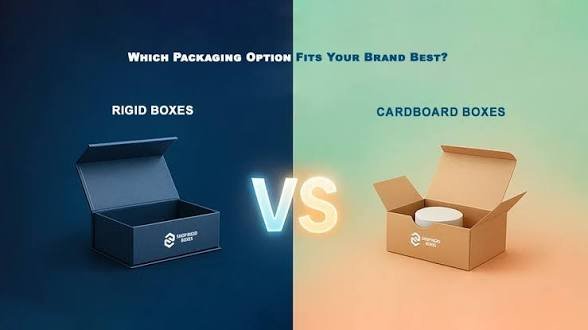
Rigid Boxes are made out of thick, compressed paperboard that does not fold up flat into a carton but is a rigid structure itself. These boxes tend to be covered in paper that is decorated and are often used to house expensive or luxury items, gift sets, electronics, and retail items.
Cardboard packaging can be used to describe both folding cartons and corrugated boxes. Folding cartons are usually composed of thin paperboard that is sent to the consumer in a flat form. Corrugated boxes are constructed by adding a fluted middle layer between two liners.
There is reason to differentiate between these types of containers because a folding carton and a corrugated box do not serve the same purpose.
Durability and Product Protection
It really depends on what type of threat the product faces.
Rigid containers have a rigid structure and do not bend, which maintains the integrity of the package. They are good at protecting products that need good presentation, such as watches, jewelry, perfume, and gift sets.
Folded containers are great for many retail products such as cosmetics and soaps since they are simple to manufacture and give enough protection depending on their size and specifications.
Corrugated boards are more suitable for transportation since they have fluting that gives a cushioning effect and provides compression resistance.
Neither rigid containers nor folded boxes are inherently the most secure choice for all types of products. Fragile and heavy products may require inserts and dividers or even a shipping box.
Which Option Is More Affordable?
For some companies, budgeting might make things easy.
The rigid boxes tend to be more expensive to manufacture compared to folding cartons to manufacture. The reason is that these boxes have a thick board and wrapping, and other features that might incur more costs.
It is usually cheaper to use folding cartons to pack products that are sold in large volumes, especially if there is an easy design.
Sometimes, corrugated boxes can also be inexpensive to use during the delivery and mass shipment of goods.
In comparing prices, you should not just focus on price per box.
Storage, assembly time, weight for shipment, insertions, and risk of product damage should all be considered.
With premium products, more money will be worth spending on the packaging.
With everyday products, a simple carton might be more economical.
Branding and Customer Perception
Packaging affects the way people perceive their product even before using it.
Sturdy box constructions provide a heavy-weight and presentable appearance. Because of their smooth surface, precise lines, and good workability for decorative finishes, they are perfect for companies that aim to integrate packaging into the product.
Here comes the importance of custom luxury packaging. Embellishments like foil stamping, embossing, textured wrapping, magnetic closures, and inserts will give you an opportunity to convey a special brand image with the help of appropriate packaging design.
Paperboard cartons have lots of possibilities for branding as well. Full-color print, illustrations, windows, and clear typeface will allow you to create very effective packaging design for your retail display.
The difference between them lies not in the fact that one can be branded, but the other cannot.
Customization Options for Both Box Types
Both packaging types can be customized for various products, although there will be differences in the range of available construction techniques and finishing options.
Magnetic fasteners, separate lids, sliding drawers, shoulder necks, and customized inserts are among the options for rigid boxes. This option works well if the act of opening the box is important.
Among the options for cardboard cartons are tuck-in fasteners, self-locking bottoms, display windows, hangers, and other features. It is because of their versatility that they are widely used in retail.
When designing packaging, take into account how the customers will open the box, whether it needs to have some inner support, and how the final box will be presented.
Which Box Is Better for Different Products?
| Product or application | Suitable option |
| Watches and jewelry | Rigid box for premium presentation |
| Luxury gifts and curated sets | Rigid box |
| Everyday cosmetics and soaps | Folding carton |
| Lightweight retail products | Folding carton |
| Heavy-duty shipping and distribution | Corrugated cardboard box |
| Premium products sold online | Rigid box with a protective outer carton |
These are general starting points, not fixed rules. Product weight, fragility, price point, retail requirements, and delivery conditions should guide the final decision.
How to Make the Right Choice
Three questions to start with: How much protection does the product require? What kind of experience should the customer have? And what is the amount of money that the company can afford for the packaging?
In case the premium packaging and structure are crucial factors in positioning the product, it might be appropriate to consider a rigid packaging solution. In case there is a need for efficient, lightweight, and affordable packaging for everyday items, it might make sense to consider the folding carton solution. Corrugated packaging might be appropriate for transportation and shipping.
The correct packaging is the one that is necessary for the product without the extra costs and complications. The combination of structure, branding, and performance makes the packaging a useful tool for brand positioning.
Author

hyderghumro3@gmail.com
Related Posts

How Regional Labor and Material Prices Affect Construction Bid Accuracy
- 0
- 1,538 word
A production bid can look precise on paper, and no matter the truth that be incorrect if the underlying fees no longer...
Read out all
Diagnosing Home Cooling Problems in Flower Mound’s Heat: What to Check Before You Call
- 0
- 1,093 word
North Texas summers put air conditioners to the test. When temperatures climb and humidity hangs in the air, even a small issue...
Read out all
Why Your Home Feels Clammy Despite Cooling in Palm Bay: A Practical Guide to AC Dehumidification
- 0
- 1,044 word
Summer on Florida’s Space Coast brings ocean air, daily downpours, and long stretches of high humidity. Even when the thermostat says you...
Read out all
What a Skilled HVAC Contractor Checks Before Recommending New Equipment
- 0
- 1,178 word
Replacing an air conditioner, heat pump, or furnace can feel like a quick swap, but comfort and efficiency depend on steps taken...
Read out all
Why Oversized Air Conditioners Leave Homes Clammy and How to Fix It
- 0
- 1,181 word
On a hot, sticky day, it is tempting to think a bigger air conditioner will cool the house faster and feel better....
Read out all
How to Choose the Best Physiotherapy in Dee Why for Your Recovery
- 0
- 883 words
Choosing physiotherapy for recovery involves more than finding the closest clinic or booking the first available appointment. The right care should help...
Read out all