
- 0
- 901 words
Have you ever come across the word integral and wondered what it actually means? The term appears in mathematics, everyday English, science, and even business conversations. While it may sound technical at first, understanding the integral meaning is much easier than most people think.
In simple terms, “integral” generally refers to something essential, complete, or connected to a whole. In mathematics, however, it takes on a more specific role related to measuring quantities like area, motion, and accumulation. This guide explores the meaning of integral in both language and math, including the definite integral meaning, with clear examples and easy explanations.
What Is the Integral Meaning?
The word “integral” comes from the idea of wholeness or completeness. Depending on the context, it can describe something important, necessary, or mathematically calculated.
Integral Meaning in English
The integral meaning in english refers to something that is essential or necessary for a complete whole. If something is integral, it plays a crucial role and cannot easily be removed.
For example:
- “Trust is an integral part of a healthy relationship.”
- “Technology has become integral to modern education.”
In these sentences, “integral” means important and necessary.
Common Synonyms of Integral
Here are some words often used in place of integral:
- Essential
- Necessary
- Fundamental
- Important
- Crucial
- Core
Although these words are similar, “integral” often emphasizes that something is a necessary piece of a larger system.
Integral Meaning in Mathematics
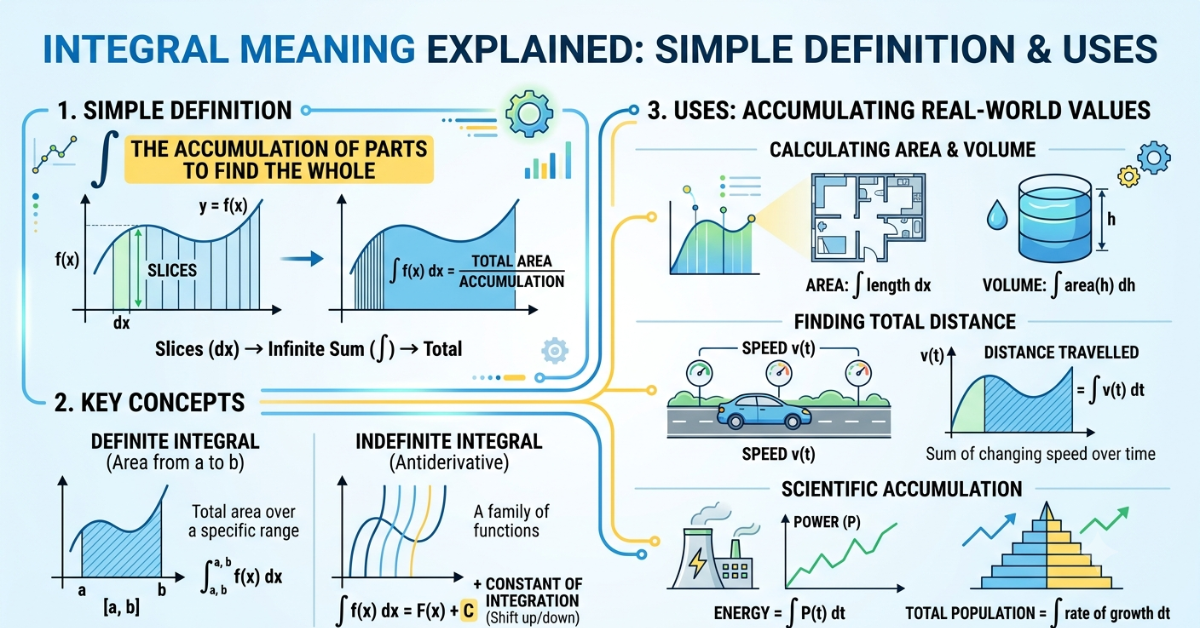
In mathematics, an integral represents a method used to calculate quantities that accumulate over time or space. It is commonly associated with areas under curves, total change, and accumulation.
Mathematical integrals are a major part of calculus and help solve real-world problems in engineering, economics, physics, and data science.
Why Are Integrals Important?
Integrals help mathematicians and scientists answer questions such as:
- How far has an object traveled?
- What is the area beneath a curve?
- How much growth happened over time?
- What is the total quantity accumulated?
Without integrals, many scientific calculations would be impossible.
Understanding Definite Integral Meaning
The definite integral meaning refers to a mathematical calculation that gives a specific numerical value over a defined interval.
In simple words, a definite integral measures the total accumulated quantity between two points.
For example, imagine tracking a car’s speed between two moments in time. A definite integral can help determine the total distance traveled.
Mathematically, it is often shown as:
\int_a^b f(x),dx
Here:
- a = starting point
- b = ending point
- f(x) = function being analyzed
- dx = tiny change in x
The result is always a fixed number rather than another equation.
Definite vs. Indefinite Integrals
People often confuse these two concepts, but there is an important difference.
Definite Integral
- Has fixed limits (start and end points)
- Produces a numerical answer
- Used to measure total accumulation
Indefinite Integral
- Has no fixed limits
- Produces a family of functions
- Includes a constant of integration
Think of it this way: one gives a final answer, while the other gives a formula.
Real-Life Examples of Integral Use
Integrals are not just classroom concepts. They appear in everyday systems and industries.
In Physics
Scientists use integrals to calculate:
- Motion and velocity
- Energy transfer
- Force and acceleration
In Economics
Economists apply integrals to measure:
- Total profit
- Consumer demand
- Cost functions
In Medicine
Medical researchers use integrals to:
- Track drug absorption rates
- Analyze blood flow
- Study biological changes over time
These practical uses make calculus incredibly valuable in modern life.
How to Understand Integral Meaning Easily
If integrals seem confusing, here is a simple way to think about them:
Imagine filling a bucket with water drop by drop. Each tiny drop adds to the total amount of water. An integral calculates the entire quantity after all those tiny additions.
That is why integrals are often described as a way of finding the sum of infinitely small parts.
Common Misunderstandings About Integrals
Many people believe integrals are only useful for advanced mathematicians. In reality, they help explain everyday systems like population growth, changing temperatures, and moving objects.
Another misconception is that integral only belongs to mathematics. As discussed earlier, the term is also commonly used in language to describe something essential or fundamental.
FAQs About Integral Meaning
What is the basic meaning of integral?
Integral generally means something essential, necessary, or forming part of a whole. In math, it refers to calculating accumulated quantities.
What is the definite integral meaning?
A definite integral calculates the total value of a quantity between two fixed points and produces a numerical answer.
What is integral meaning in English?
The phrase refers to something important or necessary to make a whole complete.
Why are integrals important in mathematics?
Integrals help calculate areas, motion, growth, and accumulated changes in science, engineering, and economics.
Is integral difficult to understand?
It can feel challenging at first, but breaking it into real-life examples makes it much easier to understand.
Conclusion
Understanding the integral meaning becomes much simpler when you separate its everyday and mathematical uses. In English, it describes something essential or necessary. In mathematics, it helps calculate accumulated quantities and solve practical problems. Knowing the definite integral meaning also gives you a clearer picture of how calculus measures change between fixed points.
Whether you are learning math, improving vocabulary, or simply satisfying curiosity, understanding integrals can open the door to deeper concepts. Keep exploring related mathematical ideas to build a stronger foundation and make complex topics feel much more approachable.
Author

linguaezone.com@gmail.com
Related Posts

I’m Patient: Understanding the Meaning, Mindset, and Power of Patience
- 0
- 1,816 word
I’m Patient: What Does It Really Mean? Have you ever found yourself waiting for something important and realized that getting frustrated will...
Read out all
Do and Not: Understanding the Difference and Using Both Correctly
- 0
- 2,303 words
Introduction: Why “Do and Not” Matters in Everyday Communication Have you ever written a sentence and wondered whether you should use “do,”...
Read out all
Proscribed: Meaning, Definition, Examples, and Correct Usage
- 0
- 2,338 words
Introduction: What Does “Proscribed” Mean? Have you ever come across the word proscribed and wondered what it actually means? It is one...
Read out all
Imput: Meaning, Common Usage, and Why People Often Use It Instead of Input
- 0
- 1,592 word
What Does Imput Mean? Have you ever typed “imput” instead of “input” and wondered whether you made a mistake? You are certainly...
Read out all
Emaculate vs Demasculate: Understanding the Difference and Correct Usage
- 0
- 2,156 words
Introduction: Emaculate vs Demasculate Have you ever come across the words emasculate and demasculate and wondered whether they mean the same thing?...
Read out all
What Does LYK Mean in Text? Simple Guide
- 0
- 1,029 word
Ever received a message that says “LYK” and paused for a second? You are not alone. If you have been wondering what...
Read out all