
- 0
- 1,288 word
Have you ever paused while writing and wondered whether it’s too small or to small? You’re not alone. This is one of the most common grammar mistakes in English because the words to and too sound exactly the same but serve completely different purposes.
If you’ve ever asked yourself, is it too small or to small, this guide will give you a clear answer. You’ll learn the difference between to and too, understand why one is correct in this context, see plenty of real-life examples, and discover simple tricks to remember the rule forever.
Is It Too Small or To Small?
The correct phrase is:
Correct: Too small
Incorrect: To small
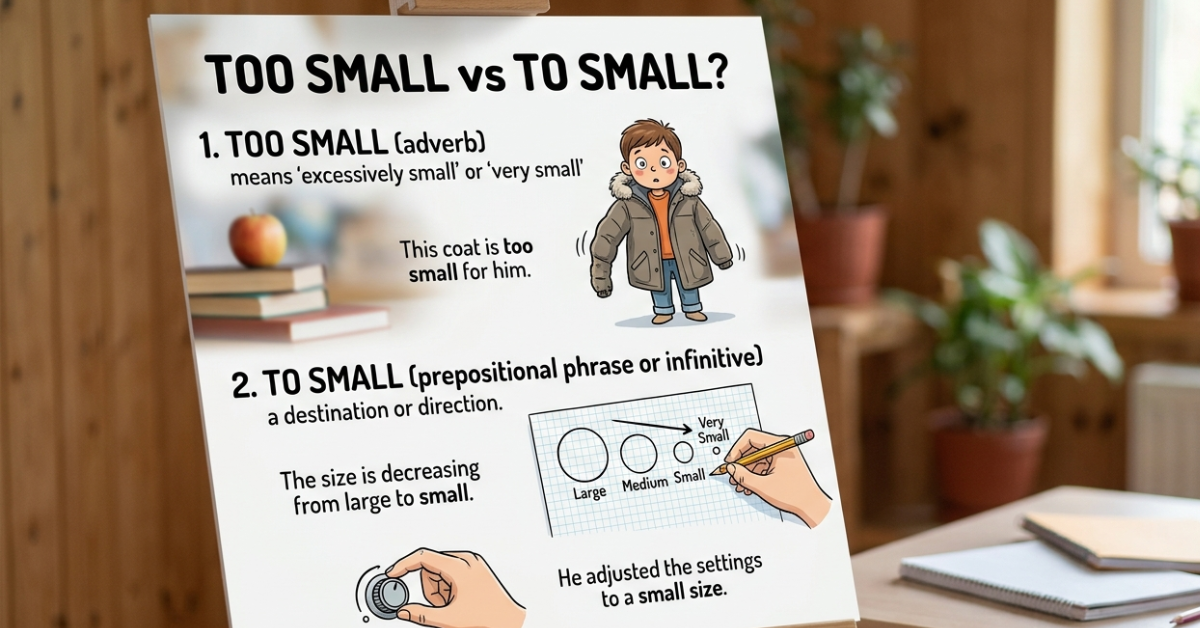
When you want to describe something as being smaller than necessary, acceptable, or expected, you should always use too.
Examples
- This shirt is too small for me.
- The apartment is too small for a family of five.
- Your handwriting is too small to read.
- The font is too small on my phone.
Using to small in these examples would be grammatically incorrect.
Understanding the Difference Between “To” and “Too”
The confusion happens because both words are pronounced the same. However, they have different meanings and grammatical functions.
What Does “To” Mean?
To is a preposition or part of an infinitive verb.
It usually shows:
- Direction
- Destination
- Relationship
- Purpose
- An infinitive verb
Examples
- I am going to school.
- She gave the book to her friend.
- I want to learn English.
- We traveled to London.
Notice that to doesn’t describe size or quantity.
What Does “Too” Mean?
Too usually means:
- More than necessary
- Excessively
- Also or as well
When describing size, too means “more than is acceptable.”
Examples
- The shoes are too tight.
- The coffee is too hot.
- The room is too noisy.
- This dress is too small.
In every one of these examples, too indicates excess.
Why “Too Small” Is Correct
The adjective small describes size.
When you add too, you’re saying the size exceeds an acceptable limit—in this case, it’s excessively small.
For example:
- The jacket is too small.
- The parking space is too small.
- The text is too small to read.
The word to cannot modify an adjective like small in this way.
Why “To Small” Is Incorrect
The phrase to small doesn’t follow English grammar rules.
Since to functions mainly as a preposition or infinitive marker, it cannot describe the degree of an adjective.
Incorrect:
The shirt is to small.
Correct:
The shirt is too small.
Easy Trick to Remember the Difference
One of the easiest grammar tricks is this:
Too has an extra “O.”
That extra letter reminds you of extra.
Whenever something is more than enough, use too.
Think:
- too hot
- too cold
- too expensive
- too loud
- too small
Common Examples of “Too Small”
Here are everyday situations where the phrase appears naturally.
Clothing
- My jeans are too small now.
- These gloves are too small for my hands.
Technology
- The icons are too small.
- The phone screen feels too small.
Furniture
- This table is too small for six people.
- The sofa is too small for the living room.
Education
- The writing is too small to read from the back of the classroom.
Business
- Our office became too small after hiring new employees.
Examples in Complete Sentences
Here are more examples to build confidence.
- This box is too small for the gift.
- My backpack is too small to carry my laptop.
- The hotel room was too small for our family.
- These shoes feel too small after walking for an hour.
- The budget is too small for the entire project.
- The image resolution is too small for printing.
- The font size is too small on this website.
- Your jacket looks too small.
Common Grammar Mistakes
Many English learners accidentally write:
- To big
- To expensive
- To fast
- To heavy
- To small
The correct versions are:
- Too big
- Too expensive
- Too fast
- Too heavy
- Too small
Whenever you’re expressing excess, choose too.
When “To” Is Correct
Although to small is incorrect, to is still correct in many other sentences.
Examples include:
- We walked to the small park.
- I spoke to the small business owner.
- They moved to a small apartment.
- She wants to study architecture.
Notice that to is connected to movement or verbs—not the adjective itself.
Too vs To: Quick Comparison
| Word | Meaning | Example |
| To | Direction, destination, infinitive | Go to school |
| Too | More than enough; excessively | It’s too small |
| Too | Also | I want to come too |
Similar Expressions You Should Know
Understanding too becomes easier when you recognize similar phrases.
Examples include:
- Too large
- Too tall
- Too short
- Too old
- Too young
- Too difficult
- Too easy
- Too bright
- Too dark
- Too expensive
In every case, too expresses excess.
Why This Mistake Is So Common
Several factors contribute to the confusion.
They sound identical
Both words are pronounced the same, making them difficult to distinguish in writing.
Autocorrect doesn’t always help
Spell check may not catch the mistake because to is a correctly spelled English word.
Fast typing
Many writers accidentally type to instead of too, especially on mobile devices.
English learners
People learning English often confuse homophones because pronunciation provides no clue.
Practical Tips to Avoid the Mistake
Use these simple habits while writing.
Ask yourself:
“Do I mean more than enough?”
If yes, use too.
Remember the extra “O”
Extra letter = extra amount.
Read your sentence aloud
Then think about the meaning rather than the sound.
Proofread carefully
Many grammar mistakes happen during quick typing.
Real-World Examples
Imagine these situations.
Shopping
“The shoes are too small, so I’ll buy the next size.”
Office
“The conference room is too small for today’s meeting.”
School
“The print is too small, making the worksheet difficult to read.”
Travel
“Our suitcase is too small for a week-long trip.”
Key Takeaways
- Too small is always the correct phrase.
- To small is grammatically incorrect.
- Too means excessively or more than necessary.
- To usually indicates direction or introduces an infinitive verb.
- Remember that too has an extra “O” for “extra.”
Frequently Asked Questions
Is it too small or to small?
The correct phrase is too small because too means “more than necessary” or “excessively.” The phrase to small is not grammatically correct.
Why do people confuse too and to?
They are homophones, meaning they sound exactly alike but have different meanings and grammatical roles. This makes them easy to mix up in writing.
Can “to small” ever be correct?
No. The words to and small cannot be combined in this way to describe size. If you’re expressing excess, always write too small.
What does “too small” mean?
It means something is smaller than needed, expected, or suitable for a particular purpose.
How can I remember when to use “too”?
Think of the extra “O” in too as standing for extra. Whenever something is excessive, use too.
Is “too” always about excess?
Not always. Besides meaning “more than enough,” too can also mean also, as in, “I’d like to come too.”
Conclusion
If you’ve been wondering is it too small or to small, the answer is straightforward: too small is the only correct expression. The word too indicates excess, making it the proper choice whenever something is smaller than it should be. Meanwhile, to serves entirely different grammatical purposes, such as showing direction or introducing infinitive verbs.
By remembering that too has an extra “O” for “extra,” you’ll avoid one of the most common English writing mistakes. Whether you’re writing emails, essays, social media posts, or professional documents, using too small correctly will make your writing clearer and more polished. Keep practicing these simple grammar rules, and they’ll soon become second nature.
Author

linguaezone.com@gmail.com
Related Posts

Breast Enlargement vs Breast Reduction: Choosing the Right Procedure for You
- 0
- 1,947 word
Breast surgery is a personal decision that can be influenced by physical comfort, body proportions, and individual preferences. While some people consider...
Read out all
The Best Small Business Funding for Expanding into Multiple Locations
- 0
- 810 words
For many successful local businesses, there comes a time when they realize that the opportunity for expansion is just too great to...
Read out all
Cloud Management Services Enable Businesses to Optimize Their Digital Infrastructure and Reduce Operational Costs
- 0
- 1,145 word
Malaysian businesses face mounting pressure to stay competitive while keeping costs under control. Digital transformation has become essential, but managing cloud infrastructure...
Read out all