
- 0
- 1,171 word
Have you ever received a text saying “Diddo!” after wishing someone good luck or saying “I miss you”? If you paused and wondered whether it should be diddo or ditto, you’re not alone. It’s one of those common spelling mix-ups that appear frequently in casual conversations, social media posts, and text messages.
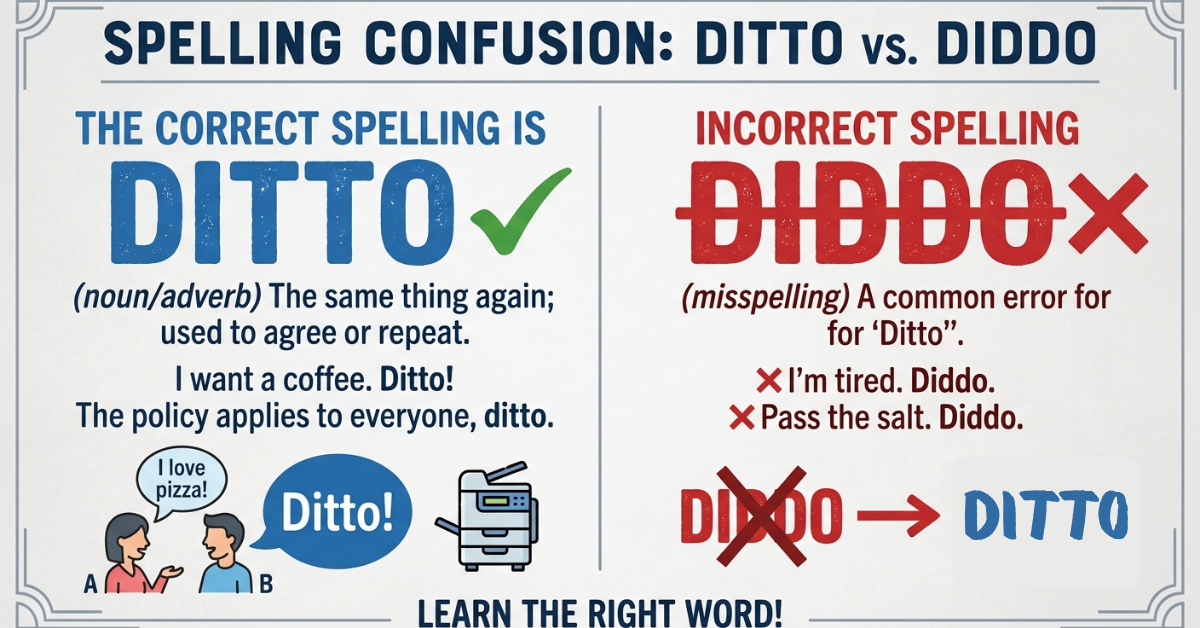
The truth is simple: “ditto” is the correct English word, while “diddo” is almost always a misspelling. In this guide, you’ll discover the correct usage, the diddo or ditto meaning, where the word came from, how to use it in different situations, and why so many people accidentally spell it incorrectly.
What Is the Difference Between Diddo and Ditto?
The biggest difference is that only one of these words officially exists in standard English.
| Word | Correct? | Meaning |
| Ditto | Yes | Used to express agreement or indicate “the same.” |
| Diddo | No | A common misspelling of “ditto.” |
If you’re writing an email, assignment, business document, or even a social media comment, ditto is always the correct choice.
What Does Ditto Mean?
The word ditto simply means:
- The same.
- I agree.
- Me too.
- Likewise.
- The same as what was just mentioned.
Instead of repeating an entire statement, people often use “ditto” to save time.
Simple examples
Person A: I love chocolate ice cream.
Person B: Ditto!
Meaning: I love chocolate ice cream too.
Person A: Have a wonderful weekend!
Person B: Ditto!
Meaning: I wish you the same.
Why Do People Write “Diddo”?
Many English learners—and even native speakers—accidentally write diddo because of pronunciation.
When spoken quickly, “ditto” may sound like:
- Did-oh
- Diddo
- Dido
This happens because, in conversational English, the T sound often becomes softer, especially in American English. As a result, people spell the word the way they hear it.
However, pronunciation does not change the correct spelling.
The Origin of the Word “Ditto”
Interestingly, “ditto” has been around for centuries.
It comes from the Italian word detto, meaning:
- Said
- Already mentioned
- Previously stated
English speakers adopted the term to avoid repeating words or phrases.
Historically, merchants and accountants even used ditto marks (” ) in ledgers instead of rewriting identical information.
Example:
| Item | Quantity |
| Apples | 10 |
| “ | 15 |
| “ | 8 |
The quotation marks represented “same item as above.”
When Should You Use Ditto?
The word works well in both spoken and informal written English.
1. Showing Agreement
Instead of repeating someone else’s opinion, simply say:
- Ditto.
- Same here.
- I agree.
Example:
“I think this movie is amazing.”
“Ditto.”
2. Returning Good Wishes
Someone says:
“Happy Birthday!”
You can reply:
“Ditto!”
Meaning:
“Happy Birthday to you too.”
3. Responding to Compliments
Example:
“You look great today.”
“Ditto!”
Meaning:
“You look great too.”
4. Casual Text Messages
Friends often use it in chats.
Examples:
- Miss you.
- Ditto.
- Love you.
- Ditto.
- Have fun!
- Ditto!
Is “Ditto” Formal or Informal?
Mostly, ditto is considered informal.
It fits naturally in:
- Text messages
- Friendly emails
- Conversations
- Social media
- Casual discussions
However, it’s generally best to avoid it in:
- Academic papers
- Professional reports
- Legal documents
- Official business writing
Instead, use phrases like:
- Likewise
- The same applies
- I agree
- The same is true
- Similarly
Common Situations Where People Use Ditto
Here are some everyday examples.
Conversation
“I’m tired.”
“Ditto.”
Office Chat
“I’ll finish the report tomorrow.”
“Ditto.”
Family
“Love you.”
“Ditto.”
School
“I found the exam difficult.”
“Ditto.”
Common Mistakes to Avoid
Many writers unknowingly make these mistakes.
Writing “Diddo”
Incorrect:
Diddo!
Correct:
Ditto!
Using It in Very Formal Writing
Instead of:
Ditto.
Use:
Likewise.
or
The same applies.
Assuming It’s a Greeting
Some people think “ditto” means “hello.”
It doesn’t.
It only refers back to something already said.
Ditto vs Similar Expressions
Sometimes other expressions communicate the same idea.
| Expression | Meaning | Formality |
| Ditto | Same | Informal |
| Me too | Same feeling | Informal |
| Same here | Agreement | Informal |
| Likewise | Same to you | Semi-formal |
| I agree | Agreement | Formal |
| The same applies | Same situation | Formal |
| So do I | Same action | Neutral |
Examples of Ditto in Everyday Life
Here are practical examples that make the meaning crystal clear.
Example 1
Emma:
“I can’t wait for the holidays.”
Noah:
“Ditto.”
Example 2
Teacher:
“Have a productive weekend.”
Student:
“Ditto!”
Example 3
Friend:
“I love this café.”
You:
“Ditto.”
Example 4
Sibling:
“I’m exhausted after today’s workout.”
You:
“Ditto.”
Should You Ever Use “Diddo”?
In standard English, no.
The only time you might see “diddo” is:
- As a typing mistake
- In informal chats where someone misspelled “ditto”
- As a username or fictional name
Dictionaries do not recognize “diddo” as the standard spelling of the expression meaning “the same.”
Practical Tips for Remembering the Correct Spelling
If you often confuse the two spellings, these tricks can help.
- Remember that ditto has two Ts.
- Think of the phrase: “Two Ts for the same thing twice.”
- Read books and articles where the correct spelling appears naturally.
- Enable spell check when writing emails or assignments.
With regular exposure, the correct spelling quickly becomes second nature.
Quick Comparison
| Feature | Ditto | Diddo |
| Correct English spelling | Yes | No |
| Found in dictionaries | Yes | No |
| Means “the same” | Yes | No |
| Appropriate in writing | Yes | No |
| Common typo | No | Yes |
Key Takeaways
- Ditto is the correct English word.
- It means “the same,” “me too,” or “I agree.”
- Diddo is simply a common misspelling.
- The word originated from the Italian detto.
- Use “ditto” in casual conversations and informal writing.
- For professional communication, choose alternatives like “likewise” or “the same applies.”
Frequently Asked Questions
Is “diddo” a real English word?
No. “Diddo” is not recognized as a standard English word. In almost every case, people mean to write ditto instead.
What is the correct diddo or ditto meaning?
The correct term is ditto, which means “the same,” “me too,” or “I agree.” It is commonly used to avoid repeating what someone else has already said.
Can I use “ditto” in professional emails?
It’s better to avoid it in formal business communication. Words such as “likewise,” “similarly,” or “the same applies” sound more professional.
Why do so many people spell it “diddo”?
The mistake usually comes from pronunciation. In everyday speech, the T in “ditto” often sounds softer, leading people to spell the word the way they hear it.
Is “ditto” considered rude?
No. In casual conversations, it’s perfectly polite. However, when responding to heartfelt messages like “I love you,” some people may prefer a more personal reply instead of simply saying “ditto.”
Can “ditto” replace “me too”?
Yes. In many informal situations, “ditto” and “me too” express the same idea. Both indicate agreement or sharing the same feeling.
Conclusion
The confusion between diddo or ditto is incredibly common, but the answer is straightforward: ditto is the only correct spelling. Whether you’re agreeing with someone, returning a kind wish, or avoiding repetition, “ditto” is a simple and effective expression that’s widely understood in English.
The next time you see someone write “diddo,” you’ll know it’s just a spelling mistake—not a different word. By using ditto correctly and understanding its meaning, you’ll communicate more clearly and confidently in both speech and writing.
Author

linguaezone.com@gmail.com
Related Posts

Kill Two Birds With One Stone Alternative: 50 Better Options
- 0
- 1,569 word
Have you ever paused before saying “kill two birds with one stone” because it sounded too violent or simply didn’t fit the...
Read out all
Happy Sabbath Meaning: A Complete Guide to Its Significance
- 0
- 1,632 word
Have you ever received the message “Happy Sabbath” and wondered what it truly means? Is it simply another way of saying “have...
Read out all
I’m So Proud of You in Other Words: 120+ Heartfelt Alternatives
- 0
- 1,562 word
Have you ever wanted to tell someone you’re proud of them but felt like saying “I’m so proud of you” sounded repetitive?...
Read out all
How Do You Spell Happy Anniversary? Correct Spelling Guide
- 0
- 1,221 word
Have you ever paused before writing an anniversary card and wondered, “How do you spell happy anniversary?” You’re not alone. Whether you’re...
Read out all
Waiting for Your Response Email: Best Examples & Tips
- 0
- 1,483 word
Have you ever sent an important email and found yourself wondering whether you should follow up or simply wait? Whether you’re communicating...
Read out all
Great Asset to the Team: Meaning, Examples & Tips
- 0
- 1,494 word
Have you ever wanted to compliment a coworker but struggled to find words that sound professional and sincere? One of the most...
Read out all