In Summer or On Summer? The Correct Grammar Explained
- 0
- 1,251 word
Have you ever paused while writing and wondered whether you should say “in summer” or “on summer”? You’re not alone. Many English learners—and even native speakers—occasionally hesitate when choosing the right preposition for seasons.
The good news is that the answer is simple once you understand the grammar behind it. In this guide, we’ll explain in summer or on summer, why one is correct in most situations, when exceptions exist, and how to use seasonal expressions naturally in everyday English. You’ll also find examples, common mistakes, practical tips, and answers to frequently asked questions.
Understanding the Difference Between “In Summer” and “On Summer”
The short answer is straightforward:
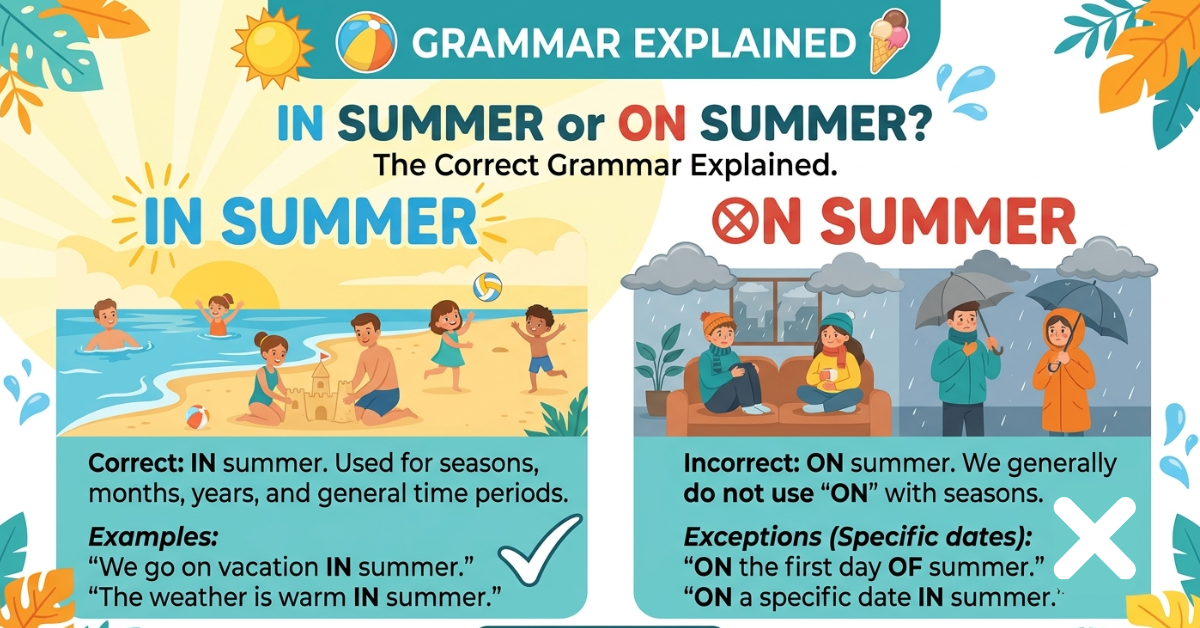
- Correct: In summer is grammatically correct in almost every situation.
- Incorrect: On summer is generally incorrect when referring to the season.
English uses different prepositions depending on whether we’re talking about time, days, dates, or specific occasions. Since summer is a season—a longer period of time—the correct preposition is usually in.
Correct Examples
- We usually travel in summer.
- The weather becomes hotter in summer.
- Many students work part-time in summer.
- Flowers bloom beautifully in summer.
Incorrect Examples
- We travel on summer.
- It gets very hot on summer.
- Schools close on summer.
Why “In Summer” Is Correct
English grammar follows a clear pattern for time expressions.
Use:
- In for months, years, centuries, and seasons.
- On for specific days and dates.
- At for exact times and certain expressions.
Here’s a simple comparison.
| Time Expression | Correct Preposition | Example |
| Summer | In | We swim in summer. |
| July | In | School starts in July. |
| Monday | On | I’ll call you on Monday. |
| June 15 | On | The event is on June 15. |
| 8:00 PM | At | Dinner starts at 8 PM. |
This rule applies consistently across standard English.
When Do People Say “On Summer”?
Although “on summer” is incorrect when referring to the season, you may occasionally encounter phrases that include both words for different reasons.
For example:
- The painting is displayed on Summer Street.
- We stayed on Summer Island.
- She performed on Summer Festival Day.
Notice that Summer in these examples is part of a proper noun rather than the season itself.
British English vs American English
Both major varieties of English agree on this grammar rule.
American English
- We like hiking in summer.
- Baseball is popular in summer.
British English
- Holidays are common in summer.
- Gardens look beautiful in summer.
Some speakers also use:
- in the summer
Example:
- We visit our grandparents in the summer.
Both expressions are correct.
Is There Any Difference?
Generally:
- In summer sounds slightly more general.
- In the summer may refer to a particular summer or simply sound more conversational.
Examples:
- Bears are active in summer.
- We renovated our house in the summer.
Both are perfectly natural.
Why People Confuse “In Summer” and “On Summer”
Several reasons contribute to this common mistake.
Direct Translation
Many languages use different preposition systems, causing learners to translate literally into English.
Confusion with Days
People remember phrases like:
- on Monday
- on Friday
- on Christmas Day
They mistakenly apply the same pattern to seasons.
Influence of Informal Speech
Sometimes grammar mistakes spread through social media, online comments, or casual conversations, making incorrect phrases appear normal.
Grammar Rule for Seasons
Whenever you’re talking about a season, use in.
Examples include:
- in spring
- in summer
- in autumn
- in fall
- in winter
Examples:
- Birds migrate in winter.
- Leaves change color in autumn.
- Flowers bloom in spring.
- Beaches become crowded in summer.
Everyday Examples
Here are natural sentences you’ll hear in daily conversation.
Travel
- We love visiting the mountains in summer.
- Beaches are crowded in summer.
School
- Students often attend camps in summer.
- Many universities offer courses in the summer.
Weather
- Temperatures rise in summer.
- Rainfall decreases in summer in many regions.
Sports
- Cricket tournaments often take place in summer.
- Families enjoy outdoor games in summer.
Common Mistakes to Avoid
Mistake 1
Incorrect: I was born on summer.
Correct: I was born in summer.
Mistake 2
Incorrect: We go swimming on summer.
Correct: We go swimming in summer.
Mistake 3
Incorrect: The weather is hot on summer.
Correct: The weather is hot in summer.
Mistake 4
Incorrect: Flowers grow on spring.
Correct: Flowers grow in spring.
Easy Trick to Remember
Think about the size of the time period.
Use:
- At → exact time
- On → day or date
- In → long periods
Since a season lasts several months, it belongs to the in category.
A quick memory tip:
If it lasts months, use “in.” If it lasts a day, use “on.”
“In Summer” vs “During Summer”
Another question learners often ask is whether during summer is also correct.
The answer is yes.
Examples:
- We travel during summer.
- We travel in summer.
The difference is subtle.
In summer sounds more natural in everyday conversation, while during summer places slightly more emphasis on the time period.
Formal vs Informal Usage
Everyday Conversation
- I work extra hours in summer.
- We barbecue in summer.
Academic Writing
- Tourism increases significantly in summer.
- Electricity demand rises during summer due to air conditioning.
Both are acceptable depending on context.
Practical Tips for Using Seasonal Prepositions
Keep these simple guidelines in mind:
- Use in with every season.
- Use on only for days and dates.
- Don’t translate directly from your native language.
- Read authentic English books and articles to reinforce correct usage.
- Practice writing seasonal sentences regularly.
Quick Comparison
| Correct | Incorrect |
| In summer | On summer |
| In winter | On winter |
| In spring | On spring |
| In autumn | On autumn |
| In the summer | On the summer |
Key Takeaways
- In summer is the correct expression when referring to the season.
- On summer is almost always grammatically incorrect.
- Use in for seasons, months, years, and long periods.
- Use on for days and dates.
- Both in summer and in the summer are acceptable in modern English.
- Regular exposure to natural English helps build confidence with prepositions.
Frequently Asked Questions
Is “on summer” ever grammatically correct?
Only when Summer is part of a proper noun, such as a street name, event, or person’s name. It is not correct when referring to the season.
Should I say “in summer” or “during summer”?
Both are correct. In summer is more common in everyday speech, while during summer often sounds slightly more formal or emphasizes the duration.
Is “in the summer” better than “in summer”?
Neither is universally better. In summer is more general, while in the summer can sound more conversational or refer to a particular summer, depending on context.
Why do English learners confuse these expressions?
Many learners translate directly from their native language or mistakenly apply the rule for days, where on is used. Learning the standard time-preposition patterns helps avoid this error.
Can I use the same rule for other seasons?
Yes. The same grammar applies to all seasons. Say in spring, in summer, in autumn (or in fall), and in winter.
How can I remember the correct preposition?
Remember this simple rule: use in for long periods like seasons and months, on for days and dates, and at for exact times.
Conclusion
Choosing between becomes easy once you understand how English prepositions work. Since summer refers to a season—a long period of time—the correct choice is almost always in summer. The phrase is generally incorrect unless Summer is part of a proper name.
Mastering small grammar rules like this can make your English sound more fluent, natural, and professional. Keep practicing with real-life examples, pay attention to how native speakers use seasonal expressions, and you’ll build confidence every time you write or speak English.
Author
britsx85@gmail.com
Related Posts
Cleverer or More Clever: Which One Is Correct?
- 0
- 1,295 word
Have you ever paused while writing and wondered whether you should say cleverer or more clever? You’re not alone. Many English learners...
Read out all
Diddo or Ditto Meaning: Which Spelling Is Correct?
- 0
- 1,171 word
Have you ever received a text saying “Diddo!” after wishing someone good luck or saying “I miss you”? If you paused and...
Read out allThumb In or Thumb Out Meaning Explained Clearly
- 0
- 1,086 word
Have you ever heard someone ask, “thumb in or thumb out?” and wondered what on earth they meant? In the simplest sense,...
Read out all
Okay Thank You in Spanish: Meaning, Usage & Examples
- 0
- 1,067 word
Have you ever wanted to reply politely in Spanish but felt unsure about the right phrase? That is exactly where okay thank...
Read out all
Fiance vs Fiancee: Meaning, Pronunciation & Usage
- 0
- 1,259 word
Have you ever paused while writing an invitation or social media post because you couldn’t remember whether to write fiance or fiancee?...
Read out all
To Many or Too Many: What’s the Correct Usage?
- 0
- 1,363 word
Have you ever paused while writing and wondered whether it should be to many or too many? You’re not alone. This is...
Read out all