
- 0
- 1,363 word
Have you ever paused while writing and wondered whether it should be to many or too many? You’re not alone. This is one of the most common English grammar mistakes because the words to and too sound exactly alike but have completely different meanings.
If you’ve ever searched is it to many or too many or wondered whether phrases like to many or too many times are correct, this guide will clear up the confusion once and for all.
By the end of this article, you’ll know the difference, understand the grammar rule, avoid common mistakes, and use these expressions confidently in everyday writing and conversation.
The Short Answer: Is It To Many or Too Many?
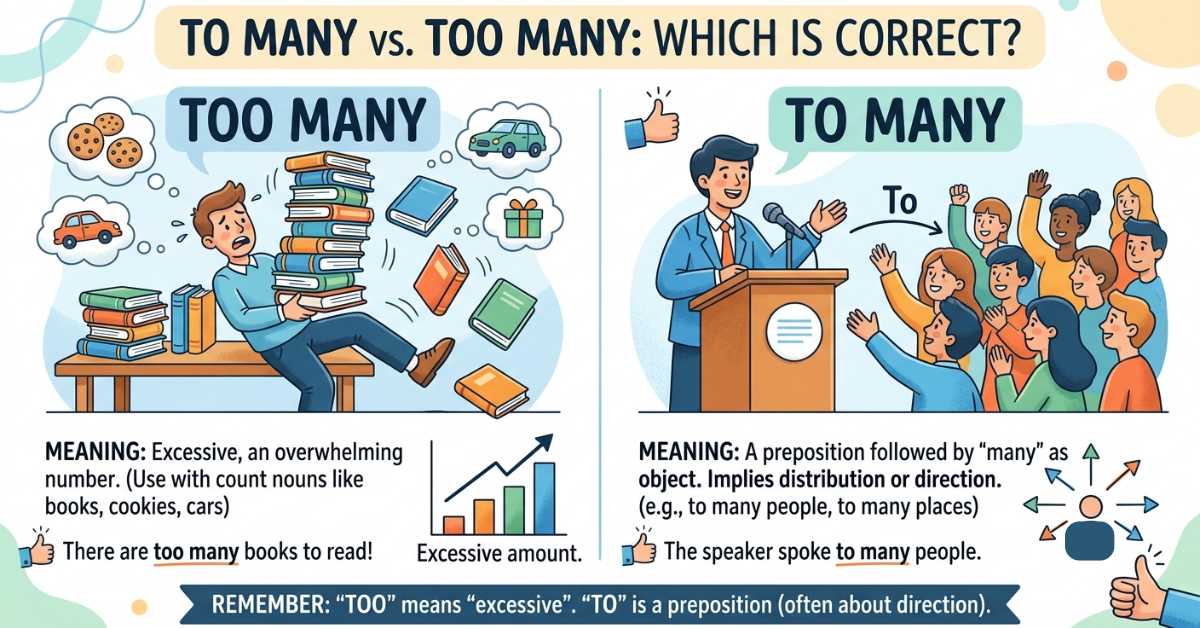
The correct phrase is too many.
Too means more than necessary, excessive, or more than desired.
Many refers to a large number of countable things.
Together, too many means an excessive number of something.
Examples:
- There are too many people in the room.
- I made too many mistakes.
- We received too many emails today.
In contrast, to many is only correct in very specific situations where to functions as a preposition rather than an adverb.
Understanding “Too”
What Does “Too” Mean?
The word too has two primary meanings:
- More than necessary (excessively)
- Also or as well
In the phrase too many, it carries the first meaning.
Examples:
- The soup has too much salt.
- She owns too many shoes.
- We spent too much money.
- There were too many visitors.
Notice that too expresses excess.
Understanding “To”
What Does “To” Mean?
The word to usually functions as:
- A preposition
- Part of an infinitive verb
Examples:
- Go to school.
- Give it to Sarah.
- I want to learn.
- Travel to London.
Unlike too, to does not indicate excess.
Why People Confuse To and Too
The confusion happens because both words are pronounced exactly the same.
English contains many homophones—words that sound alike but have different spellings and meanings.
Examples include:
- Their / There / They’re
- Your / You’re
- Two / Too / To
Although they sound identical, using the wrong spelling changes the meaning of your sentence.
Too Many Meaning Explained
The phrase too many means:
- More than needed
- More than wanted
- More than acceptable
It is always followed by countable nouns.
Examples:
- Too many books
- Too many cars
- Too many questions
- Too many cookies
- Too many students
Think of it this way:
Too = excessive
To Many Meaning Explained
Now let’s answer the common question:
Is “To Many” Ever Correct?
Yes—but only in certain grammatical structures.
Examples:
- The announcement was sent to many employees.
- She spoke to many guests.
- The award was presented to many volunteers.
Here, to is a preposition indicating direction or recipients.
Notice that to many does not mean “an excessive number.”
Instead, it simply means “to a large number of people.”
To Many or Too Many: Side-by-Side Comparison
| Feature | Too Many | To Many |
| Correct for excess? | Yes | No |
| Indicates quantity beyond what’s needed? | Yes | No |
| Uses “too” as an adverb? | Yes | No |
| Uses “to” as a preposition? | No | Yes |
| Common in everyday writing? | Very common | Less common |
Examples of Too Many
Here are some natural examples.
- We invited too many guests.
- There are too many advertisements online.
- She bought too many clothes.
- They asked too many questions.
- I have too many assignments this week.
- The movie had too many unnecessary scenes.
- There were too many interruptions during the meeting.
- We made too many changes at once.
Examples of To Many
Now look at examples where to many is actually correct.
- The letter was addressed to many families.
- The coach spoke to many athletes.
- The speech appealed to many voters.
- The message was delivered to many customers.
- The invitation was sent to many relatives.
Notice that to always connects something to a recipient.
To Many or Too Many Times?
Many learners search for to many or too many times because they are unsure which phrase is correct.
The correct expression is:
Too many times
Examples:
- I’ve watched this movie too many times.
- You have apologized too many times.
- He has repeated the same mistake too many times.
- We’ve discussed this too many times already.
Why?
Because you’re describing an excessive number of occasions.
Using to many times is grammatically incorrect.
Too Many vs Too Much
This is another common source of confusion.
Use Too Many
Use too many with countable nouns.
Examples:
- Too many chairs
- Too many students
- Too many mistakes
- Too many apples
Use Too Much
Use too much with uncountable nouns.
Examples:
- Too much water
- Too much sugar
- Too much information
- Too much noise
Easy rule:
- Countable = Too many
- Uncountable = Too much
Common Mistakes to Avoid
Mistake 1
Incorrect: There are to many cars.
Correct: There are too many cars.
Mistake 2
Incorrect: I made to many mistakes.
Correct: I made too many mistakes.
Mistake 3
Incorrect: We’ve talked to many times.
Correct: We’ve talked too many times.
Mistake 4
Incorrect: She bought to many dresses.
Correct: She bought too many dresses.
Easy Memory Trick
A simple trick can help you remember the correct spelling.
Too has an extra “O.”
Think of the extra “O” as representing something extra or excessive.
Extra letter = Extra amount
So whenever you mean “more than enough,” choose too.
Everyday Sentences Using Too Many
Here are examples you’ll hear in daily life.
- There are too many notifications on my phone.
- We ordered too many pizzas.
- The classroom has too many desks.
- She has too many meetings today.
- I drank too many cups of coffee.
- There are too many advertisements online.
- We received too many complaints.
- He owns too many gadgets.
Grammar Rule to Remember
Whenever you mean:
- excessively
- beyond what is needed
- more than desired
Use too many.
Whenever to indicates movement, direction, or recipients, to many may be correct.
Practical Tips for Avoiding This Mistake
- Pause and ask yourself whether you mean “excessive.”
- If yes, choose too many.
- Check whether to is showing direction or identifying who receives something.
- Proofread your writing for homophones like to, too, and two.
- Read the sentence aloud and think about its meaning rather than its pronunciation.
Key Takeaways
- Too many means an excessive number of countable things.
- To many is only correct when to acts as a preposition.
- If you’re talking about excess, always use too many.
- The phrase too many times is grammatically correct.
- Remember that the extra “O” in too represents something extra
Frequently Asked Questions
Is it to many or too many?
The correct phrase is too many when referring to an excessive number of countable things. To many is only correct when to functions as a preposition, such as “The invitation was sent to many guests.”
Is “to many times” correct?
No. The correct expression is too many times because it describes something happening more often than desired.
When can I use “to many”?
You can use to many when to introduces the people or things receiving an action, such as “She explained the project to many employees.”
What does “too many” mean?
Too many means more than necessary, acceptable, or wanted. It is used only with countable nouns.
What’s the difference between too many and too much?
Too many is used with countable nouns like books, people, or mistakes. Too much is used with uncountable nouns like water, money, or information.
How can I remember the difference?
Remember that too has an extra “O,” which represents something extra. Whenever you mean “more than enough,” use too many.
Conclusion
Understanding to many or too many becomes much easier once you know the role each word plays. Too many is the correct choice whenever you’re describing an excessive number of countable items, while to many is only appropriate when to functions as a preposition before a group of people or things.
If you’re ever unsure, remember the simple rule: the extra “O” in too stands for something extra. With that quick memory trick and the examples in this guide, you’ll be able to avoid this common mistake and write with greater confidence. Keep practicing, proofread carefully, and you’ll soon use these expressions naturally in both spoken and written English.
Author

linguaezone.com@gmail.com
Related Posts
Kill Two Birds With One Stone Alternative: 50 Better Options
- 0
- 1,569 word
Have you ever paused before saying “kill two birds with one stone” because it sounded too violent or simply didn’t fit the...
Read out all
Happy Sabbath Meaning: A Complete Guide to Its Significance
- 0
- 1,632 word
Have you ever received the message “Happy Sabbath” and wondered what it truly means? Is it simply another way of saying “have...
Read out all
I’m So Proud of You in Other Words: 120+ Heartfelt Alternatives
- 0
- 1,562 word
Have you ever wanted to tell someone you’re proud of them but felt like saying “I’m so proud of you” sounded repetitive?...
Read out all
How Do You Spell Happy Anniversary? Correct Spelling Guide
- 0
- 1,221 word
Have you ever paused before writing an anniversary card and wondered, “How do you spell happy anniversary?” You’re not alone. Whether you’re...
Read out all
Waiting for Your Response Email: Best Examples & Tips
- 0
- 1,483 word
Have you ever sent an important email and found yourself wondering whether you should follow up or simply wait? Whether you’re communicating...
Read out all
Great Asset to the Team: Meaning, Examples & Tips
- 0
- 1,494 word
Have you ever wanted to compliment a coworker but struggled to find words that sound professional and sincere? One of the most...
Read out all