
- 0
- 1,255 word
Have you ever paused while writing and wondered whether you should use complaint or complain? You’re not alone. These two words are closely related, but they serve completely different roles in English grammar.
Understanding complaint vs complain is essential for speaking and writing correctly, whether you’re sending a customer service email, writing an academic paper, or simply having a conversation. In this guide, you’ll learn the meaning of each word, when to use it, common mistakes to avoid, memory tricks, and plenty of real-world examples.
What Is the Difference Between Complaint and Complain?
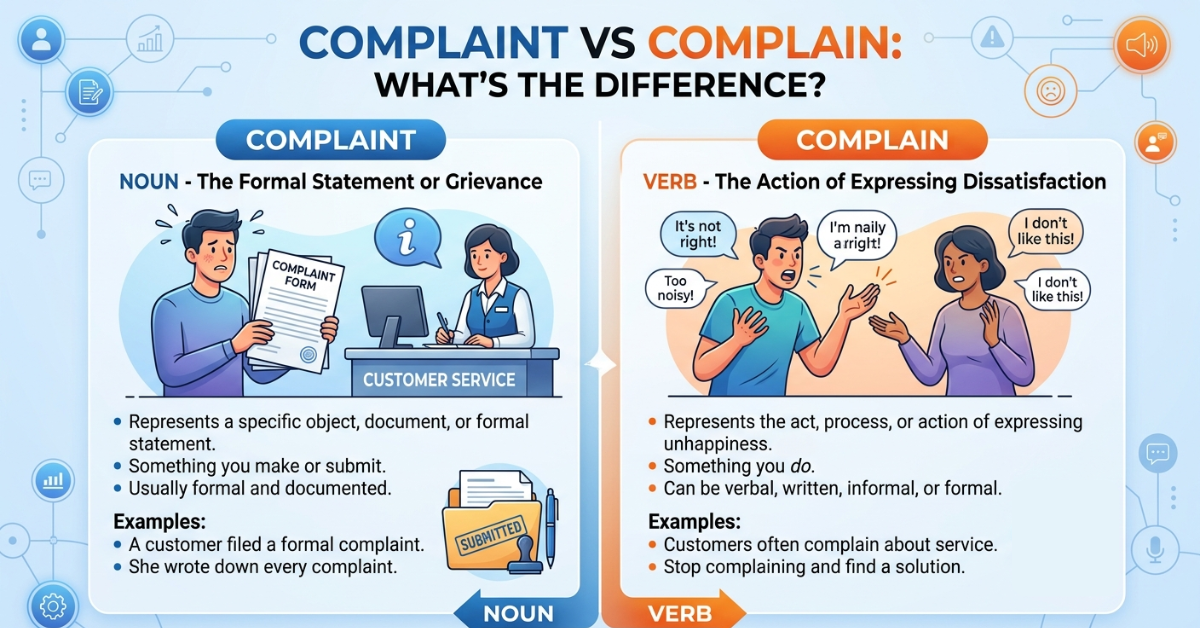
The simplest difference is this:
- Complaint is a noun.
- Complain is a verb.
In other words:
- A complaint is the problem or expression of dissatisfaction.
- To complain means to express dissatisfaction.
Think of it this way:
You complain by making a complaint.
This relationship is similar to:
- Decide → Decision
- Respond → Response
- Apply → Application
The action comes first (verb), while the result or thing is the noun.
Complaint Meaning
A complaint is a statement expressing that something is wrong, unsatisfactory, or unfair.
It refers to the issue itself rather than the action of expressing it.
Examples
- The customer filed a complaint about the delayed delivery.
- We received several complaints regarding the noise.
- Her biggest complaint was the poor customer service.
- The hospital addressed every patient complaint promptly.
In each sentence, complaint is the object or thing being discussed.
Complain Meaning
Complain means to express dissatisfaction, annoyance, or disappointment about something.
It describes the action someone performs.
Examples
- Customers often complain about long waiting times.
- Don’t complain before trying to solve the problem.
- She never complains, even when work becomes difficult.
- They complained about the expensive tickets.
Notice that complain shows an action.
Complaint vs Complain: Side-by-Side Comparison
| Feature | Complaint | Complain |
| Part of speech | Noun | Verb |
| Meaning | An expression of dissatisfaction | To express dissatisfaction |
| Function | Names the issue | Describes the action |
| Example | I submitted a complaint. | I complained about the service. |
When Should You Use “Complaint”?
Use complaint whenever you’re referring to:
- A report of a problem
- A formal grievance
- A written or spoken objection
- The issue itself
Common situations
- Customer complaints
- Workplace complaints
- Legal complaints
- Product complaints
- Medical complaints
Examples
- The company investigated every complaint carefully.
- Please submit your complaint online.
- His complaint was resolved within two days.
- There were no complaints after the update.
When Should You Use “Complain”?
Use complain whenever someone is expressing dissatisfaction.
It usually appears with words like:
- about
- of
- that
- to
Examples
- They complained about the food.
- She complained to the manager.
- Many people complain that prices are rising.
- He complained of severe headaches.
Grammar Rules for Complaint and Complain
Understanding their grammatical role makes choosing the correct word much easier.
Complaint Is a Noun
A noun names:
- a person
- a place
- a thing
- an idea
Since complaint is a thing, it can be:
- singular
- plural
- modified by adjectives
- preceded by articles
Examples:
- a complaint
- several complaints
- a formal complaint
- your complaint
Complain Is a Verb
A verb shows an action.
It changes depending on tense.
Present
- I complain
- You complain
- They complain
Third Person
- She complains
Past
- They complained
Continuous
- He is complaining.
Common Expressions Using Complaint
English speakers frequently use these phrases:
- file a complaint
- make a complaint
- submit a complaint
- receive a complaint
- investigate a complaint
- customer complaint
- official complaint
- formal complaint
- noise complaint
Example
The manager handled every customer complaint professionally.
Common Expressions Using Complain
You’ll often hear:
- complain about
- complain to
- complain of
- complain that
- constantly complain
- frequently complain
Example
Customers complain about slow internet speeds during peak hours.
Real-Life Examples
In Customer Service
Correct:
- I’d like to make a complaint.
- I’d like to complain about my order.
Incorrect:
- I’d like to make a complain.
- I’d like to complaint about my order.
In School
Correct:
- The student filed a complaint against bullying.
- Students often complain about difficult exams.
At Work
Correct:
- HR received a formal complaint.
- Employees complained about overtime policies.
In Healthcare
Correct:
- The patient complained of chest pain.
- The doctor reviewed the patient’s chief complaint.
Common Mistakes People Make
Mistake 1
Incorrect: I want to complaint.
Correct: I want to complain.
Mistake 2
Incorrect: She made a complain.
Correct: She made a complaint.
Mistake 3
Incorrect: They complaint every day.
Correct: They complain every day.
Mistake 4
Incorrect: He submitted a complain.
Correct: He submitted a complaint.
Easy Memory Trick
Here’s a simple way to remember the difference.
Complain = Action
If someone is doing something, use complain.
Example:
She likes to complain.
Complaint = Thing
If you’re talking about the issue itself, use complaint.
Example:
Her complaint was resolved quickly.
Think of it this way:
Complain is what you do.
Complaint is what you make.
Synonyms of Complaint
Depending on context:
- grievance
- objection
- criticism
- protest
- concern
- accusation
- issue
- report
Synonyms of Complain
Possible alternatives include:
- protest
- object
- criticize
- grumble
- moan
- whine
- express dissatisfaction
- voice concerns
Complaint vs Complain in Formal Writing
Formal writing usually prefers specific phrases.
Examples:
- submit a complaint
- file a complaint
- investigate complaints
- complain formally
- complain to the authorities
Business emails, legal documents, and customer support communications often distinguish clearly between the action (complain) and the document or issue (complaint).
Everyday Conversation Examples
Friend:
“I always complain when my coffee is cold.”
Restaurant:
“The manager apologized after receiving our complaint.”
Office:
“Employees shouldn’t hesitate to complain if policies are unfair.”
School:
“The teacher addressed every complaint respectfully.”
Quick Practice Quiz
Choose the correct word.
1.
I’d like to ______ about the delayed package.
complain
2.
The company received a customer ______.
complaint
3.
Why do people always ______ about the weather?
complain
4.
Your ______ has been forwarded to our support team.
complaint
Key Takeaways
- Complaint is a noun that refers to a problem, grievance, or expression of dissatisfaction.
- Complain is a verb that means to express dissatisfaction.
- You make, submit, or file a complaint.
- You complain about, complain of, or complain to someone.
- Choosing the correct word improves clarity in both formal and everyday English.
Frequently Asked Questions
Is it “complaint” or “complain”?
It depends on the sentence. Use complaint when referring to the issue or grievance, and use complain when describing the act of expressing dissatisfaction.
Can complaint be used as a verb?
No. Complaint is only a noun. If you need an action word, use complain.
What is the easiest way to remember complaint vs complain?
Remember this phrase: You complain by making a complaint. The verb describes the action, while the noun names the issue.
Is “make a complaint” grammatically correct?
Yes. “Make a complaint” is the standard and widely accepted expression in both spoken and written English.
Can I say “file a complain”?
No. The correct phrase is file a complaint because you’re filing the grievance, not the action.
Why do English learners confuse complaint and complain?
They share the same root word and have similar spellings, making them easy to mix up. Remembering that complain is the action and complaint is the result helps avoid this common mistake.
Conclusion
The difference between complaint vs complain is straightforward once you understand their grammatical roles. Complain is the verb used when someone expresses dissatisfaction, while complaint is the noun referring to the concern or grievance itself. Using the correct word makes your communication more accurate, professional, and natural.
The next time you’re writing an email, speaking with customer support, or helping someone learn English, remember this simple rule: you complain by making a complaint. Mastering this distinction will help you avoid common grammar mistakes and communicate with greater confidence.
Author

linguaezone.com@gmail.com
Related Posts

Kill Two Birds With One Stone Alternative: 50 Better Options
- 0
- 1,569 word
Have you ever paused before saying “kill two birds with one stone” because it sounded too violent or simply didn’t fit the...
Read out all
Happy Sabbath Meaning: A Complete Guide to Its Significance
- 0
- 1,632 word
Have you ever received the message “Happy Sabbath” and wondered what it truly means? Is it simply another way of saying “have...
Read out all
I’m So Proud of You in Other Words: 120+ Heartfelt Alternatives
- 0
- 1,562 word
Have you ever wanted to tell someone you’re proud of them but felt like saying “I’m so proud of you” sounded repetitive?...
Read out all
How Do You Spell Happy Anniversary? Correct Spelling Guide
- 0
- 1,221 word
Have you ever paused before writing an anniversary card and wondered, “How do you spell happy anniversary?” You’re not alone. Whether you’re...
Read out all
Waiting for Your Response Email: Best Examples & Tips
- 0
- 1,483 word
Have you ever sent an important email and found yourself wondering whether you should follow up or simply wait? Whether you’re communicating...
Read out all
Great Asset to the Team: Meaning, Examples & Tips
- 0
- 1,494 word
Have you ever wanted to compliment a coworker but struggled to find words that sound professional and sincere? One of the most...
Read out all