
- 0
- 1,092 word
Have you ever written a quick message and paused for a second: should it be by or bye? It is one of those small spelling choices that can completely change the meaning of a sentence. Understanding By vs Bye is simple once you see how each word works in real English.
In this guide, you will learn the meaning of both words, how to use them correctly, common mistakes to avoid, and a few easy memory tricks that make the difference stick.
What Does “By” Mean?
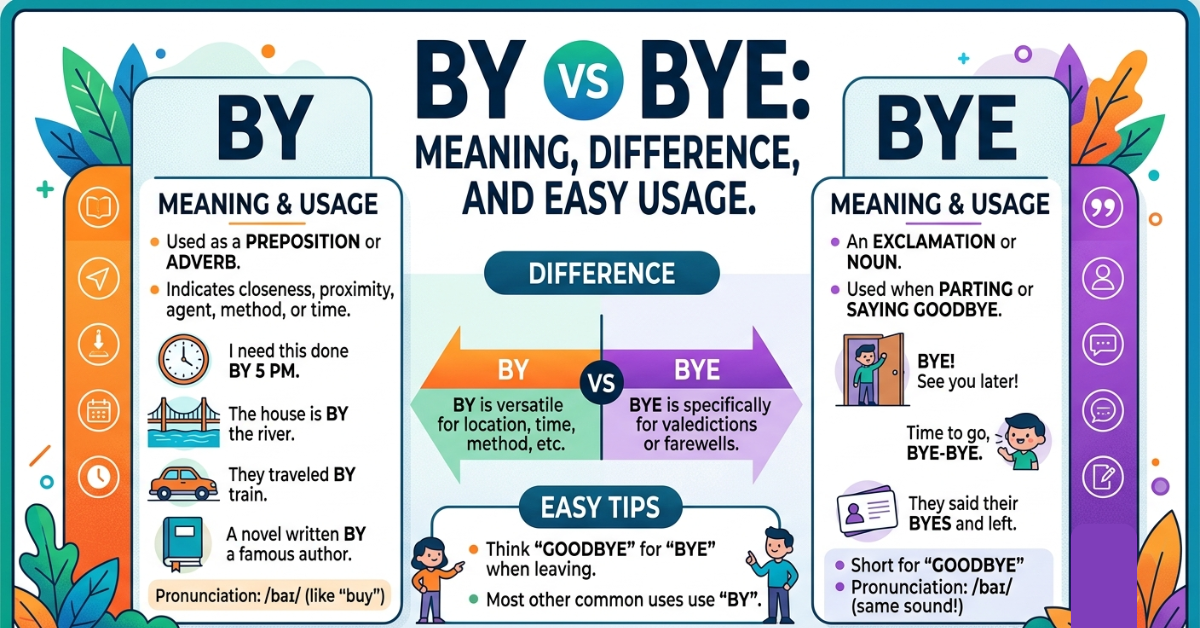
“By” is a preposition, and it has several common uses in English. It can show:
- Location or place
The shop is by the station. - Time or deadline
Please finish the work by Monday. - Method or means
She traveled by train. - Who did something
The book was written by a famous author.
“By” is one of the most flexible words in English, which is why it appears so often in writing, speech, emails, and formal documents.
Examples of “By” in sentences
- I sit by the window every morning.
- The report must be submitted by 5 p.m.
- He learned the lesson by watching others.
- This painting was created by a student.
What Does “Bye” Mean?
“Bye” is a shortened form of “goodbye.” It is used when leaving someone or ending a conversation. It is informal, friendly, and common in everyday speech.
You will often see it in:
- Text messages
- Chats
- Casual conversations
- Farewells
Examples of “Bye” in sentences
- Bye, see you tomorrow!
- She waved and said bye.
- Bye for now.
- It was late, so they said bye and left.
By vs Bye: The Core Difference
The simplest way to remember By vs Bye is this:
- By = shows relation, time, place, method, or agent
- Bye = a farewell
They sound the same, but they are not interchangeable. Using one instead of the other can make your sentence confusing or incorrect.
Compare these examples
- Correct: I will arrive by noon.
- Incorrect: I will arrive bye noon.
- Correct: Bye, take care!
- Incorrect: By, take care!
Easy Ways to Remember the Difference
A few memory tricks can help you avoid mistakes.
1) Think of “bye” as saying goodbye
The extra “e” in bye can remind you of ending or leaving.
2) Think of “by” as a relationship word
“By” links things together:
- a person and an action
- a place and an object
- a deadline and an event
3) Check the meaning of the sentence
Ask yourself:
- Am I saying farewell? Use bye
- Am I showing time, place, or method? Use by
Common Mistakes People Make
Many errors happen because both words sound identical. That is why spelling is the key.
Mistake 1: Using “bye” in formal writing
In professional writing, bye is usually too casual unless you are literally ending a message.
- Please send the file by Friday.
Not: Please send the file bye Friday.
Mistake 2: Using “by” when saying goodbye
- Bye, I will call you later.
Not: By, I will call you later.
Mistake 3: Confusing deadlines and farewells
- The assignment is due by tomorrow.
- Bye, class is over.
The first sentence shows a deadline. The second sentence ends a conversation.
When to Use “By” in Real Life
“By” appears in many practical situations. Here are the most common ones.
Time and deadlines
Use it when showing the latest time something should happen.
- Submit the form by Thursday.
- We should be there by 8 o’clock.
Transportation or method
Use it to show how someone travels or does something.
- He came by car.
- They communicated by email.
Nearness or location
Use it to show something is beside or next to something else.
- Stand by the door.
- There is a café by the bridge.
Authorship or responsibility
Use it to show who made or did something.
- A poem by Shakespeare
- A design by a famous artist
When to Use “Bye” in Real Life
“Bye” works best in casual, spoken, or friendly settings.
Common situations
- Ending a phone call
- Leaving a chat
- Signing off from a message
- Saying goodbye in person
Examples
- Bye! Talk to you later.
- Okay, bye everyone.
- Bye, have a safe trip.
If you are writing a formal email, you may prefer “regards,” “sincerely,” or “best wishes” instead of “bye.”
Quick Comparison Table
| Word | Part of Speech | Meaning | Example |
| By | Preposition | Shows time, place, method, or author | Finish by Friday |
| Bye | Interjection / noun | Short for goodbye | Bye, see you soon |
Practical Tip for Exams, Emails, and Writing
When you are unsure, pause and read the sentence aloud.
- If the sentence is about leaving, use bye
- If the sentence is about relation or timing, use by
This small habit saves you from careless spelling errors in essays, messages, and professional writing.
Why This Confusion Happens So Often
The confusion between By vs Bye is common because they are homophones, meaning they sound the same but have different meanings and spellings. English has many homophones, and this is one reason spelling can feel tricky even for fluent speakers.
The good news is that once you connect each word to its role, the confusion fades quickly.
Key Takeaways
- By is used for time, place, method, and authorship.
- Bye is used when saying goodbye.
- The words sound the same but are not interchangeable.
- Reading the sentence meaning is the fastest way to choose correctly.
- A little practice makes the difference feel automatic.
FAQ: By vs Bye
1. Is it “by” or “bye” when saying goodbye?
Use bye when you are saying goodbye. By is not used as a farewell.
2. What is the easiest way to remember by vs bye?
Remember that bye is for leaving or ending a conversation, while by usually shows time, place, or method.
3. Can “by” and “bye” be used in the same sentence?
Yes, but only if both meanings are needed. For example: Bye, I’ll be there by 6 p.m.
4. Is “bye” formal or informal?
Bye is usually informal and friendly. In formal writing, people often use expressions like “best regards” instead.
5. Why do people confuse by and bye?
They sound the same, so the confusion comes from pronunciation, not meaning. Spelling and sentence context solve the problem.
6. Is “by” only used for time?
No, by can also show location, method, or the person who did something. It is a very common and versatile word.
Conclusion
The difference between By vs Bye is small in spelling but big in meaning. By is a versatile preposition that connects ideas, while bye is the friendly word you use when saying goodbye.
Once you focus on context, the choice becomes easy. Keep practicing with real sentences, and this common mix-up will stop feeling confusing.
Author

linguaezone.com@gmail.com
Related Posts
Kill Two Birds With One Stone Alternative: 50 Better Options
- 0
- 1,569 word
Have you ever paused before saying “kill two birds with one stone” because it sounded too violent or simply didn’t fit the...
Read out all
Happy Sabbath Meaning: A Complete Guide to Its Significance
- 0
- 1,632 word
Have you ever received the message “Happy Sabbath” and wondered what it truly means? Is it simply another way of saying “have...
Read out all
I’m So Proud of You in Other Words: 120+ Heartfelt Alternatives
- 0
- 1,562 word
Have you ever wanted to tell someone you’re proud of them but felt like saying “I’m so proud of you” sounded repetitive?...
Read out all
How Do You Spell Happy Anniversary? Correct Spelling Guide
- 0
- 1,221 word
Have you ever paused before writing an anniversary card and wondered, “How do you spell happy anniversary?” You’re not alone. Whether you’re...
Read out all
Waiting for Your Response Email: Best Examples & Tips
- 0
- 1,483 word
Have you ever sent an important email and found yourself wondering whether you should follow up or simply wait? Whether you’re communicating...
Read out all
Great Asset to the Team: Meaning, Examples & Tips
- 0
- 1,494 word
Have you ever wanted to compliment a coworker but struggled to find words that sound professional and sincere? One of the most...
Read out all