
- 0
- 1,468 word
Have you ever typed a word, stared at it for a few seconds, and thought, that doesn’t look right? If so, you’re definitely not alone—and one of the most common words people second-guess is embarass or embarrass.
It’s a classic spelling trap. The word is used often in everyday conversation, emails, essays, and social media, yet many people still pause when writing it. Is it embarass with one r, or embarrass with two? In this guide, you’ll learn the correct spelling, why the confusion happens, how to remember it easily, and how to use the word correctly in real sentences.
Embarass or Embarrass: Which Spelling Is Correct?
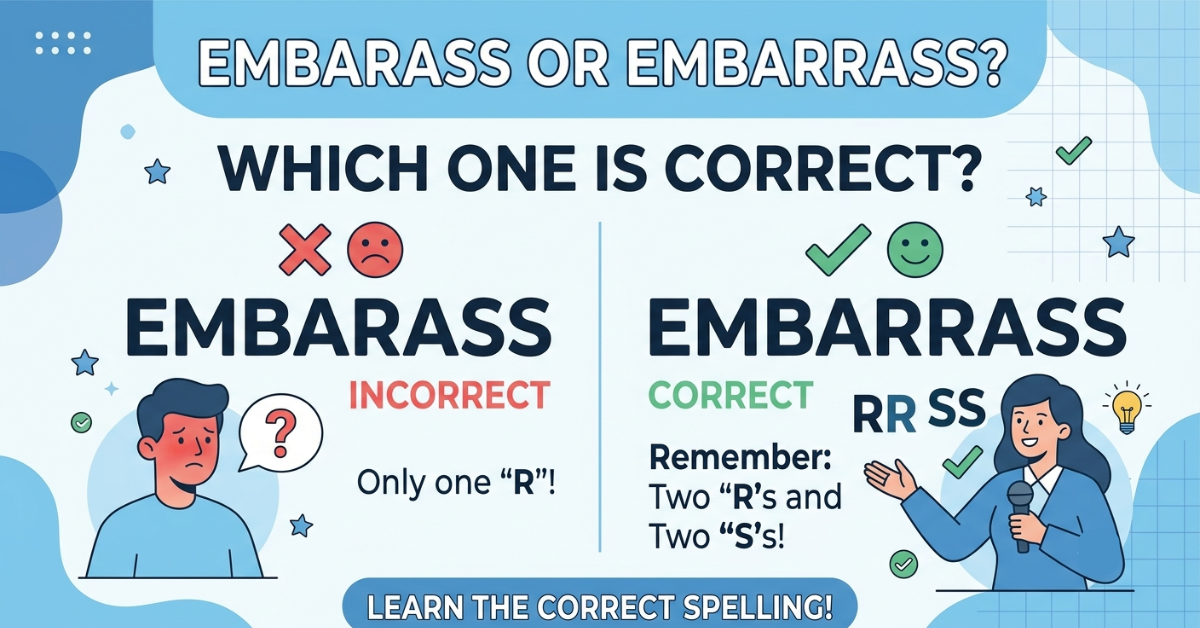
The correct spelling is embarrass.
The spelling embarass is incorrect.
Correct:
- embarrass
Incorrect:
- embarass
If you’ve been mixing them up, you’re in good company. “Embarrass” is one of those English words that doesn’t look intuitive, which is exactly why it gets misspelled so often.
What Does “Embarrass” Mean?
Embarrass is a verb that means to make someone feel awkward, self-conscious, ashamed, or uncomfortable—especially in front of other people.
Examples:
- Please don’t embarrass me in front of my friends.
- He was embarrassed after forgetting his presentation lines.
- I didn’t mean to embarrass her by bringing up that story.
The word can describe social awkwardness, emotional discomfort, or situations that make someone feel exposed.
Why Do People Confuse “Embarass” and “Embarrass”?
The confusion happens because embarrass has a spelling pattern that doesn’t feel obvious. Many people remember only one doubled consonant and forget the other.
The correct word has:
- two R’s
- two S’s
So it’s spelled:
e-m-b-a-r-r-a-s-s
Not:
- embarass
- embarasss
- embarass
- embarres
Why this word is easy to misspell
Here are a few reasons:
1. Double letters are tricky
English is full of words with double consonants, but they’re not always predictable. With embarrass, you need to remember both rr and ss.
2. Pronunciation doesn’t fully help
When spoken quickly, “embarrass” doesn’t always make the double letters obvious. That makes it easier to rely on memory—and memory can be unreliable with tricky spellings.
3. It’s visually awkward
Ironically, embarrass is a word that looks embarrassing to spell. It’s one of those words people type, delete, and retype because it just doesn’t seem right on the screen.
The Simple Rule to Remember
If you’re wondering how to remember embarass or embarrass, use this:
Embarrass has 2 R’s and 2 S’s.
A quick memory trick:
- You feel extra awkward when you’re embarrassed—so the word gets extra letters.
- Think: em + barr + ass
- Or remember this phrase: “R and S both come in pairs in embarrass.”
It may sound silly, but silly memory tricks work surprisingly well for spelling.
How to Spell Embarrass Correctly Every Time
Here’s the correct breakdown:
Embarrass
- Em
- barr
- ass
That gives you:
E + M + B + A + R + R + A + S + S
A fast spelling check
When writing the word, ask yourself:
- Does it have double R?
- Does it have double S?
If the answer is yes, you’ve likely got it right.
Common Forms of the Word “Embarrass”
Learning related forms can also help lock in the correct spelling.
Embarrass
The base verb.
Example: I didn’t want to embarrass him.
Embarrassed
Past tense or adjective.
Example: She felt embarrassed after slipping on stage.
Embarrassing
Used for situations that cause awkwardness.
Example: That was an embarrassing moment.
Embarrassment
The noun form.
Example: To my embarrassment, I sent the message to the wrong person.
Notice something important? Every form keeps the same root spelling: embarrass.
Embarass vs Embarrass: Side-by-Side Comparison
| Word | Correct or Incorrect? | Meaning |
|---|---|---|
| Embarrass | Correct | To make someone feel awkward, ashamed, or uncomfortable |
| Embarass | Incorrect | Misspelling of “embarrass” |
If you’re writing professionally, academically, or even casually online, it’s worth memorizing the correct version because misspellings can stand out quickly.
Example Sentences Using “Embarrass”
Sometimes the best way to remember a spelling is to see it in context. Here are a few natural examples:
- I hope this question doesn’t embarrass you.
- My parents always find a way to embarrass me in public.
- She was embarrassed by the attention.
- It would be embarrassing to show up late on the first day.
- He laughed to hide his embarrassment.
These examples also show how often the word appears in everyday speech and writing.
Words Commonly Confused with “Embarrass”
If you struggle with embarass or embarrass, you might also pause on similar English words with double letters. For example:
- Occasionally
- Necessary
- Accommodation
- Millennium
- Recommend
- Harass
These words often cause the same kind of hesitation because they involve doubled consonants and unusual spelling patterns.
Is “Embarrass” Used in Formal Writing?
Yes—absolutely. Embarrass is a standard English verb and is perfectly acceptable in formal, academic, business, and conversational writing.
You might see it in:
- essays and assignments
- emails and workplace communication
- books and articles
- social media captions
- personal messages and texts
That said, in formal writing, the tone matters. For example:
Informal:
- I didn’t want to embarrass him.
More formal:
- I did not want to cause him unnecessary embarrassment.
Both are correct, but the second may suit professional or academic writing better depending on context.
How Dictionaries Spell It
Major English dictionaries—including the Cambridge Dictionary, Merriam-Webster, and Oxford English Dictionary—list embarrass as the correct spelling.
There is no accepted standard English entry for embarass. If you type it in a word processor or grammar tool, it will usually be flagged as a spelling mistake.
Why Correct Spelling Matters
A single spelling mistake doesn’t define your intelligence—but it can affect clarity, confidence, and credibility, especially in certain situations.
Correct spelling matters when you’re writing:
- job applications
- academic assignments
- client emails
- website copy
- captions, bios, and public posts
- professional messages
Misspelling a common word like embarrass won’t ruin your writing, but polishing these details makes your communication look sharper and more trustworthy.
Practical Tips to Remember “Embarrass”
Here are a few simple ways to stop second-guessing the word:
1. Memorize the pattern: RR + SS
Think of embarrass as the word with two pairs of letters:
- rr
- ss
2. Use it in a sentence
Write your own sentence using the word:
- “I don’t want to embarrass myself during the presentation.”
Using a word in context helps fix it in memory faster than simply reading it.
3. Learn the family of the word
Practice:
- embarrass
- embarrassed
- embarrassing
- embarrassment
Once the root becomes familiar, the rest becomes easier too.
4. Let spellcheck teach you
Instead of just clicking “correct,” pause and notice what changed. That tiny moment of attention can train your eye over time.
Quick Answer: Embarass or Embarrass?
If you only want the short answer, here it is:
- Embarrass = correct
- Embarass = incorrect
The correct spelling has two R’s and two S’s.
Key Takeaways
- Embarrass is the correct spelling.
- Embarass is a common misspelling.
- The word means to make someone feel awkward, ashamed, or uncomfortable.
- A simple memory trick is to remember that embarrass has double R and double S.
- Related words include embarrassed, embarrassing, and embarrassment.
FAQs About Embarass or Embarrass
1. Is it embarass or embarrass?
It is embarrass. The spelling embarass is incorrect and is considered a common misspelling in English.
2. Why is embarrass spelled with two R’s and two S’s?
That’s simply the standard accepted spelling in modern English. Since pronunciation doesn’t clearly reveal the double letters, many people accidentally drop one r or one s.
3. Is embarass ever correct in British English?
No. Embarass is not correct in either British or American English. The accepted spelling in both is embarrass.
4. What is the easiest way to remember embarrass?
Remember that embarrass has two R’s and two S’s. A useful trick is to think of it as a word with “extra letters for extra awkwardness.”
5. What is the noun form of embarrass?
The noun form is embarrassment. For example: To her embarrassment, she forgot everyone’s name.
6. Is embarrassed also spelled with double letters?
Yes. Embarrassed keeps the same root spelling as embarrass, which means it also contains rr and ss.
Conclusion
If you’ve ever hesitated between embarass or embarrass, the correct choice is embarrass—with two R’s and two S’s. It’s a small spelling detail, but one that trips up plenty of smart writers because the word doesn’t look as straightforward as it sounds.
The good news is that once you remember the double-letter pattern, it becomes much easier to spot and spell correctly. Keep the RR + SS rule in mind, use the word in real sentences, and you’ll stop second-guessing it. If you’re polishing your writing, mastering small spelling challenges like this can make a big difference in clarity and confidence.
Author

linguaezone.com@gmail.com
Related Posts
Kill Two Birds With One Stone Alternative: 50 Better Options
- 0
- 1,569 word
Have you ever paused before saying “kill two birds with one stone” because it sounded too violent or simply didn’t fit the...
Read out all
Happy Sabbath Meaning: A Complete Guide to Its Significance
- 0
- 1,632 word
Have you ever received the message “Happy Sabbath” and wondered what it truly means? Is it simply another way of saying “have...
Read out all
I’m So Proud of You in Other Words: 120+ Heartfelt Alternatives
- 0
- 1,562 word
Have you ever wanted to tell someone you’re proud of them but felt like saying “I’m so proud of you” sounded repetitive?...
Read out all
How Do You Spell Happy Anniversary? Correct Spelling Guide
- 0
- 1,221 word
Have you ever paused before writing an anniversary card and wondered, “How do you spell happy anniversary?” You’re not alone. Whether you’re...
Read out all
Waiting for Your Response Email: Best Examples & Tips
- 0
- 1,483 word
Have you ever sent an important email and found yourself wondering whether you should follow up or simply wait? Whether you’re communicating...
Read out all
Great Asset to the Team: Meaning, Examples & Tips
- 0
- 1,494 word
Have you ever wanted to compliment a coworker but struggled to find words that sound professional and sincere? One of the most...
Read out all