
- 0
- 1,681 word
Have you ever paused while typing and wondered whether you should write yea, yeah, or yay? It happens more often than you might think. These words look similar, and they can even sound close in conversation; however, they do very different jobs in English.
That is why yea vs yeah vs yay is such a useful topic to understand. One word belongs in formal voting language, another works best in casual conversation, and the third shows excitement or celebration. In this guide, you will learn exactly how each one works, when to use it, and how to avoid common mistakes.
Quick Meaning of Yea vs Yeah vs Yay
To begin with, here is the simplest way to remember the difference:
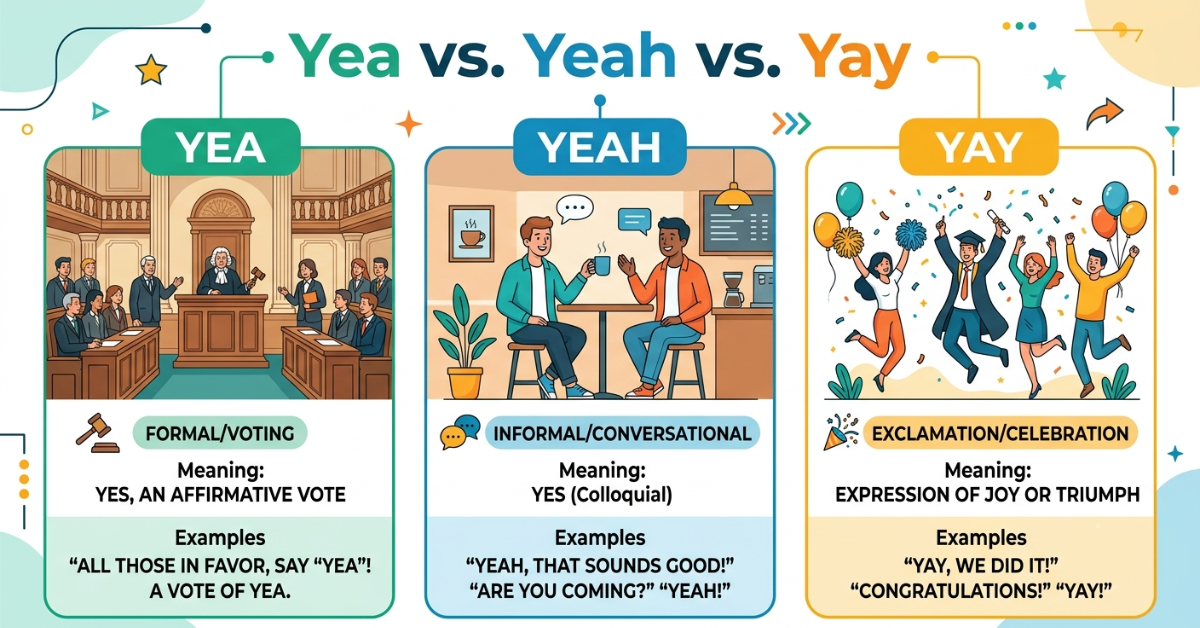
- Yea means yes or in favor, especially in formal voting
- Yeah means yes in a casual, conversational way
- Yay means excitement, happiness, or celebration
In other words, the words may look alike, but they are not interchangeable. Instead, each one reflects a different tone and purpose.
Why People Confuse These Words
There are a few reasons why this mix-up happens so often. First, the spelling is very similar. Second, the pronunciation can overlap in fast speech. Third, all three words feel positive in some way, so people often assume they mean the same thing.
Nevertheless, the difference matters. For example, yeah can answer a question, while yay reacts to good news. Meanwhile, yea usually appears in official or historical contexts, not everyday texting.
What Does “Yea” Mean?
Yea is a real English word that means yes or in favor. However, it is much less common in modern casual writing. Instead, it usually appears in voting, formal records, or older literary language.
Common uses of “yea”
- A formal vote of approval
- A historical or literary form of “yes”
- An official response in structured decision-making
Examples
- The committee voted yea on the motion.
- All those in favor may say yea.
- The final tally was 12 yeas and 4 nays.
In each case, the word signals approval. Therefore, it works best in formal settings rather than everyday conversation.
Where “Yea” Is Used
1. In voting
Most often, yea appears in official voting language. For instance, legislative bodies, councils, and committees may record votes as yea or nay.
2. In older or religious writing
Additionally, the word sometimes appears in historical, biblical, or poetic writing. In those cases, it can sound solemn or old-fashioned.
3. In stylized writing
Occasionally, writers use yea on purpose to create a dramatic or archaic tone. Even so, this is rare in modern everyday English.
What Does “Yeah” Mean?
Yeah is the casual, spoken-English version of yes. Because of that, it is one of the most common words in everyday conversation. You will hear it in texts, chats, phone calls, and even fiction dialogue.
Common uses of “yeah”
- Agreeing with someone
- Confirming information
- Responding casually
- Showing understanding
Examples
- Yeah, I can help you tomorrow.
- Yeah, that sounds good.
- “Did you finish the report?” “Yeah, I did.”
Unlike yea, this word feels relaxed and natural. As a result, it fits informal writing far better than formal documents.
When to Use “Yeah”
Use yeah when you want to sound casual and conversational. For example, it works well in:
- text messages
- friendly emails
- social media posts
- dialogue
- everyday speech
However, it is usually better to avoid it in professional or academic writing. In those situations, yes often sounds more polished.
Examples
- Yeah, I saw your message.
- Yeah, we can meet after class.
- Yeah, that makes sense.
What Does “Yay” Mean?
While yeah means agreement, yay expresses excitement, joy, or celebration. In fact, it is often used as a cheerful reaction to good news.
Common uses of “yay”
- Celebrating a success
- Showing happiness
- Reacting to something positive
- Expressing relief or excitement
Examples
- Yay! I passed the exam.
- Yay, the package finally arrived.
- Yay! It’s the weekend.
So, if you are not simply saying yes but instead reacting emotionally, yay is usually the right choice.
When to Use “Yay”
Use yay when something good happens and you want to show joy. For instance:
- after getting good news
- when celebrating an achievement
- when posting an excited caption
- when reacting to a fun event
Because of its playful tone, yay is best in informal settings. Even so, it works perfectly when the situation is cheerful and lighthearted.
Yea vs Yeah vs Yay: Side-by-Side Comparison
Here is a simple comparison to make things clearer:
| Word | Meaning | Tone | Best Use |
| Yea | Yes; in favor | Formal, old-fashioned | Voting, records, historical writing |
| Yeah | Yes | Casual, conversational | Speech, texting, informal writing |
| Yay | Excitement or celebration | Cheerful, emotional | Good news, happy reactions |
As you can see, the difference is not just in spelling. Instead, it is also about tone, context, and purpose.
Yea vs Yeah vs Yay in Sentences
To understand the difference better, let us look at real examples.
Yea
- The board voted yea on the proposal.
- All members in favor said yea.
- The motion passed with 15 yeas.
Yeah
- Yeah, I’ll join you later.
- Yeah, that’s correct.
- “Are you coming?” “Yeah, definitely.”
Yay
- Yay! We won the match.
- Yay, my order arrived early.
- Yay! The holiday has started.
These examples show that each word fits a different situation. Consequently, choosing the right one makes your writing sound clearer and more natural.
The Main Difference: Agreement, Approval, or Excitement
A helpful way to remember the difference is to ask what you are expressing.
- If you mean agreement, use yeah
- If you mean formal approval, use yea
- If you mean celebration, use yay
For example:
- “Do you want tea?” — “Yeah.”
- “The committee voted yea.”
- “We got the tickets!” — “Yay!”
Because the emotional purpose changes, the word changes too.
Is “Yea” the Same as “Yeah”?
No, it is not. Although the two words look close, they are used differently. Yea is formal and often tied to voting. Yeah, on the other hand, is casual and used in everyday speech.
Compare:
- Correct: The vote was counted as yea.
- Correct: Yeah, I already know.
- Incorrect: The vote was counted as yeah.
Therefore, if you are writing about a vote, yea is the proper choice. If you are replying casually, yeah is usually better.
Is “Yay” the Same as “Yeah”?
Not at all. While both are informal, they do not mean the same thing. Yeah confirms something, whereas yay celebrates something.
Compare:
- “Do you want to go?” — “Yeah.”
- “We’re going!” — “Yay!”
In the first sentence, the speaker agrees. In the second, the speaker is excited. That difference may seem small, but it changes the whole tone.
Common Mistakes to Avoid
Because these words are so similar, people often use them incorrectly. Here are the most common mistakes.
1. Using “yay” when you only mean “yes”
- Incorrect: Yay, I can come to class.
- Better: Yeah, I can come to class.
2. Using “yea” in casual texting
- Incorrect: Yea, I’m on my way.
- Better: Yeah, I’m on my way.
3. Using “yeah” in formal vote language
- Incorrect: The motion passed with ten votes yeah.
- Correct: The motion passed with ten votes yea.
4. Ignoring tone
Each word sends a different message. Therefore, choosing carefully improves both clarity and style.
Easy Memory Trick
If you still mix them up, this simple trick can help:
- Yea = vote
- Yeah = yes
- Yay = yay, celebration!
Another way to remember is this:
- If it sounds like a board meeting, choose yea
- If it sounds like a normal conversation, choose yeah
- If it sounds like a happy cheer, choose yay
Formal vs Informal Usage
In formal writing, yes is usually the safest choice. However, yea can still appear in voting or historical contexts. In contrast, yeah and yay are generally too informal for academic or professional writing.
Formal examples
- Yes, the file is attached.
- The proposal passed by a majority yea vote.
Informal examples
- Yeah, I’ll send it tonight.
- Yay! We’re done.
As a result, the right word depends on the setting as much as the meaning.
Practical Tips for Using These Words Correctly
To use these words well, keep these tips in mind:
- Match the word to the tone of the sentence
- Use yeah for casual agreement
- Use yay for excitement
- Use yea in formal vote-related writing
- Read the sentence aloud if you are unsure
If the sentence sounds cheerful, yay may be the best fit. If it sounds like a normal reply, yeah is probably correct. Meanwhile, if it sounds official, yea is the safer choice.
Key Takeaways
- Yea means formal approval or “yes” in voting contexts
- Yeah means casual “yes”
- Yay means excitement or celebration
- The three words are similar in spelling, but not in meaning
- Context tells you which one to use
FAQ: Yea vs Yeah vs Yay
Is “yea” a real word?
Yes, yea is a real word. However, it is mainly used in formal voting or older writing rather than casual conversation.
What is the difference between yeah and yay?
Yeah means casual agreement, while yay shows excitement or happiness. One answers a question; the other celebrates good news.
Can I use “yeah” in an essay?
Usually, no. In academic or professional writing, yes is usually better than yeah because it sounds more formal.
Is “yay” grammatically correct?
Yes, yay is grammatically correct as an exclamation. It is informal, but it works well when expressing joy or excitement.
Why do people confuse yea vs yeah vs yay?
People confuse them because the words look similar and sound somewhat alike. However, their meanings and tones are different.
When should I use “yea”?
Use yea mainly in votes, official records, or older literary writing. In most everyday situations, yes or yeah will sound more natural.
Final Thoughts
Understanding yea vs yeah vs yay can make your writing clearer and more polished. Although the words are small, they carry very different meanings. Yea belongs to formal approval, yeah belongs to casual agreement, and yay belongs to celebration.
So, the next time you write a message, caption, or sentence, pause for a second and think about the tone you want. That small habit can make a big difference in how natural and accurate your writing sounds.
Author

linguaezone.com@gmail.com
Related Posts
Kill Two Birds With One Stone Alternative: 50 Better Options
- 0
- 1,569 word
Have you ever paused before saying “kill two birds with one stone” because it sounded too violent or simply didn’t fit the...
Read out all
Happy Sabbath Meaning: A Complete Guide to Its Significance
- 0
- 1,632 word
Have you ever received the message “Happy Sabbath” and wondered what it truly means? Is it simply another way of saying “have...
Read out all
I’m So Proud of You in Other Words: 120+ Heartfelt Alternatives
- 0
- 1,562 word
Have you ever wanted to tell someone you’re proud of them but felt like saying “I’m so proud of you” sounded repetitive?...
Read out all
How Do You Spell Happy Anniversary? Correct Spelling Guide
- 0
- 1,221 word
Have you ever paused before writing an anniversary card and wondered, “How do you spell happy anniversary?” You’re not alone. Whether you’re...
Read out all
Waiting for Your Response Email: Best Examples & Tips
- 0
- 1,483 word
Have you ever sent an important email and found yourself wondering whether you should follow up or simply wait? Whether you’re communicating...
Read out all
Great Asset to the Team: Meaning, Examples & Tips
- 0
- 1,494 word
Have you ever wanted to compliment a coworker but struggled to find words that sound professional and sincere? One of the most...
Read out all